





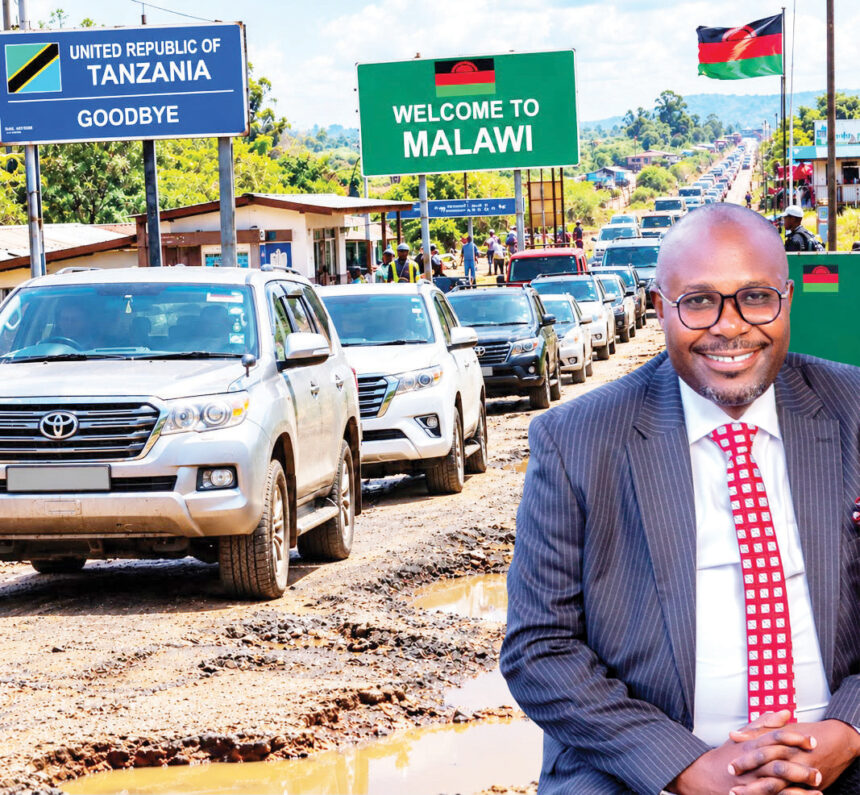
Just around 1,000 cars enter Malawi every month.
Read that number again.
Stop.
Read it again.
Now pause and think about the story behind this rather mind-boggling statistic.
- Advertisement -
Why is it mind-boggling? Because this is a country that is constantly complaining about foreign exchange shortages, yet we continue importing large quantities of vehicles—products that require forex not only to purchase, but also to maintain and fuel.
Now apply your arithmetic.
1,000 cars multiplied by 12 months is 12,000 cars a year.
In five years, that is 60,000 cars.
- Advertisement -
- Advertisement -
Sixty thousand!
Which roads are these cars going to use? Which parking spaces? Which cities?
Perhaps the cars know something about Malawi’s future that we don’t.
The bigger question is whether we have a strategic and scientific plan for the growth of this country.
Countries become prosperous when they learn to think beyond today. Tomorrow becomes the benchmark against which today’s decisions are made.
Unfortunately, that wisdom sometimes appears to be in short supply here. We think about now. We think about today. Tomorrow is apparently somebody else’s problem.
Look at the way we plan our cities.
Why do we allow people to construct buildings right next to major roads when we know that, as populations and vehicle numbers increase, those roads will eventually need to be expanded?
Because perhaps we are operating on the philosophy that we will not be around when the problem arrives.
Let those who live in Malawi in 2045 deal with it.
That is how selfish short-term planning can become.
Why should developers be allowed to put two-storey, warehouse-looking buildings in prime urban spaces without sufficiently considering future traffic, parking, public transport and road expansion?
But let me not divert.
Let us return to our 1,000 cars a month.
Our appetite needs to be challenged.
It is like a family going through a difficult financial period. At some point, someone has to say: “We cannot continue spending as though the money is unlimited.”
This is where the vehicle debate becomes an economic debate.
The 1,000 cars are not necessarily a bad thing. A vehicle can be a productive asset. A truck transporting goods, a taxi generating income, a delivery van supporting a business or a vehicle facilitating agricultural production can contribute to economic activity.
But a luxury vehicle that generates no income is a different proposition.
If the vehicle helps make money, it makes economic sense.
If it merely consumes money, we should at least ask whether it is the best use of scarce foreign exchange.
Some of us buy cars we cannot maintain. Others buy cars whose fuel consumption can empty a bank account faster than a Malawian politician can promise development initiatives.
Some buy cars as status symbols, only to discover later that the car looks richer than its owner.
There is nothing wrong with buying a car. But in an economy experiencing forex and fuel challenges, buying one requires more than swiping a card.
It requires the full use of the brain.
Governance expert Henry Chingayipe, speaking on Developmental State Philosophy at a National Planning Commission retreat, challenged the authorities to recognise that crises require decisive action.
African Institute for Development Policy Executive Director Eliya Zulu similarly argued that Malawi’s problem is not simply the absence of forex, but the way foreign exchange is circulated, including through the black market.
That raises an important question: if forex is scarce, what should we prioritise?
Fuel?
Medicine?
Machinery?
Industrial inputs?
Agricultural equipment?
Or another luxury SUV that spends most of the week parked outside the owner’s house?
National Planning Commission Director General Fredrick Changaya has suggested restricting liquid-fuel vehicle imports, promoting electric vehicles and eventually establishing lithium-battery manufacturing plants, arguing that Malawi has lithium and graphite resources that could support such an industrial direction.
That is the kind of thinking we need: not simply asking what we can import today, but what we can produce tomorrow.
Because every dollar we spend importing a finished product is a dollar that cannot simultaneously finance something else.
We therefore need to change the question.
It should not simply be: “Can I afford this car?”
It should be: “Can the country afford the economic cost of importing this car?”
If the answer is yes, drive carefully.
If the answer is no, perhaps take a minibus.
Af t e r all, the minibus may be uncomfortable—but at least it does not require you to explain to your spouse why the monthly fuel bill is bigger than the grocery budget.
Malawi does not necessarily have a car problem.
We have a priority problem.
And before another 1,000 cars arrive, perhaps we should ask the most important question: Where exactly are we going?