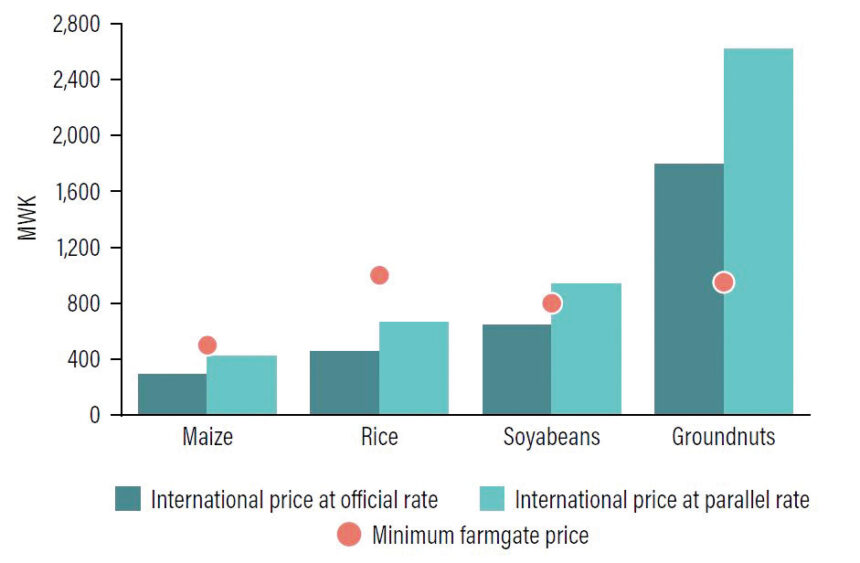
The World Bank has said this year’s elevated farmgate prices for agricultural commodities may be among barriers for international market entry.
The global lender says, in its 17th Malawi Economic Monitor (Mem) launched in Lilongwe Wednesday, that the rate would render the local produce non-competitive on the global market.
Recently, the Ministry of Agriculture set K500 per kilogramme (kg) as farmgate price for maize. Price for polished rice was set at K1,000 per kg, rice unpolished at K500 per kg and sorghum at K400 per kg.
Finger millet price was pegged at K550 per kg, soya beans at K800 per kg, pure beans at K700 per kg while mixed beans price was pegged at K600 per kg.
But in its Mem, the Bretton Woods institution says aggregating, grading and transporting agricultural produce is costly which cannot be met by the market-based farmgate prices that are generally lower than market prices.
- Advertisement -
“The minimum farmgate prices announced for the 2022-23 agricultural season are in many cases higher than international prices, with regional prices for locally produced commodities often even lower.
“Enforcing such high minimum farmgate prices encourages imports and favours those traders who are inclined to ignore the Ministry (of Agriculture) mandated minimum prices,” warns the World Bank in the report.
It says setting minimum prices too high can also counter the government’s aspiration of supporting smallholder farmers and promoting local value addition.
For instance, the World Bank says high soybean minimum farmgate prices encourage the importation of cooking oil from neighbouring countries, leaving local value-adding oil mills without business.
- Advertisement -
- Advertisement -
In an interview Wednesday, Grain Traders and Producers Association (GTPA) President Grace Mijiga said local producers are failing to compete with other producers from neighbouring countries.
“This is very true, particularly on soya. We have been heavily affected because we cannot even compete with neighbouring countries such as Mozambique and Zambia.
“Unfortunately, our production on soya was high, meaning more than the Malawi market can absorb. It is very unfortunate to us who invested heavily in producing soya and our farmers are heavily affected,” Mijiga said.
Minister of Agriculture Sam Kawale could neither pick our phone calls nor respond to WhatsApp Messages when contacted on the matter.
However, in March this year, when the Ministry announced the farmgate prices, Kawale took to his Facebook page that the prices were set after considering the cost of production.
“It is our hope that, after this harvest, a lot of farmers will go into winter cropping to take advantage of these prices. If you have the ability to go into winter cropping, please do so because we now have a huge international market that is ready to buy our produce,” Kawale wrote.