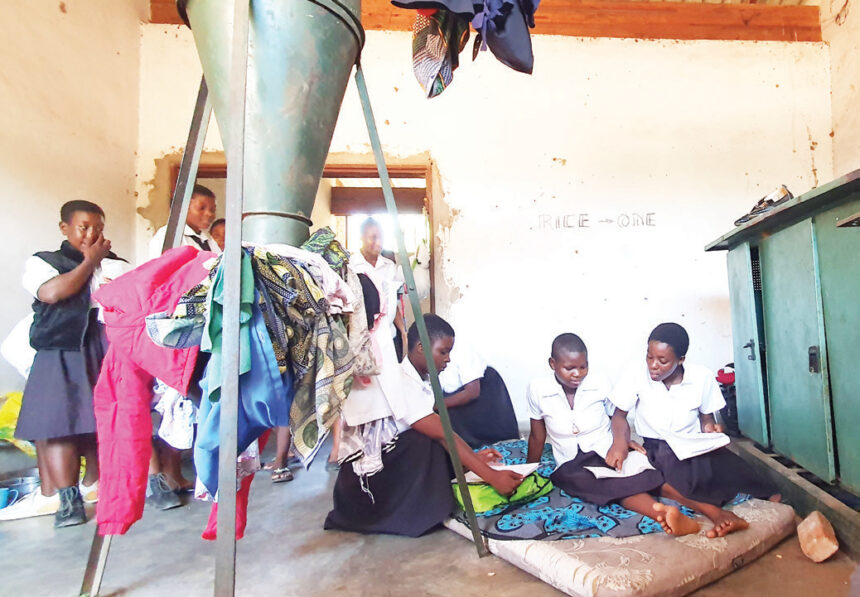
At Nyamadzere Community Day Secondary School (CDSS) in Nsanje District, there are two tiny buildings – one in which stands parts of what should have been a maize mill and the other serves as a kitchen.
These structures, both school property, serve another purpose.
They are hostels for girls at the school.
When government introduced CDSSs in Malawi in early 2000, it did not bring along new structures, let alone hostels.
But the schools came with good-sounding political messaging: that they were meant to expand access to secondary school education in Malawi.
- Advertisement -
This made sense, but, as it turned out, it was the number of learners that mattered. Not the quality of education and how students would access it.
More than two decades today, many such schools suffer from lack of critical infrastructure such as libraries, laboratories and classroom blocks.
Lack of accommodation for leaners is equally acute, leaving many of them having to rent within neighbourhoods, often in sordid conditions, so they can stay close to their schools.
Along the way, some such schools have managed to have proper hostels, largely courtesy of partners and community and individual school initiatives.
- Advertisement -
- Advertisement -
However, shortage of accommodation for learners in these schools remains critical.
At Nyamadzere, the authorities tried to intervene. They launched a hostel construction project in 2017.
Nine years later, the project remains unfinished. There are no works going on to complete it.
In its absence, school authorities have converted a kitchen and a maize mill housing into a dormitory for girls.
Head teacher of the school, McConnel Kalikokha, was reluctant to speak to us. All he could say about the hostel situation at the school is “it is unfit for learning”.
Stella Mofolo, a Form 4 student at the school, is among the occupants of the kitchen. She said the conditions are hard to bear.
The ‘hostel’ has no water fittings. There is no electricity to enable the leaners study at night.
It has no windows, and in the semi-arid temperatures of the Shire Valley, the ‘hostel’ becomes a cauldron sometimes, she said.
So what is happening with the uncompleted hostel?
Because it is uncertain that the project will make progress anytime soon, the school has had to deploy security to protect it from being vandalized. The guards are students.
Male students are accommodated there. It does not have functioning washrooms, no proper fittings that would make it livable in a true sense of the word.
To be able to read at night, the school gave students in this hostel two torches to share among them. The torches operate only for two hours.
“After two hours, the lights go off. And studying ends,” said Form 4 student, Stephen Mazonda.
Chair of board of governors for the school Mavuto Zawangeti said they have repeatedly engaged authorities, including the Ministry of Education, the District Commissioner’s office and local members of Parliament, for help.
“We have been to different places, even to Capitol Hill, for this project. We have failed,” he said.
He described the accommodation situation at the school as painful, especially for girls.
“We are told that when we educate a girl, we are educating the whole nation. But for this girl child we are talking about here, she does not have a good environment to study. This is not a place where a student should stay, let alone a girl child,” he said.
Member of Parliament for Nsanje South West Walter Nyamilandu Manda acknowledged the challenge. He said plans are in place to support the school to improve studying and teaching conditions and increase learning opportunities for both boys and girls.
Noel Msiska, Capacity Development Associate for the Malawi Human Rights Resource Centre (MHRRC), described the conditions at Nyamadzere as a blow to Malawi’s development agenda.
In the stalled project are wasted public resources and absent accountability, he said.
These are some of the issues MHRRC is tackling.
With support from the Norwegian Church Aid and Dan Church Aid (NCA-DCA), MHRRC is implementing a citizen participation programme in governance and development processes. The aim is to close the gap of the inequalities that exist, particularly focusing on the marginalized communities.
“It is worrying that there are such projects where money was invested in but no one is interested in reaching an outcome and making sure that it benefits the intended communities. This is an accountability issue on the part of the authorities,” Msiska said.
For students at Nyamadzere CDSS, they are tired of the grinding life in maize mill building, in the hot temperatures of a kitchen and insanity of an abandoned hostel.