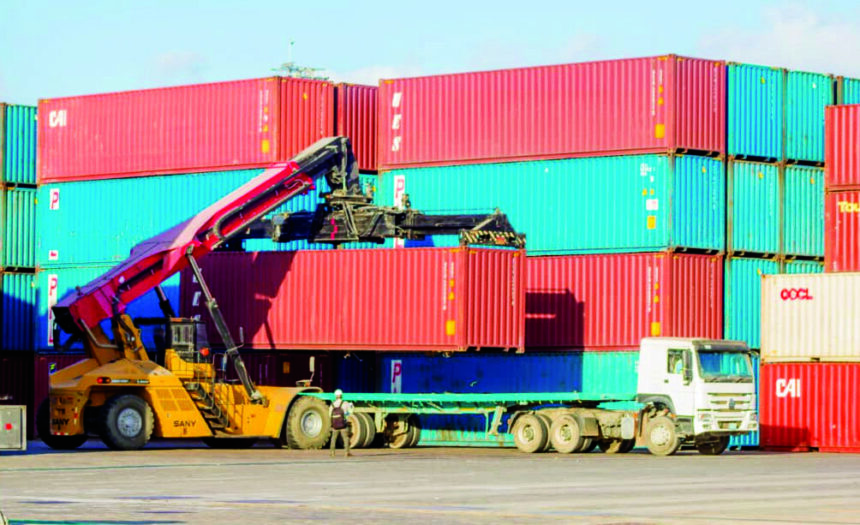
Despite the acute shortage of foreign exchange in the country, Malawi’s total value of imports hit K527.9 billion last month, an 87.1 percent increase from K282.1 billion in July 2023, figures from the National Statistical Office (NSO) show.
At the same time, exports rose to K146.6 billion from K108.3 billion in July 2023, reflecting a 35.4 percent increase.
This, according to NSO, resulted in the country’s trade balance widening to a deficit of K381.4 billion in July 2024, compared to a deficit of K173.8 billion in July 2023, reflecting a 119.4 percent increase in the trade deficit between Malawi and the rest of the world.
NSO has since put the ratio of exports to imports for July 2024 at approximately 1:3.6, meaning that for every unit of exports, there were 3.6 units of imports.
International trade commentator Frederick Changaya Thursday told Times Business that, primarily, terms of trade as a function of exchange rate means that any devaluation and accelerating interest rates risk worsening the deficit.
- Advertisement -
Changaya, therefore, said Malawi’s Monetary Policy authorities need to critically examine decisions on exchange rate.
“In Malawi I think the policy framework requires overhaul. We have justified devaluation and a tight policy stance, saying it will unlock more forex, for example.
“Where is forex? We sign the tripartite agreement meaning we want free trade so we can grow exports. Meanwhile RBM raises interest rates,” he said.
According to Changaya, it would also be interesting to dissect the imports and exports.
- Advertisement -
- Advertisement -
“This concept that came some months ago that SoEs shouldn’t be limited to buying from the cheapest may require revisiting.
“There are glaring examples where something we could have paid for a fraction of the price, we leak millions of dollars. Perhaps we can improve the governance and efficiency, particularly in government entities,” he said.
He added that Malawi also needs massive import substitution, especially on value added goods.
“That way, we can reduce the import bill and probably enhance the value of exports too. But this may not be possible if we don’t have a well-balanced policy mix-trade, fiscal and monetary.
“As long as these don’t speak to each other, we will continue to have a widening deficit,” he said.

Blantyre-based economist Marvin Banda said the chronic trade deficit should not be viewed negatively.
According to Banda, the pressures that arose from the stochastic to the macroeconomic variables, especially food production, as well as the currency realignment in November 2023 means that the export proportion of the current account have plunged the trade balance in a deficit abyss.
“The trade deficit itself isn’t shocking, considering we are a net importer. However what is worrisome is what proportion of imports were aimed towards sustainable development.
“To counterbalance the ill effects of a negative trade balance, taxes and tariffs have been placed on goods that can be readily available domestically to boost not only import substitute production but to lessen the burden on the already tight foreign reserves liquidity,” Banda said.
He observed that policies aimed at limiting the export of raw materials is crucial because the export value is minuscule on the ladder of production with emphasis placed on value added products.
“Currently our top exports are tobacco, tea and soya beans. Government should continue making efforts to implement the National Export Strategy (NES II), which outlines the challenges and how to overcome them by targeting markets in neighbouring countries, regional markets, European Union, USA, Russia, the Middle East, Asia and emerging markets such as Canada, Australia and Switzerland to promote value added exports.
“In order for the trade deficit to decline, manufacturers and industry have to be priority areas that can be used as economic catalysts.
“The potential that mining can have on the economy in the next decade could define a generation if exploited to the general benefit of Malawians,” Banda said.