By Isaac Salima:
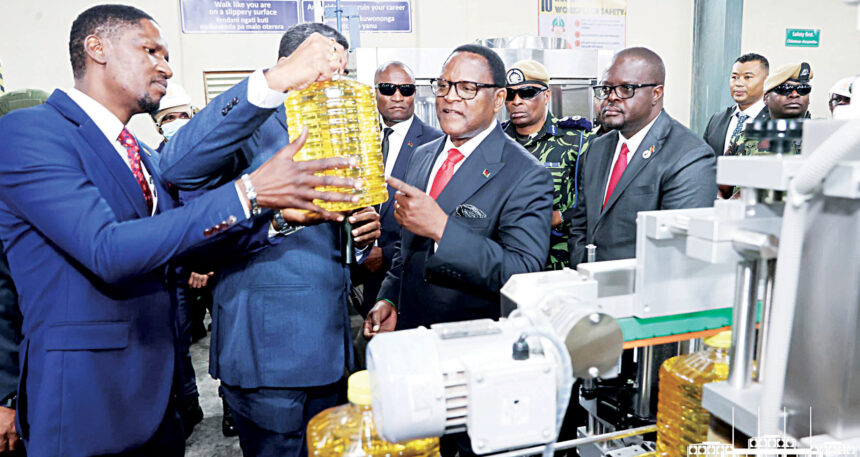
President Lazarus Chakwera Wednesday commissioned a solvent extraction and cooking oil refinery plant in Blantyre, where he declared that the country is on course to meeting industrialisation goals.
The plant, which is owned by Bakhresa Malawi Limited, will be processing soya and producing cooking oil.
Chakwera said apart from creating job opportunities, the plant would also offer farmers a ready market for their produce.
“I was looking forward to [the] commissioning of this factory both because of what it does for our country and because of what it represents in the new future that we are creating for young people.
- Advertisement -
“What this factory does is to make Malawi a producer of export-quality bread flour, because the production of 500 metric tonnes of bread flour that happens here every day is what Malawi 2063 means by productivity,” he said.
Chakwera further touted the factory, saying it would save Malawi millions of United States dollars in forex.
“What this factory does is to employ over 300 people, thus supporting their families with an income for feeding themselves, paying rentals and educating their children. What this factory does is to provide our farmers with a ready market for their soya, because this plant is effectively an off-taker of what they grow,” Chakwera said.
The First Citizen also challenged farmers to intensify soybean production as the plant would be requiring a supply of 180,000 tonnes of soybean every year.
- Advertisement -
- Advertisement -
“I want you to think about the gap that we need to fill as a country in order to make the most of this factory. At the moment, Malawi already has the capacity to process 600,000 tonnes of soya and this Bakhresa plant will now mean we can process close to 800,000 metric tonnes,” Chakwera said.
But the question I want us to grapple with, in the second term of my presidency, is where is the 800,000 metric tonnes of soya to be processed at factories like this going to come from? You see, our farmers in this country only produce 200,000 metric tonnes of soya, which means that we need to help our farmers increase their production of soya four times in order for factories like this to operate at their full capacity,” he said.
“So, what I plan to do is to facilitate the investment of companies like Bakhresa in the productive capacity of our farmers, even if it means contracting our farmers and helping them mechanise their operations to increase yield. But the bottom line is that my government wants to give companies like Bakhresa an opportunity to grow by helping to grow the capacity of our farmers. That is what will be the game changer,” Chakwera said.
On his part, Bakhresa Malawi Limited General Manager Venkatesh Rao Pattipati said the establishment of the plant, which is valued at $100 million, aligns with the country’s national export strategy and signifies the potential of the country’s industrialisation agenda.
He said the company would not only offer farmers a sure market for their produce but also give direct employment to 500 people.
Minister of Trade and Industry Vitumbiko Mumba said the plant represented “a huge economic gain” for the country.
“By linking village-level cooperatives that cultivate soya to processing hubs like this one and then onward to packaging, distribution and even downstream food and feed industries, we create a living ecosystem of economic activity,” he said.
Bakhresa was established 22 years ago and has diversified its investments from their initial wheat flour milling to soap manufacturing, Azam TV management services and commercial services.