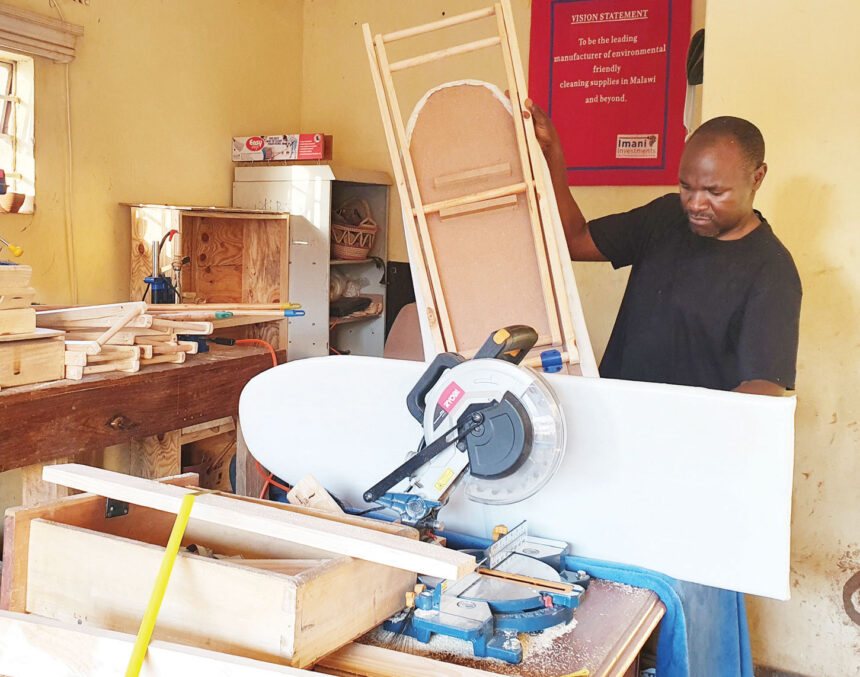
At a time cybercrime cases are rising, especially among youths, there are Malawians who are basking in the digital age’s glory. THOMAS KACHERE writes.
Moses Nyirenda, an accountant by profession, is one of the people who have decided to transform their fortunes by trying something different.
“I decided to embrace information, communication and technology. In 2016, while staying in Blantyre, I secured a job in Lilongwe and started lodging in Chigwirizano Township while waiting for a comfortable house to let.
“While commuting to town, I used to meet mop-stick sellers who told me that they were fetching the sticks illegally from some forests nearby. Looking at the quantity of small trees they were destroying every day, I did simple calculations and noted that such a business was a ruthless blow to natural resources as the sellers were only targeting small trees that were sprouting,” Nyirenda says.
He then decided to find a way of making the mop handles reusable.
- Advertisement -
“I turned to the internet to learn more about mope handles and woodwork. My interest in the internet eventually paid off because, while surfing the internet, I came across information that shed light on how wood items, including iron boards, are made.
“As time passed, I kept on improving on quality and quantity of the products and eventually made a market breakthrough. Of course, I try to work as consultant accountant but, through my new-found job, I have managed to purchase big machinery for my Imani Investment Company, apart from creating employment for others,” Nyirenda points out.
He says young people can learn a lot from the internet to better their lives, instead of using the internet for entertainment purposes or gossip.
Malawi University of Business and Applied Sciences staff associate in the Department of Journalism and Media Studies— which is under the School of Education, Communication and Media Studies— Hastings Ndebvu says people can make the best out of the internet.
- Advertisement -
- Advertisement -
“We are now living in a digital era when we cannot deny that most of the transactions nowadays are done on the cyber space and we have seen that some of the people that have access to the internet are acquiring life-changing knowledge,” he says.
He adds that, with the government putting an extra gear in efforts aimed at bridging the digital divide, the future can only be bright.
“What is needed, considering that most people are trading online, is to ensure that cyber security work is intensified. Fortunately, there are policies and laws that are governing digital space affairs, notably the Malawi Digital Economy Strategy, Electronic Transaction and Cyber Security Act, among others, all of which are there to govern the practices of people online,” Ndebvu explained.
“In fact, the number of people who are acquiring skills through the internet is growing. Some people are also operating as entrepreneurs while others are using it to enhance their skills,” he adds.

Team leader for Muuni Fund at Malawi Communications Regulatory Authority (Macra) Wezi Salima has, meanwhile, commended Nyirenda for using ICT in a right way, adding that this should serve as a lesson to others.
“People need to utilise the internet for educational and professional development. The wealth of knowledge available online can help people acquire new skills, pursue career goals and expand their horizons. Through skills development, people become more innovative,” Salima indicates.
She explains that Macra has a number of initiatives in place to increase access to the internet, citing community broadband networks which are premised on enabling people from rural areas to have internet access.
Salima identifies Connect-A-School and Hospitals iniative as another intervention that is aimed at easing people’s lives.
“In addition, Malawi has signed a diplomatic data corridor [agreement] with Tanzania, which will aid in bridging the digital divide and enabling as many Malawians as possible [to embrace the fruits of the digital space]. This will reduce the cost of transmission of broadband, whose cost is eventually borne by the last-mile consumer,” Salima stresses.
She implores Malawians and residents of Malawi to be innovative in the way they use the internet, saying the cyberspace is strewn with opportunities.
The hope is that, when Malawians grab internet opportunities with both hands, meeting Sustainable Development Goals will not be far off the mark.