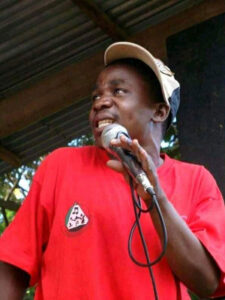
By Sam Banda Jnr & Madalitso Musa:
An introduction to formality, especially education, starts with the vowels A, E, I. O. U.
These are baby words, from which syllables are formed. Syllables are words, words make phrases, phrases grow to sentences, then paragraphs. Then stories.
Thomas Chibade’s story of music started with vowels. In his very debut album Zatukusira, there is a song titled ‘Mawu Anga’ in which Chibade plays with the kindergarten vowel recital of A. E. I.O.U. Actually, with the passage of time, the song “Mawu Anga” lost its title and came to be known as A.E.I.O.U.
In the song Chibade sings:
- Advertisement -
A-Awa ndiye mawu anga
E-Embekeza ndikuuze
I-Iyi ndiye nyimbo yanga
O-Osati sewero
- Advertisement -
- Advertisement -
U-Umvere mawu anga, umvetsetu lero
(These are my words, pay attention, this is my song, and I mean business, listen to my words and listen well).
The artistry in the song is both thematic, a precursor and a testimony of how one can weave words in a song.
When he released this song, Chibade was young and had just had his music virginity broken. He sings with innocence of kindergarten recitals, yet with a dense message of love. The lyrics are easily sung from memory because of their softness and infantile chant yet with fermented message.
It is a song that announces that a star, a young star, is born. Perhaps, just as A.E.I.O.U is introductory, the song also introduced Chibade to the legend that he became until he sang his last song of life.
Even in the introduction of his music journey with seemingly infantile and jocular lyrics, Chibade weaved his verses in thorough anger against societal injustice. In one of his songs in the debut album; Chibade bares his wrath against a sordid culture of property grabbing. In the song ‘Mukhute’ (Nkhondo Amawo) Chibade plays an orphan and a widow who has had their property grabbed by relatives of the departed sire and husband. Seething with fury, the person allows the relatives to grab the property and, as well, proceed to grab the dead body and cannibalise it to slake their thirst for blood and hunger for human flesh. He sings:
Katunduyu mukatilanda
komanso mupite kumanda
Mukawafukule bambo
mudzawasiye ku chipinda kwanu
Chumacho mudye nanga
Chikadzatha mukatengenso
mtembo muutafune mukhute
(After grabbing the property, proceed and have the dead body exhumed and keep it in your bedroom. After sharing the property and when you are done, you can as well eat the dead body until you are satisfied.)
Such was the talent and dexterity in composition and thought in Chibade’s music.
Chibade was without doubt one of the finest when it came to music composition and his librettos were so ironic and mature and resonated well with people.
His ingress to the music livelihood is deep rooted in his albums including Zatukutsira, a project produced by veteran Ralph Ching’amba.
His popularity with Zatukutsira was not confined to Malawi but, rather, it spilled over to Zambia where The Daily Times of August 23 2005 reported, then, that Chibade’s music enjoyed airplay as far as Comesa market.
Comesa market is popular in Zambia and, so, Chibade songs such as ‘Tiwalandire’ played on repeat.
Musicians Union of Malawi (Mum), in a letter signed by its general secretary Tonny Chitimatima, said they were saddened with Chibade’s death.
“He was very unique. He had his own style of music,” Chitimatima said of the musician, who will be laid to rest tomorrow at Likuluma Village, Traditional Authority Chikowi, in Zomba.
The Daily Times of June 27 2005 screamed with a headline ‘Chibade, Ralph Records’ take off and this was before Malawi News of June 11-17 2005 told of Chibade’s song of being a new kid on the block.
Veteran producer Ralph Ching’amba, with his Ralph Records recorded Chibade’s Zatukutsira and he describes his death as hard to swallow.
“He was hard working and talented. He is one of the few talented artists I worked with. I hoped for his comeback but, sadly, we have lost him. He will be greatly missed with his uniqueness in music composition and singing,” Ching’amba said of the artist, who was widely known as Che Nkhumba.
He recalls that he knew Chibade through Mr Chikwatu when he came to record his debut album.
“The idea of Mr Chikwatu was that Chibade should come and pay for one song and, then, he should listen to it if he could be satisfied with it and then help him with all the other songs and, by then, I had not sponsored any artist and when he later did the ‘AEIOU’ song, I just fell in love with it and said we had to record all the songs,” he said.
Ching’amba also recollects that Chibade was very young when he came for his debut assignment and that he did not even know his age.
“To get his age, I actually had to ask him as to whether he knew Bakili Muluzi then and later came to notice that he was between 14 and 16 years until later, when we were doing his bank details, they needed his date of birth and, so, he had to pick the date, month and year,” he said of the artist, who used to come on a bicycle from Milepa to Bangwe.
The artist, who, at one time, was one of the best-selling musicians, released several songs that include ‘Our Love’, ‘Batchala’, ‘Freedom Fighter’, and ‘Bulu Wanding’amba Nthiti’.
He at one time told The Daily Times, after one of his performances in Blantyre, that he was working on a new album.
Legendary poet Benedicto Wokoma-atani Malunga mourns Chibade in his verse, saying October has become a month of painful departures, coming with an outpour of sorrow triggered by unforeseen and expected deaths.
With the creative industry still mourning another talented musician Atoht Manje, who was laid to rest two weeks ago, Malunga says it is painful to lose the folkloric and ebullient Chibade, the owner of a musical signature totally and authentically his own as he tackled the prophetic ‘Mawu Anga’ and other captivating pieces assembled with riveting creativity.
The deceased’s uncle Richard Makala said Chibade was the family’s bread winner.
“We leave everything in God’s hands. His music was good,” Makala said.
Chibade, who was in his late 30s, is survived by a wife and five children.