








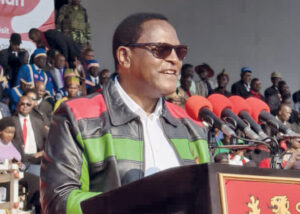
Modern-day political events in Malawi continue to unveil an intriguing transformation, with President Lazarus Chakwera emerging as a unique and unprecedented figure in the country’s political history.
Unlike his predecessors, Chakwera has distinguished himself through an unorthodox style of governance that appears to defy the entrenched norms of Malawian politics. He is not merely participating in the nation’s political discourse— he is redefining it.
His composure, restraint, and focus on institutional reform place him in a league of his own, making him stand apart in a landscape that has long been perceived as a venture designed for savagery, dirty works and personal vendettas.
Political analysts, both local and across the borders, have increasingly begun to describe Chakwera as a figure who has not only demystified the Malawian political scene but has brought about, decency, restraint, calmness, patience, hope and a deeply etched sense of belonging. The commentators, all and sundry, argue that Chakwera’s leadership marks a clear positive leap from the traditional political playbook. If truth were the yardstick, it would be difficult to deny that Chakwera’s demeanor, policy approach, and governance ethos embody a rare blend of statesmanship and reformist ambition.
He has proven adept at maintaining political civility where others have indulged in acrimony, and this alone sets him apart as a symbol of change in an otherwise volatile arena.
- Advertisement -
Historically, Malawi’s political narrative has been saturated with hostility— vengeance, tit-for-tat rivalries, ceaseless personal attacks, and a relentless culture of slander and defamation have long been the defining features of the country’s democratic experience. Political contests often devolved into spectacles of mudslinging, mockery, and backbiting, where the focus on policy was frequently eclipsed by character assassination. This toxic political culture became so deeply embedded that it seemed part and parcel of the democratic process itself.
Here is a slice of history. Former President, the late Bingu wa Mutharika, who served the country from 2004 until his death in April 2012, left a legacy of a leader whose approach to issues was rather militant.
On several occasions, Bingu has had his patience snapping in public. In his first term of office between 2004 and 2009, Bingu was all diplomatic and this earned him applause from Malawians as well as the diplomatic community. However, in his second term, Bingu proved that a militant approach to issues is not the best recourse for the president’s office as his uttering and actions made him an enemy of the very same people who had praised him earlier.
Because of his iron-fist handling of issues, Bingu was enmeshed in unpleasant situations with civil society organisations, members of the clergy, the media and even the international community. From expelling diplomats, refusing diplomacy with the Bretton Woods institutions, chasing tobacco buyers to unleashing terror on Malawians, Bingu’s last two years was a misery and Malawians suffered because of his kind of leadership.
- Advertisement -
- Advertisement -
Before Bingu and after him, Malawi has had presidents who have taken podium rantings and insults as the sure ways of having a grip of power. Bakili Muluzi reigned for a decade before Bingu, Joyce Banda had a fleeting time after Bingu’s death, then came Peter Mutharika who was at the helm between 2014 to 2020.
If one has to flip through historic documents, this period was characterised by speeches that can best be described as sessions of hate and vengeance and not building the nation. During this time, leaders, somehow, refused to live with the reality that Malawians were suffering and needed leadership that encourages hope and unity.
Before 2020, we have had leaders who instead of solving problems Malawians were facing, they resorted to cooking up laws that were meant to silence Malawians from expressing their grievances. It was either through draconian legal instruments or even using paramilitary instruments to gag citizens.
What was most appalling is that whenever leaders took to the podium, the speeches were all about castigating Malawians. History has pages where Malawians were reduced far beneath humanity by being called demeaning names like atonkhwetonkhwe, (chameleons) abwilibwise (small ugly fish) achule (frogs) apuludzu (obstinate laggards) mahule (prostitutes) mbutuma (dunderheads) anyapaphi (dunces) and many other unprintable words.
Even the leaders themselves have not spared each other of bad names and public ridicule too nasty to the ear and unbefitting to be coming from people who wear the tag of honorable.
Records have it about leaders making fun of sensitive issues like someone’s medical condition, marital or even bedroom affairs.
Addressing a group of 600 business men and women at Sanjika Palace on January 25, 2024, Chakwera told them: “I have no enemy and in fact you are all my friends.” He was greeted with chants of contentment and joy in unison from the vendors who included tailors, airtime vendors, minibus drivers, minibus touts, second car dealers, among others.
As an icing on the cake, many political commentators contend that President Chakwera is living by his promise to Malawians through his Super Hi 5 agenda for the country.
The Super Hi 5 is embedded around the motto of Malawi Congress Party (MCP) campaign manifesto, “Build a New Malawi on the foundation of a Democratic Developmental State.”
Tellingly, Chakwera sees no gain in political castigations as that would deviate him from his Super Hi 5 tenets of “Prospering Together, Uniting Malawi, Ending Corruption, the Rule of Law, and Servant Leadership.”
Recently, while addressing a crowd at Nkhwazi Admarc ground in Mchinji, on the sidelines of International Nurses Day, Chakwera even stunned Malawians by directing MCP women to stop composing songs that attack Mutharika and all other opposition figures. This call is first of its kind in Malawi and no one can dispute this fact.


