It is around 6am on a Tuesday morning.
I happen to produce electronic news bulletins that air on Times Radio and Times Television and when on duty, I have to be at the office by at least 6:30am.
The driver honks his horn outside my house, signalling his arrival.
All the way from my base in Chilomoni to our head office at Ginnery Corner in Blantyre, my eyes are drawn to people on foot, each engaged in different errands.
Most of them are in groups, taking long strides.
- Advertisement -
We stop at the Zebra Crossing near Mount Soche, in compliance with the red light.
A man, whose name I do not know, takes advantage of our stoppage to greet me and ask if we could give him a lift.
“I am also heading to Ginnery Corner; can’t you offer me a lift?” he pleads.
We agree to let him in.
- Advertisement -
- Advertisement -
He tells me that he works for one of the companies at Ginnery Corner.
I take the opportunity to ask him about the life of a worker who relies on public transport, especially amid the fuel shortage in the country.
“It is really tough. Now, from Chilomoni to Blantyre, we have to pay at least K1, 000. You have to pay the same amount to connect to a minibus to either Chichiri or Limbe. That is K2, 000 for one way and the same amount when going back home,” he explains.
He adds that he also needs money for lunch.
“It means that on a daily basis, I need about K10, 000 so that I can leave something at home. Where will I get the money from? I receive about K150, 000 per month, meaning that without paying other bills, my salary can only take me through 15 days,” he says.
The fuel shortage has worsened the livelihoods of people in lower-paying jobs, who, unfortunately, are in the majority in the country.
This is because some public transport operators have tripled fares due to the scarcity of the commodity.
Minibus operators, like other motorists, have been spending long hours at fuel stations and when they manage to get the commodity, they compensate for the lost time by charging exorbitant fares.
Unfortunately, the working class, especially those who cannot afford to walk to their offices, is bearing the brunt of this.
As a result, their expenses have doubled.
“Unfortunately, our income remains the same. Life has been tough. Taking a minibus to work is now regarded as a luxury. Where will we get the money for transport?” Esnart Amosi, who lives in Bangwe but works around Makata Industrial Area, says.
We are also curious to observe how people working in different companies spend their lunch breaks.
A visit to Chichiri, Makata Industrial Area and Ginnery Corner reveals one thing: people continue to struggle to make ends meet.
“We rely on cooked cassava and sweet potato. When you have at least K200, you can eat something. If you don’t have it, you just have to wait until lunch is over. It is really bad. We cannot afford proper meals because our pockets do not allow it,” Herbert Paipi says.
The situation has also affected schoolchildren.
Children who rely on public transport are suffering from the fuel shortage.
Innocent Golden, a Form Four student at Chichiri Secondary School who resides in Machinjiri, Blantyre, says that his parents cannot afford to give him money for transport amid the surge in fares.
He says he still has to report for classes every day.
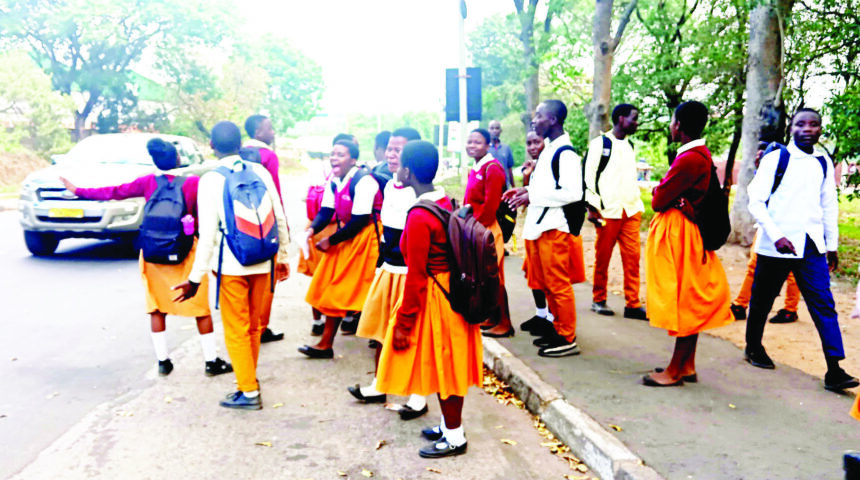
We find Innocent and his fellow students at a bus stop near Castel Limited in Blantyre, hoping that someone will offer them a lift.
Around 4pm, which is knock-off time for most secondary school students, some bus stops in Blantyre are filled with students begging for free rides from motorists heading in the direction of their homes.
“Our parents cannot manage to give us money for transport every day. We also need money for lunch. On top of that, minibus fares have gone up. If we could not afford a minibus when the fares were lower, what chance do we have now?” Angel Kamtsitsi says.
She adds that they are forced to leave home early to cover the distance to school on foot.
“If we have transport, we take a minibus. However, such days are rare. When returning, we are too tired to walk, so we have to wait at bus stops, hoping that someone will give us a lift,” she says.
Such is the life of day students who come from far locations.
Angel laments that on bad days, they can reach home late.
“We do not know where a car will come from to take us home. It is like a lottery. Some days, we do not get home until 7 or 8pm the next day, if we do not have money for transport, we have to walk to school again,” she says.
In towns, some students still struggle to get an education.
Unlike in rural areas, where most students use bicycles to get to school, in towns, this is not an option. One has to use public transport or else walk. Sadly, parents have to meet the cost of both transport and food.
Wycliffe Chimwendo, president of the Independent Schools Association of Malawi, says that most parents are struggling to meet their financial obligations.
“It is only through compassion that we accept them, but most parents continue to default on fees. It is sad, but that is the reality due to the tough economic times we are going through,” he says.