By Vincent Khonje:
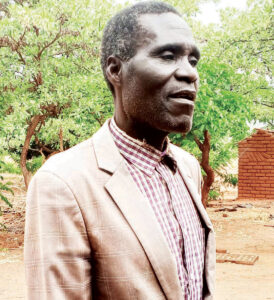
Group Village Head (GVH) Chimtazi, in Traditional Authority (TA) Nyoka in Mchinji, is a witness to the changes the environment has undergone in his area.
The traditional leader says that the forest cover which the area once enjoyed is now gone, leading to degraded soils.
He mentioned that Mchinji used to be known as a food basket, feeding other districts, but now that narrative is slowly disappearing.
“We used to have natural forests and our hills used to be fully covered with indigenous trees. We enjoyed natural fruits and our crop fields were protected,” the local leader said.
- Advertisement -
GVH Chimtazi now narrates a sad tale of the transformation that has taken place in his area.
He explains that communities in his area are struggling with diminishing crop yields and natural resources due to deforestation, soil erosion and unpredictable rainfall.
In Mzenga Village, within TA Kapunula, the communities have abandoned a large area of farm fields because water runoff from nearby Malendo Hill washes away crops.
Deep gullies define the land and a large area is bare, with a few small trees growing here and there.
- Advertisement -
- Advertisement -
Dorothy Phiri, one of the smallholder farmers from the area, says that the abandoned land has caused many problems, as the people have sought solace from other hills for cultivation.
“The people are now encroaching on other hills as if they haven’t learnt any lessons,” Phiri laments.
However, despite all this, smallholder farmers in the area believe that the Climate-Smart Enhanced Public Works Programme (CS-EPWP), which was introduced in the local councils, will be a lifeline because it has assisted communities in developing water and soil conservation measures.
Through the National Local Government Finance Committee, the Malawi Government is carrying out the programme, which is part of the Social Support for Resilient Livelihood Programme (SSRLP Tidzidalire).
The World Bank and the Social Protection Multi-Donor Trust Fund are providing financial support for the programme.
James Phiri, a participant from Katungulu Micro-catchment in TA Nyoka, says the interventions introduced by CS-EPWP have the potential to heal the land, which has now become unproductive as it once was.
Phiri states that the programme has seen communities working on creating structures to control soil degradation, thereby protecting fields downhill.
“The interventions brought by the programme have ensured that we begin by taking care of the hills, by looking after the trees and then building structures that control water runoff to allow the water to settle.
“The water then easily infiltrates the ground, which improves the water table and provides the much-needed moisture for crops downhill,” Phiri says.
Apart from caring for naturally regenerating trees, the structures that participants at Katungulu Micro-catchment have built include infiltration pits and swales.
They have also established nurseries to raise seedlings for planting trees in all bare lands.
At Kamphoro Micro-catchment, which also encompasses Mzenga Village in TA Kapunula, the communities under CS-EPWP have implemented soil and water conservation structures, similar to those in Katungulu.
Catchment Management Committee chairperson Paul Mwanza says that, with a large area abandoned by the communities, they are hopeful that the land can be reclaimed.
“We have Malendo Hill, which brings down a lot of water at high speed, so we thought of managing the water by putting down proper structures.
“We have a stone bund and swales around the hill, which we believe will reduce water runoff and allow the communities to continue using the land they had abandoned,” said Mwanza.
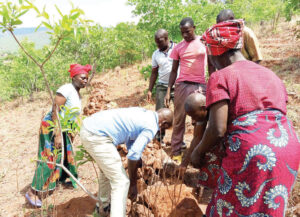
The programme has repaired deteriorated landscapes and sparked a shift in perspective through creative initiatives, including afforestation, natural regeneration and soil and water conservation.
Aware of the long-term advantages for their livelihoods and ecology, the villagers who once felled trees for survival now plant and care for them.
Desk Officer for CS-EPWP in Mchinji, Rhoda Njikho, says that, considering the extensive agricultural activities in the border district, there is a need to conserve the environment.
Njikho explains that Mchinji is populated with smallholder farmers growing maize, groundnuts, soybeans and beans while some even cultivate tobacco.
“The communities wholeheartedly engage in sub-projects such as soil and water conservation, nursery establishment, forest management and riverbank protection,” she says.
With 25 micro-catchments and over 27,000 participants in Mchinji, there is hope that communities will drive the process of repairing their land.
GVH Chimtazi, whose area is covered by Katungulu Catchment, testifies that he is confident there will be positive results from the interventions.
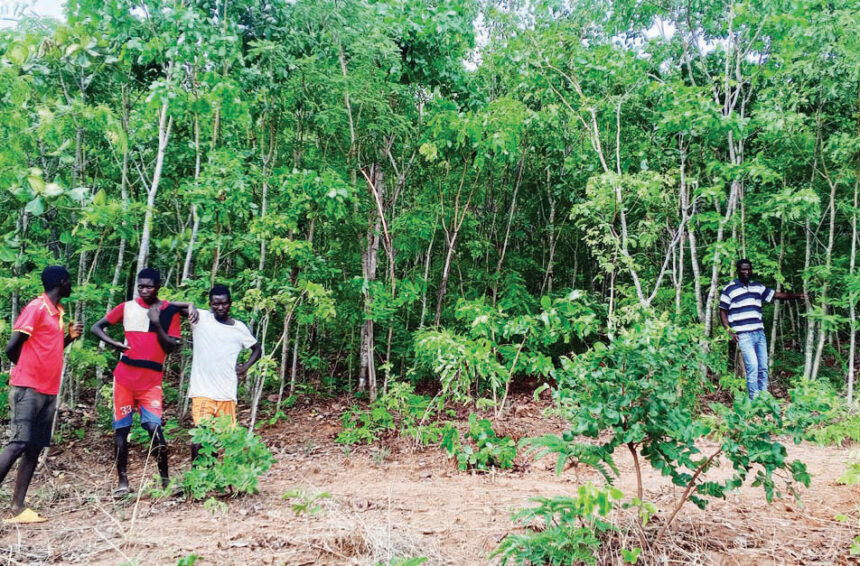
“For the short time we have cared for the trees on Kalibenjere Hill, we have seen the environment coming back to life.
“We will plant more trees in the bare lands and continue with other interventions. Salvation is just around the corner through this programme,” the chief says.
The conservation of the land and the replenishment of the environment is one side of the coin in the programme, as the communities restore the land.
The consumption element of the programme also provides wages, which the people use in their households.