The National Planning Commission (NPC) has said the country’s economy has remained resilient amid myriad shocks that have stifled growth prospects in recent years.
NPC, a public entity mandated to craft and oversee implementation of the country’s long-term development plans, says amid the economic challenges, room for recovery and sustainable growth remains wide if right interventions are made.
NPC Head of Research Andrew Jamali made the remarks on Monday when he delivered a key-note address at the Wealth Magazine Leadership Summit in Mangochi.
The sentiment comes as Malawi’s aspiration of becoming a lower middle-income economy, at least by 2030, seems dim as gross domestic product (GDP) growth continues to be swayed by shocks the country faces.
The local economy has in recent years been riddled with structural challenges and exogenous shocks coupled with harsh weather.
- Advertisement -
The challenges have led to rocketing inflation, seen at 33.9 percent in August 2024, high interest rates, forex scarcity and a volatile exchange rate.
The government’s budgetary operation is not spared as the fiscal space has faced intense pressure emanating from public expenditure overruns vis-à-vis inability to meet revenue generation targets.
But in his address, Jamali said amid the effects of cyclones, Covid pandemic, drought and misplaced policies, the country’s economy remains on trajectory to recover and register growth.
He emphasized on the need by the private sector and state-owned corporations to be strategic in helping the government’s interventions towards achieving its short, medium and long-term growth aspirations.
- Advertisement -
- Advertisement -
“We cannot grow our economy when the private sector is working with strategic plans which are parallel to what the government is doing. The private sector has a huge role to ensure that any country’s economy is growing,” he said.
Jamali said in the five years the country has been implementing plans embedded in the Malawi 2063 first 10-year Implantation Plan (MIP-1), positive strides have been registered.
He said the commission has also incorporated manufacturing in the economic strategy christened ATM [Agriculture, Tourism and Mining] as a feeder for growth.
Malawi Economic Justice Network (MEJN) Executive Director Bertha Lipipa Phiri said while the economy might be resilient, there is need to make sure that the growth and resilience is being noticed by local Malawians.
Phiri observed that the government needs to work towards making sure that Malawians are beneficiaries of the economic gains that are being registered.
“The most important thing is for the government to make sure that it is creating an environment suitable for the business sector to work with it in the implantation plans of Malawi 2063,” She said.
In her remarks Minister of Tourism Vera Kamtukule hailed the Leadership summit explaining that it has accorded heads of department to understand their role in the Malawi Implementation Plan 1 as a part of the Malawi 2063.
She said the business community cannot operate in isolation of the government’s economic plan because the private sector is key in any economic growth, hence the need for the government and the private sector to collaborate.
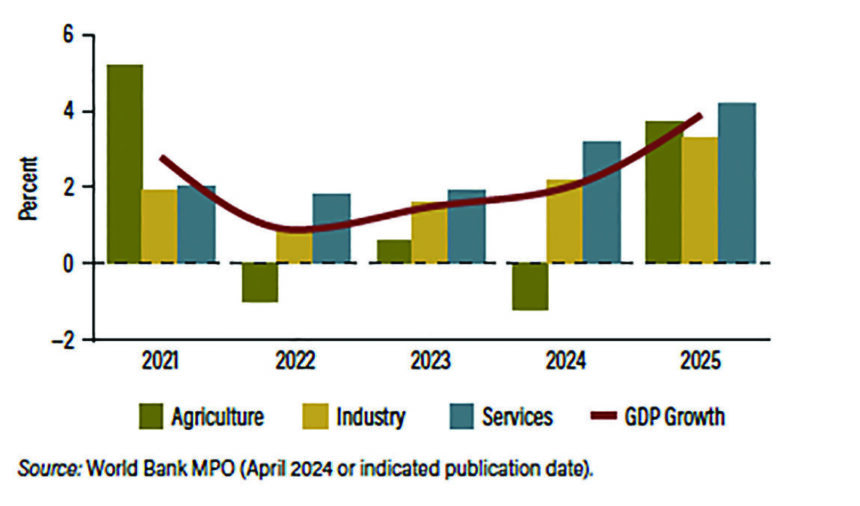
In the past decade, the country has recorded an annual average growth rate of not more than 2.5 percent.
According to the first Malawi 2063 Implementation Plan (MIP-1), Malawi set an ambitious target of graduating to a middle-income economy within a decade from 2020.
Available data shows that between 2005 and 2020, the country has registered an average growth rate of 4.9 percent compared with an average of 5.9 percent in low-income countries in sub-Saharan Africa.