









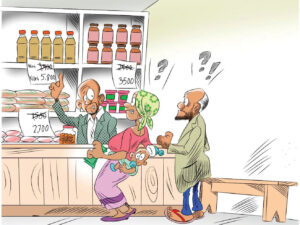
 There are no two ways about it: Wednesday’s 44 percent devaluation of the Kwacha, which became effective Thursday, has already started biting, as prices of commodities on the market have been adjusted upwards.
Most economists appear to agree that devaluing the currency was long overdue and that it was a necessary evil.
Well, such sentiments do not take away the pain that consumers are experiencing after the purchasing power of the little they have got significantly weakened.
But, in any case, this devaluation has been in the offing for some time now. It was just a matter of time.
Market forces have been very clear about how the value of the kwacha had slumped and why any attempt to stick to the cosmetic position would not last long.
- Advertisement -
Let us look a few things that trigger devaluation and why we may not be done yet.
Reserve Bank of Malawi (RBM) governor Wilson Banda said the devaluation stemmed from the bank’s assessment of the currency, which showed that supply-demand imbalances remained in the market despite adjustments of the rate through the auction system.
“Arbitrage opportunities have resurfaced in the market due to the mismatch in exchange rates in the cash and TT markets.
“Spot checks on some market players indicate that the market is able to clear import bills at this rate,” Banda said in a statement.
- Advertisement -
- Advertisement -
A TT (telegraphic transfer) rate is a rate at which a bank converts foreign currency into local currency.
There is speculation that the devaluation, that came barely a week before the International Monetary Fund (IMF) Executive Board scrutinises Malawi’s Eligibility for the Extended Credit Facility (ECF), was one of the pre-conditions for the granting of ECF.
Well, IMF has not veiled its position that Malawi needs to align the local currency with the “reality” on the ground.
In fact, apart from unsustainable public debt and other factors, the “overvalued” exchange rate has been one of the major concerns for the Bretton Woods institution throughout negotiations for the four-year $174 million ECF programme.
That is what happens when you cannot control your own economy and are constantly at the mercy of lenders.
The same experts who are positing that the devaluation was a necessary evil have also warned that without cushioning measures, the poorest of the poor will be heavily hit.
That is why it is surprising that Minister of Finance Simplex Chithyola Banda will have to wait until Monday to outline measures government has put in place to mitigate the impact of the devaluation.
In the meantime, we do not produce enough commodities that can compete on the international market to bring home the so much sought-after dollars.
It is a fact that if a currency is more valuable, the exports will become more expensive in the global markets. In our case, which commodities can really have an impact on the international market?
Tobacco does not come into the picture since it has a fixed market and is only sold during a particular period.
Elsewhere, devaluation of a currency results in an increase in exports and a decrease in imports, narrowing down the trade deficit and improving the balance of payments.
In our case, the same question crops up: Which exports should we talk about in Malawi, a country that could not even satisfy some minute demand in South Sudan?
You sometimes wonder whether we really have an export strategy in place.
The yawning gap between our exports and imports sends a message of how we are failing economically and why we are not done yet with devaluations.
Our prolonged failure to clinch a programme with IMF should teach us important lessons about growing our economy and not relying on the goodwill of multilateral lenders and donors.
The dollars, euros and pounds that used to flow into the custody of RBM are being withheld by some development partners who are waiting for a signal from the IMF.
So, everyone who wants to buy something from outside the country has to scramble for the little forex that is there, especially on the black market.
As long as the forex remains in short supply, the Kwacha will continue losing its value.
Our hope should be in the IMF programme, which may open aid taps, thereby shifting more forex into Malawi.
Only then might the forex situation normalise a bit.
At present, demand remains high and we are not exporting enough to overturn the crisis.
We cannot even manufacture toothpicks and cotton swabs but expect to have forex in abundance.
Now, commodity prices are rising by the hour while demand for imported goods remains.
What is missing are important conversations and strategies regarding how to address the crisis.

