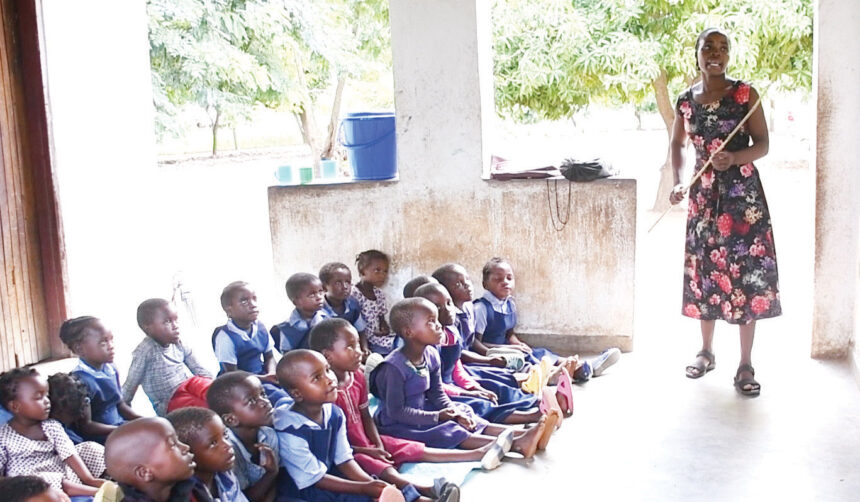
Malawi, and the world as a whole, is falling behind on early childhood education and development. This is putting many children – especially among the poor – at a serious disadvantage. Yet children, as WANANGWA CHAFULUMIRA writes, are the country’s most important asset. In Balaka District, John and Christina Ndala realise that young children deserve the strongest educational foundation people can give them for success in life
A sound of children’s laughter can be heard inside a classroom.
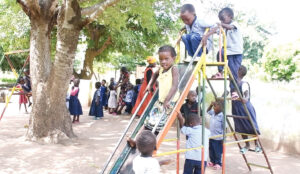
At 10 am, a bell tolls.
Enthusiastically running around, the children soon fill the playground at Genesis Foundation in Group Village Maliwata, Traditional Authority Sawali in Balaka District.
Some cluster around while beamingly chattering.
- Advertisement -
“I want to be a soldier,” four-year-old Agatha Bwanali proudly tells us.
Pre-primary school is fun – serious fun.
Music, storytelling, movement, outdoor play, role play and drama, experts say, give children basic literacy, numeracy and problem-solving skills.
These are the building blocks of a child’s education that put them on the right track for a life of learning.
- Advertisement -
- Advertisement -
Unesco’s 2023 Global Education Monitoring Report focusing on Africa says children who do not have the chance to start their education early are seriously disadvantaged before they even start school.
Early moments, which translates to mmera mpoyamba in Chichewa, matter. That is the core mantra of Early Childhood Education and Development (ECED).
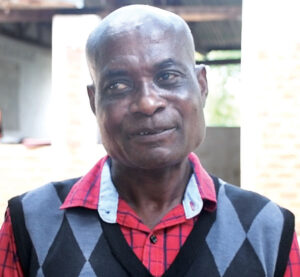
The catchphrase made John Ndala, 60, and his wife Christina to come up with a start-up idea that reaches hundreds of children in Group Village Maliwata.
“Like most other parents, we wanted children in our home area to grow up in an atmosphere of respect and acceptance. We also wanted them to realise their potential from an early age.
“I dropped out in Standard Eight due to financial challenges; so, I don’t want this future generation to experience the same,” Ndala says.
He says the best way for children to do that and have the same opportunities as children from wealthier families who can afford early education classes is to enrol in a quality public institution.
In Malawi, access to education might be crouching near universal for children between the ages of six and 17.
But the picture changes when it comes to infants and toddlers.
Unicef’s report, Education Budget Brief 2023/24: Towards a Sustainably Financed Education Sector to Support Malawi’s Human Capital Development, shows more efforts are required to improve the quality of ECED services in Malawi.
The report says only 34 per cent of infants are enrolled in ECED.
Unfortunately, out of the 34 per cent, a few have access to good quality training which would lead to their active participation in national development, as advanced in National Policy on Early Childhood Development.
Across the country, formal centre-based ECED training is offered both through private and public outlets.
Public centres are free but provision is patchy, making access to quality ECED limited to the privileged few who can afford to enrol their children to private centres.
At such centres, which are few and mostly in urban areas, children, for example, can talk about their dream cars, their favourite TV programmes, their lucrative dream jobs and so forth.
The World Bank says some 71 per cent of Malawi’s population live on less than $1.90 per day and most people in rural communities are subsistence farmers.
An estimated 61 per cent of children aged zero to 17 years are now considered multi-dimensionally poor – deprived of two or more essential services – compared to 63 per cent in 2012- 13, Unicef says in Malawi 2023: For Every Child Survive and Thrive report.
Unicef says while 59 per cent of children aged three to four years are developmentally on track in physical, social-emotional development and learning in the country, only 17 per cent are developmentally on track in literacy-numeracy.
But lecturer in early childhood education at Unicaf University Naine Mkandawire says 80 per cent of human brain development happens in the first four years after conception.
“The kind of training a child receives in these formative years is critical in shaping who one becomes,” Mkandawire says.
According to Mkandawire, government is not serious about ECED because the country still has low funding for early childhood education services within the national budget.
“Caregivers (rural preschool teachers) continue to teach on a volunteer basis and rural preschools are of low standard in terms of infrastructure. They are under-resourced in teaching and learning materials and play materials,” he says.
He adds that the discrepancy between rural and urban quality of ECED provision is strikingly huge.
To fight this structural inequality, John opened an ECED centre, Genesis Foundation, in 2014.
“I used part of my salary to open the centre. I was working as a driver for Project Concern International (PCI) Malawi here in Balaka but the project phased out in 2020,” he says.
He bought the land where he established the centre and mobilised communities who perform various tasks including cooking porridge which they provide to children.
“I do not charge a fee, which places operational challenges on me and my wife and partially the committee which comprises communities.
“At first, I was getting support from American volunteers Caroline Kuruger and Wallen Thomson. They used to send me materials including blankets which I was distributing to children enrolled with us. However, they have grown old, hence they stopped assisting us,” he says.
He says the only support he gets outside the community is from neighbouring Toleza Farm which allows the centre to collect fuelwood for cooking porridge from the farm.
“Now, I manage the centre using proceeds from my taxi business I run at Balaka Township and my wife’s fish-selling business. I engaged two caregivers who are occasionally given some token from my pocket.
“I grow maize and groundnuts with which we prepare porridge for the children. The committee helps us with some farming activities but I wish we had some more nutritious foods like soya. Balaka District Social Welfare Office only provides supervisory roles and training of caregivers” he says.
Group Village Head Maliwata says the centre needs support to provide quality education to children.
“Challenges here range from lack of enough space for learning as the structure built 10 years ago is small, lack of teaching and learning materials, insufficient food and lack of potable water.
“Water is drawn from a borehole a kilometre or so away,” the traditional leader says.
Nkhonde Ward Councillor Steve Sauka advises the Ndalas to register the centre with Balaka District Council so that it operates as a community-based organisation, which he suggest could help the school have access to more sustainable and reliable funding.
“Otherwise, seeking assistance from individuals like myself is unsustainable,” Sauka says.
Balaka District Social Welfare Officer Nellia Kumalele ignored our efforts to seek her say on the centre’s operations.
Four-year-old Fazida Kawawa’s mother Ireen Gunda from Maliwata Village says her daughter’s social skills are improving since she enrolled at the centre.
“She rarely played with her friends at home but now she plays a lot and is learning a lot from her playmates,” Gunda says.
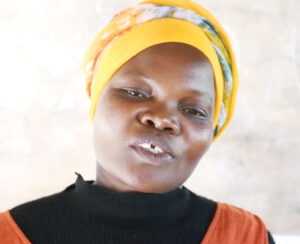
A caregiver at the centre Shalom Pahuwa says children who pass through Genesis Foundation perform better when they enrol into primary schools.
Aside from running the centre that has currently 34 children, the Ndalas take care of 19 elderly persons drawn from villages under Group Village Head Maliwata.