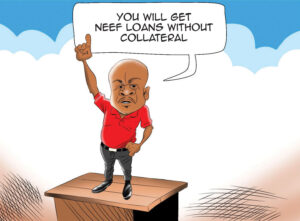
 Reading between the lines, it is clear that the politics which used to cloud National Economic Empowerment Fund (Neef) loans is returning to the programme.
That is, if the proposal by Vice-President Michael Usi that loan beneficiaries should not provide any collateral for the agreements comes to pass.
In an apparent bid to win over Malawian voters, possibly ahead of next year’s election, Usi has been telling seekers of Neef loans that it does not make sense for them, given their poverty, to provide collateral.
It is not as if those before him never considered this. It is not as though they were unaware that some Neef loan beneficiaries are poor individuals who are simply seeking a springboard to get started.
There is a precedent for the collateral arrangement that neither politics nor elections should dismiss, as long as Malawi aims to eliminate the senseless loss of public funds.
- Advertisement -
Those who established the collateral requirement carefully considered the dangers of disbursing loans without proper mechanisms to ensure beneficiaries repay them.
They must have learnt lessons from previous programmes where politically connected individuals and cronies of those in power obtained loans and failed to repay.
They had little to compel them to return what they had obtained apart from their own free will and conscience, which can sometimes be very rare.
In fact, we are still discussing Neef having written off billions of Kwacha in loans disbursed by its predecessor organisations because the chances of recouping them are almost zero.
- Advertisement -
- Advertisement -
For years, the State loan organisation has been urging those who received the funds to repay them so that others can benefit, but to no avail.
In an attempt to avoid having on its books money it may never recover, Neef appealed to the government to allow it to write off the figures, so that if it eventually recoups the money, it should be considered a bonus.
And we know that nothing is going to happen to those who obtained the loans and have refused to pay back.
While it may be difficult to trace some of them due to the lack of proper arrangements to track them in the event of default, others simply do not care because they know someone powerful facilitated the loans.
Therefore, the introduction of several measures to ensure loan beneficiaries feel obliged to repay the money they receive, so that others can also benefit, should have been welcomed.
Usi believes it is unnecessary to have collateral because the people who access or are supposed to access Neef loans are poor and do not possess anything that could be taken from them if they fail to repay the loan.
In other words, the vice president is suggesting that if the poor fail to repay their Neef loans, the government should take responsibility and never bother about recovering the funds.
We all know that this is happening because of politics.
Efforts to buy voter support will obviously lead government officials seeking another mandate to make absurd decisions merely to appear caring to potential voters.
At a time when Neef is celebrating having recovered record amounts of money disbursed to beneficiaries, it is absurd that methods which previously contributed to repayment challenges are being reintroduced into the system.
Neef officers, who are striving to strengthen mechanisms to reduce defaults, must have been dismayed by Usi’s remarks.
Let the systems and procedures for managing the loans not be clouded by politics, especially when the sentiment has been that the programme seems to be making progress.
But we all know that Usi was not discussing something he had merely dreamed of during his visit to Blantyre townships or conjured up when he received the call appointing him State vice president.
There must have been such discussions in the corridors of power and high-profile individuals were aware of these declarations long before they were made public.
Having been relatively new to larger government affairs—the presidency—it was unlikely for Usi to make such a significant declaration publicly without prior approval.
After all, he mentioned having discussed the matter with President Lazarus Chakwera, who must have agreed to the suggestion that collateral requirements should be removed from Neef loans.
Should this come to pass, which it likely will, it will be all about politics and elections and the scramble for votes.
It will not be about the poor gaining easier access to loans, some of which they might not even want in the first place.
But we all know that in our political landscape, politicians will always find a way, especially when it concerns those in government.