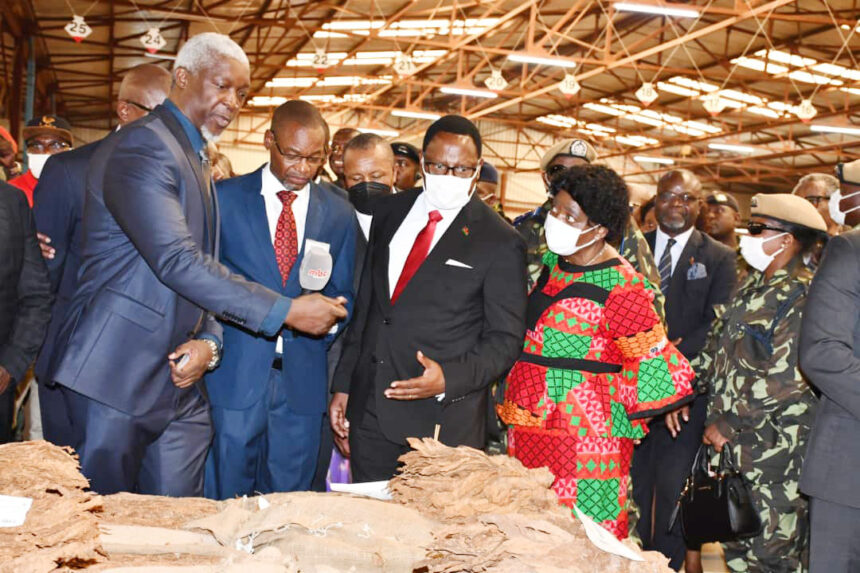

Agriculture Minister Sam Kawale is a man caught between two worlds; that of elation and one of concern.
On one hand, he is ecstatic that the 2024 tobacco marketing season kicked off on a high note last Monday, when trading stated at Chinkhoma Auction Floors in Kasungu.
On that day, at an event which President Lazarus Chakwera graced, burley tobacco attracted prices as high as $3 on the usually troubled auction side of the market.
It, really, was a day of firsts. To begin with, it marked the first time in over a decade that tobacco growers could be heard laughing aloud, perhaps aware that they were raking in the much needed United States dollars from the green gold.
In the second place, it marked the first time in 88 years that the opening of the tobacco marketing season was conducted outside the Lilongwe Auction Floors in the administrative capital.
- Advertisement -
No wonder that Msayiwale Zacharia, who led growers in protesting poor prices at the start of last year’s tobacco selling season, was the first one to flash smiles at all those that visited the auction floors.
“This is what we want. We are very happy with how the market has started this year,” Zacharia explained.
Events at the auction floors on opening day did not escape the attention of Chakwera, who was accompanied by Vice President Saulos Chilima.
“Even though this [what is available on the opening day of the auction floors] is lower leaf, they have started with good prices and I trust that we can continue with this type of performance,” Chakwera pointed out.
- Advertisement -
- Advertisement -
Kawale reflected that enthusiasm in his demeanor.
At the same time, something is bothering Kawale. That is, low tobacco production levels.
Speaking during the opening of this year’s tobacco market at Lilongwe Auction Floors— a day after Chakwera presided over a similar event in Kasungu— Kawale bemoaned low tobacco production.
“I am worried over reduced production levels this year.
“While the demand for tobacco remains high, climate change continues to pose challenges to production. Events like cyclones and El Niño have impacted us, such that there is a need for farmers to adopt irrigation methods and [a need] for more farmers to join the tobacco industry through the Mega Farms programme,” Kawale indicated.
He was quick to say government plans to engage farmers on the issue and also work on amending the Tobacco Act as some of the strategies for addressing challenges that farmers are facing.
This year, Malawi is expected to produce 140 million kilogrammes (kg) of tobacco against the demand of 190 million kg, resulting in a 50 million kg deficit.

TECHNOLOGY—Moyo
Whatever the case, farmer Charles Moyo from Jailosi Moyo Village, Inkosi Mtwalo, in Mzimba District believes that one of the panaceas for increasing production levels has been found.
“I am talking about poly-potting technology,” Moyo brags.
Poly-potting is a farming innovation in which farmers transplant tobacco seedlings from the nursery to the field using plastic tubes.
“I wish I had known about the method long ago. I am saying so because, before the system was introduced to us, farmers, a lot of seedlings were dying in the process of transferring from the nursery to the crop field. This is because the relocation process was disturbing root development.
“Every time we transferred tobacco seedlings from the nursery, we could anxiously wait to see which ones [seedlings] would survive because some roots could die during the process. It was a painful process because it was like watching a loved one die. And we lost a lot of money whenever the transplanted seedlings died. This is no longer the case and that is why I wish I had learned about poly-potting technology long ago,” says Moyo, 45.
The farmer, who has two vehicles bought using tobacco proceeds, embraced poly-potting four years ago and, all of a sudden, his six hectare field has become a cash spinner.
“I am not surprised that I am now earning more money than before. This is because the survival rate of seedlings transplanted using poly-potting is between 99 percent and 100 percent. It is almost like a miracle,” the farmer, who is under Integrated Production System under Alliance One Tobacco Limited, indicates.
Last year, when heavy rains affected the crop in his six hectare field, he generated K8 million.
“This year, I am more than optimistic that I will generate more profits from burley and flue cured tobacco because the crop is doing well.
“Last year, when heavy rains affected output, I got 89 bales of burley tobacco and over 60 bales of flue cured tobacco.
“This year, I am hoping to produce more kilogrammes (kg) because my tobacco has done well when compared to last season. I am happy that the poly-potting method of transplanting seedlings has not disappointed me in the past four years. Instead, tobacco production levels have improved. I also thank Alliance One Tobacco Limited leaf technicians for offering their expertise to me. I always know that I am not alone,” Moyo emphasises.
He is not the only one singing praises of poly-potting.
One of the Alliance One Tobacco contracted growers Donnex Kaunga Nyirenda, who comes from Tomasi Nyirenda Village in the same area, says his life has changed for the better since he embraced poly-potting farming technology.
“The survival rate of transplanted seedlings reaches 100 percent, which is something that was unheard of before.
“For your information, I started using the poly-potting transplanting method about three years ago. Now members of Chikosera Club are reaping the benefits of following leaf technicians’ advice because we are assured that almost all the seedlings we transplant will survive. This is because there is no root disturbance during the process as roots are not disturbed in any way. As such, when we transplant them, they continue the growing process, assuring us of quality leaf,” Nyirenda points out.

appreciate the benefits
Such sentiments are pleasing to the ears of Ben Kawonga, who is Alliance One Tobacco Limited Corporate Affairs Officer.
“We are happy with progress that farmers who have embraced poly-potting are making. That is why we introduced poly-potting technology to our tobacco growers.
“When we introduced the technology, there was some resistance from some farmers but now they have appreciated the benefits of the technology, such that many more are expressing interest in following suit,” Kawonga says.
True to his words, Moyo has become a poly-potting addict.
“I cannot stop following the poly-potting method. Even if someone were to promise me billions of Kwacha to stop using it, I would not, for a second, entertain such a thought,” Moyo vows.
This is happening when the second round of tobacco estimates published by the Tobacco Commission (TC) on Tuesday showed that tobacco production is expected to shrink to 140 million kg this year.
This represents a four percent drop when compared to the 146 million kg projected during the first-round crop estimates last month.
TC Board Chairperson Godfrey Chapola blames the situation on weather.
“This year, we could have produced more than the projected 140 million kilogrammes if we were not hit by dryspells in some tobacco growing areas.
“Despite this, the output this year has increased due to good prices offered last year, availability of inputs and increased number of growers,” Chapola said.
Add poly-potting to the combination good prices and availability of inputs and the result is outright smiles on farmers’ faces.