


Australian mining company Sovereign Metals Limited has announced a major and strategic rare earth breakthrough at its Kasiya Rutile-Graphite Project in Lilongwe.
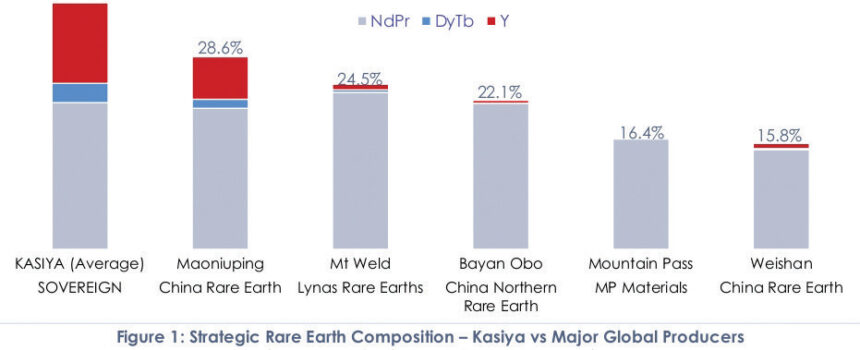
The rare earth’s composition is said to distinguish Kasiya from all major global producers.
In its latest statement, the company says it has successfully recovered a monazite concentrate containing high-value heavy rare earth elements (REEs) from the tailings stream generated during rutile processing at its upgraded Lilongwe laboratory.
The firm says the material was recovered from non-conductor tailings that would otherwise be discarded during electrostatic separation of heavy mineral concentrates from Kasiya ore, meaning that no additional complex processing is required.
Sovereign Metals said chemical analysis of magnetic concentrates from processed drilling samples, carried out by Scientific Services South Africa, confirmed favourable rare earth oxide distributions.
- Advertisement -
It says preliminary results showed that the monazite concentrate contains exceptional levels of heavy rare earths, averaging 2.9 percent combined dysprosium and terbium, rising to as much as 3.9 percent, and averaging 11.9 percent yttrium, with values reaching 17.3 percent.
The concentrate is also said to contain light rare earths, including 21.8 percent neodymium-praseodymium.
According to the company, this rare earth composition distinguishes Kasiya from all major global producers.
The five largest rare earth operations, which together account for more than 70 percent of global output, are dominated by light rare earth elements, while strategically critical heavy rare earths are in short supply and increasingly sought after by the United States, Japan and the European Union.
- Advertisement -
- Advertisement -
Sovereign Metals Limited Managing Director and Chief Executive Officer Frank Eagar described the recovery as an exceptional development with the potential to fundamentally enhance Kasiya’s strategic significance.
Eagar said the heavy rare earths recovered, including dysprosium, terbium and yttrium, were essential for advanced technologies such as permanent magnets, defence systems, aerospace applications and high-temperature engines, and that they had become even more critical following China’s export controls imposed in April 2025.
“China imposed export controls on all three in April 2025, and Western supply chains are now acutely exposed. What makes this value addition particularly significant is that this product was recovered from our rutile processing tailings stream.
“We are not currently contemplating a complex, standalone rare earth operation. We have recovered critically strategic rare earths from what would otherwise be discarded– a by-product of the processing route we will use for rutile and graphite production,” he said.
Eagar observed that Kasiya’s rutile would feed aerospace-grade titanium production, adding that its graphite was essential for battery anodes and traditional industrial applications.
“And now Kasiya has the potential to also deliver critical heavy rare earths. We have an exciting workstream ahead of us as the potential of the heavy rare earth minerals is delineated,” Eagar said.
He said he recent visit by the US State Department to Sovereign Metals Malawi operations, combined with the firm’s Collaboration Agreement with the International Finance Corporation (IFC), reflected the strategic importance that governments and institutions are beginning to attach to Kasiya.
Last month, Sovereign Metals signed a strategic Collaboration Agreement with IFC, a member of the World Bank Group and the largest global development institution focused on the private sector in developing countries, to advance the sustainable development of the Kasiya Rutile-Graphite Project.
Under the Agreement, IFC will use its expertise to support aligning Kasiya with IFC’s environmental, social and governance standards.
IFC will also complement Sovereign’s owner’s team and supplement Rio Tinto’s input for the development of the Environmental and Social Impact Assessment (ESIA) aligned with global best practice sustainability standards.
Speaking in October when he swore in State Second Vice0President Enock Chihana, Minister of Agriculture, Irrigation, and Water Development Roza Fatch Mbilizi and Minister of Industrialisation, Business, Trade and Tourism George Partridge, President Peter Mutharika said if proper measures were taken, the country could significantly benefit from mining sites discovered at Kasiya and Kangankude.
Mutharika said if the mining proceeds from the two sites would be managed properly, the country would be generating around $500 million every year.