By Temwani Mgunda:
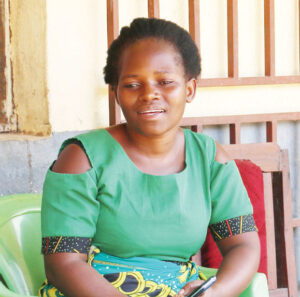
In April this year, Malisera Lackfen was distressed for days on end. Her breasts swelled and became weighty while her body battled with sporadic fever attacks.
“The pain was unbearable. I wondered if my condition had anything to do with the decision I made to stop breastfeeding my two-year-old son,” says Lackfen, a 26-year-old mother of two from Chiutsa Village in Dedza District.
She could not immediately seek medical opinion on her condition, largely because there is no health facility within the area. It would have meant traveling to Dedza District Hospital, which is far away from her rural home located at Linthipe in the Central Region district.
Then, the other day, Lackfen landed on information that would end up saving her from the excruciating pain. She heard about Chipatala Cha Pa Foni (Health Centre by Telephone) after listening to a health campaign song by local musician Skeffa Chimoto. The song, she says, encourages patients in need of medical assistance to call the number 54747.
- Advertisement -
“I dialled in and a healthcare worker advised me to intermittently press a bottle of cold water against the breasts. After three consecutive days of doing that, I became fine,” Lackfen says, adding that the healthcare worker told her that if left untreated, her condition (mastitis) could lead to an abscess that would need surgical treatment.
A decade of impact
It is now more than a decade since Chipatala Cha Pa Foni rolled out its services to such rural areas as Lackfen’s Village. The facility—an innovation by international non-governmental organisation, Village Reach—was launched to primarily provide solutions for improving maternal health.
The organisation’s country director, Alinafe Kasiya, says in the years prior to the launch of the hotline, the country registered countless maternal and child deaths mostly because healthcare service facilities were overwhelmed with increasing number of maternal-related cases. It was against this backdrop that VillageReach introduced Chipatala Cha Pa Foni’s pilot project in Balaka District.
- Advertisement -
- Advertisement -
“It started as a small project. Initially, health surveillance assistants (HSAs) went door-to-door with their phones, urging rural expectant women to call and talk to healthcare workers on issues about maternal health,” Kasiya explains.
He says the hotline— staffed by trained clinical professionals—is toll-free for Airtel subscribers following a partnership between Village Reach and Airtel Malawi after the latter had already launched its own toll-free initiative called ‘Dial the Doc’.
Apart from calling, Chipatala Cha Pa Foni has an interactive voice message platform that accommodates voice messages in Chichewa, English, Yao and Tumbuka languages.
“Voice messaging options make sure that language and literacy are not a barrier to accessing Chipatala Cha Pa Foni services,” Kasiya says.
From pilot to national project

In 2019, Chipatala Cha Pa Foni transitioned to the Ministry of Health after Government adopted the initiative and made the hotline an integral part of healthcare service delivery structures. The facility had, by then, already scaled up to all districts in the country and had also expanded its focus by including other topics in addition to maternal health. The transition was made complete by placing all the hotline healthcare workers on the government payroll.
Abdullah Sayidi, head of the Health Advisory Unit at Ministry of Health, says government adopted Chipatala Cha Pa Foni because of its proven record in bridging the health information gap among Malawians.
Sayidi says the service is key in the promotion of universal health coverage as Malawians are encouraged to seek healthcare services in a timely manner to improve their health outcomes.
“Chipatala Cha Pa Foni has contributed to improvements in maternal and child health indicators, as well as improvement in scaling up nutrition,” he says.
According to the 2018 impact evaluation of Chipatala Cha Pa Foni, the facility’s users were more knowledgeable of the danger signs in pregnant women and under-five children and that 78 percent of the users were more likely to know the importance of a diversified daily diet against 22 percent of non-users.
And, in the recent past, Chipatala Cha Pa Foni has, at times, diversified its operations by becoming quite instrumental in the emergency response drive by the Ministry of Health, as was the case during the Covid pandemic and then cholera outbreak and, finally, the Tropical Cyclone Freddy disaster.
Integrating health and nutrition
It was not going to be a smooth transition to the Ministry of Health for Chipatala Cha Pa Foni if it were not for the partnership between VillageReach and GIZ Malawi’s Food and Nutrition Security Project (FNSP), funded by German Development Cooperation, according to Kasiya.
He says the partnership came at a crucial time during the transition process as it was GIZ that covered the salaries of hotline workers for three months in 2019, when the Ministry of Health was still working on their employment contracts. GIZ also supported other related operational costs to sustain the hotline.
“That ensured that there were no gaps in the functions of the hotline,” Kasiya says.
GIZ’s FNSP team leader, Martina Kress, says she first learned about VillageReach and Chipatala Cha Pa Foni during a mid-term review mission conducted at her organisation’s global programme level in 2015, long before she joined FNSP as team leader.
She remembers how the hotline was still operating in few selected districts at the time but how the aspiration of covering the whole nation had deeply impressed her at the time.
“The FNSP team had come up with the idea of Chipatala Cha Pa Foni possibly hosting the topic of nutrition and targeting the districts of Dedza and Salima where GIZ is implementing food and nutrition security interventions,” explains Kress.
She says the primary objective of the agreement was for Chipatala Cha Pa Foni to provide nutrition advisory services by developing a high level of nutritional expertise among the hotline staff.
At that time, Chipatala Cha Pa Foni’s primary focus was sharing information on maternal and child health and Kress says the absence of nutrition from the advice provided to hotline clients was a considerable gap considering that health and nutrition ought to be integrated.
She says, through GIZ support, modules on nutrition were developed, and the hotline started to cover the nutrition component extensively.
“By introducing content on nutrition, more impact was made. People were calling to obtain information on nutrition not only from Dedza and Salima, but also from across the country,” Kress says, adding that even if people do not directly call on nutrition, the hotline healthcare workers are encouraged to advise them on dietary issues and provide more information on nutrition in relation to the diseases they are suffering from at the time of calling the hotline.
Looking ahead
According to Kasiya, plans are underway to further expand Chipatala Cha Pa Foni’s services.
He says, for instance, the Ministry of Health has plans to integrate emergency medical services with CCPF, to enable clients to call in for an ambulance in times of emergencies such as road accidents on the M1 Road. There are also plans to extend this to cover maternal health, where pregnant women can also access this emergency service.
He further says that apart from introducing a TNM toll-free number, the hotline will launch telemedicine—a platform that will help connect patients in the districts with specialist doctors based at Kamuzu Central Hospital in Lilongwe.
“Telemedicine is whereby a patient sits with a healthcare worker at a district hospital and talk to a specialist at a referral hospital,” he explains.
The future introduction of a WhatsApp chat board using Artificial Intelligence (AI) aims to enhance confidentiality and address the reluctance of some youths to seek sexual and reproductive health knowledge through the hotline.
In summary, Chipatala Cha Pa Foni stands as a beacon of an innovation that was successfully integrated into government structures, positively impacting rural healthcare and nutrition. As it continues to evolve and expand its services, it remains a vital resource for Malawians seeking timely and reliable health and nutrition information.