
By Deborah Madeya:
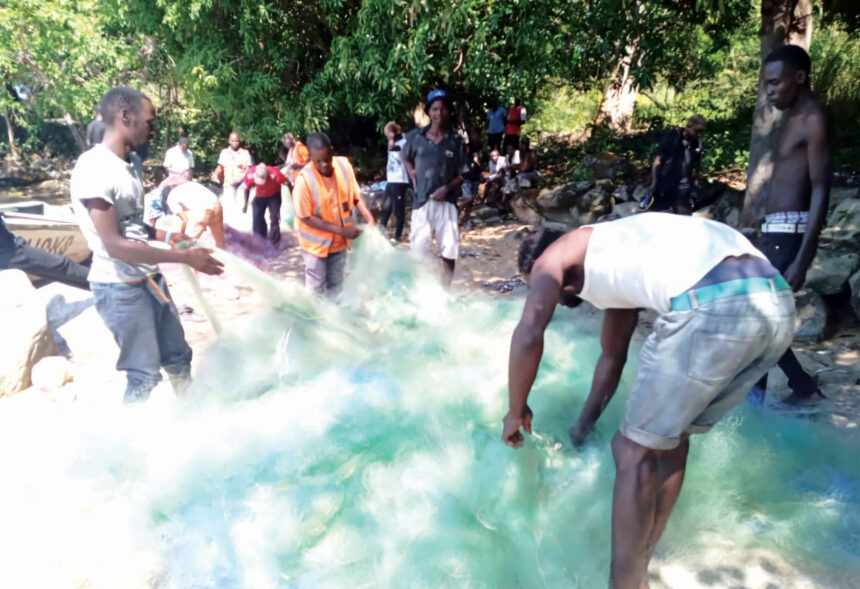
For fishermen like Scoch Chuma, the day begins when the sun is setting in. He runs his trade along the sandy shores of Senga Bay in Salima District.
Here canoes are dragged above the waterline overnight, fishermen are already at work untangling nets by torchlight, loading ice into cooler boxes.
By the time the sun rises above the horizon, the lake is already busy. It has always been this way, long before Malawi had a name.
Chuma said the lake has always been a place of certainty.
- Advertisement -
Each season, he said, he would return home with a reliable haul of Utaka, Chambo, and Usipa, among other species.
“I started fishing as a business in 2008. For all these years, I derived my livelihood from the lake. I have children who depend on the income I earn to pay for their schooling,” he explained.
Chuma is also a farmer but depends primarily on fishing to support his agricultural activities.
“Farming demands considerable investment in fertiliser, equipment and other inputs and the proceeds of my fishing business allow me to meet all of these costs,” he indicated.
- Advertisement -
- Advertisement -
However, Chuma observed with concern that some fish species have become scarce since water levels on the calendar lake began rising in the last five years.
“Depending on the season, we catch different fish species. From February to May, we always catch Utaka, Mcheni and Jamison but, for the past five years, catches have been deeply disappointing.
“This year has been particularly dire, with Utaka having vanished from local catches entirely. We are still able to catch Jamison, but not as much as before,” he said.
Chuma said fishermen expected larger catches when there is more water in the lake, but the opposite is happening.
Lester Wakana, a fisherfolk in Nkhata Bay District, echoes the sentiments.
“Catches have dwindled over the past five years. September to November is traditionally our peak season for Usipa. We still catch some, but not as much as before,” he said.
Wakana, a retired teacher and chairperson for Makuzi- Kamwala Beach Village Committee, said they had established a breeding area for the fish, but catches are still low.
“It is said that in the 1980s, the same thing happened; many species had become scarce, to the extent that fishermen began selling their equipment and joining other professions but, eventually, everything returned to normal,” Wakana said.
Lake Malawi is the third largest fresh water lake in Africa and one of the most biologically diverse bodies of freshwater on earth. It is home to more than 1,000 fish species.
The fisheries sector contributes approximately 40 percent of the animal protein consumed nationally and employs, directly and indirectly, 1.6 million people across the value chain.
Nkhata Bay Principal Fisheries Officer Dellings Kamenya acknowledged the concerns of fishermen but cautioned that rising water levels tell only part of the story.
In his assessment, overfishing remains the greatest threat to fish stocks in Lake Malawi, hence the low catches.
“Species like Chambo have been overfished and may become scarce in the long run. To restore this, it depends on fisheries management to ensure that the stock that is available is given space to breed,” he said.
Kamenya said high water levels push fish into deeper water zones that lie beyond the reach of small-scale fishermen.
He also noted that rising waters carry a positive ecological dimension, as they create more breeding area for the fish.
“Some species are migratory. They move between areas to breed and are, therefore, temporarily absent from familiar grounds. This does not mean the species have disappeared; they simply require time to reproduce.
“We have a number of initiatives that are being implemented to preserve fish species. We are also working with traditional leaders in lakeshore areas and fishermen to protect endangered fish species. The Fisheries Conservation and Management Act provides a legal framework for regulating catches, setting closed seasons and enforcing minimum mesh sizes so as to ensure the sustainability of fishing activities,” Kamenya said.
The National Water Resources Authority said the current swelling of Lake Malawi is driven by above-average rainfall across the catchment area.

The authority’s public relations officer Masozi Kasambala said they expect water levels to continue rising and warned that flooding in low-lying lakeshore communities remains a significant risk.
“Historically, Lake Malawi reached its highest recorded level of approximately 477.22 metres above sea level in 1980, an event associated with widespread lakeshore flooding and infrastructure damage. The lake has since experienced natural fluctuations.
“However, for the past five years, average levels increased from 474.8 to 475.0 masl in 2020-21 and 2021-22 to above 475.9 masl in 2023-24. During the 2024-25 season, levels exceeded 476.3 masl, and in the current 2025-26 season, the lake has remained unusually high, reaching approximately 476.45 masl in mid-April 2026. This means the lake is now at its highest level in more than four decades and is approaching the historic high levels experienced around 1980,” Kasambala said.
Environmentalist Matthews Malata called for a balanced strategy that combines conservation with sustainable livelihoods for fishing communities in fish species management
“Communities should be empowered through awareness campaigns and co-management initiatives so that they become active custodians of the lake and its resources.
“In addition, the government and stakeholders should invest more in research and monitoring to better understand how climate change is affecting fish populations. Restoring degraded ecosystems, reducing water pollution and promoting aquaculture can also help reduce pressure on natural fish stocks,” Malata said.
However, much as water levels have had a hit on fisherfolks, fish volumes continue to dwindle on the lake owing to climate variability, overfishing, illegal fishing methods, habitat degradation and pollution, among other factors.