




 There is something deeply unsatisfying about the way the Nocma saga is unfolding.
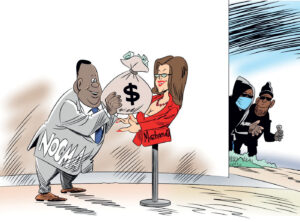
A public institution loses about $403,605, or roughly K700 million, in a payment that was supposed to settle a legitimate bill.
Two senior officials are arrested. The Anti-Corruption Bureau (ACB) summons the chief executive. Investigations are said to be continuing.
And then what?
That cannot be where the story ends.
- Advertisement -
The arrests are important. The ACB summons is important. But neither answers the central question that is now hanging over this affair. what exactly happened to the money, and how did it leave Nocma?
Malawians deserve to know.
They deserve to know who initiated the change of bank account. They deserve to know who received the request, who checked it, who believed it was genuine, who recommended the payment and who finally authorised it.
Most importantly, they deserve to know whether the money was paid into the right account.
- Advertisement -
- Advertisement -
That question may sound simple, but it is at the core of this entire matter.
Nocma says it received communication purporting to come from Mozhandling Limited advising that the company had changed its banking arrangements.
New account details at Bank of America were provided. Nocma says it also received a letter purportedly from the bank confirming the account before National Bank of Malawi was instructed to make the payment.
Two weeks later, Mozhandling contacted Nocma asking about an outstanding payment.
That is when the alarm bells rang.
So, somewhere between the request for new banking details and the eventual transfer of $403,605, something went terribly wrong.
The question is where.
And this is where the contradictions become troubling.
Nocma initially described the matter as suspected fraud after communication purporting to come from Mozhandling resulted in the change of banking details.
But on Times Radio’s Kulinji programme, Nocma spokesperson Raymond Likambale offered a strikingly different interpretation.
He said Mozhandling’s bank had confirmed receipt of the funds and, therefore, the government had not been swindled.
That raises another obvious question. If the money reached an account belonging to Mozhandling, why was there a need for an investigation into suspected fraud at Nocma in the first place?
And if it did not reach Mozhandling’s legitimate account, what exactly did the bank confirm?
These are the substance of the matter.
A government institution handling hundreds of millions of kwacha cannot afford explanations that change depending on who is speaking.
There is also the question of timing.
Chief Executive Officer (CEO) Emmanuel Matapa says the payment cannot be attributed to him because it was made on April 29, two days before he assumed office on May 1.
Fair enough. That is a factual issue that investigators can establish from documents, signatures, electronic records and internal approvals.
But his arrival date should not become a convenient line that brings the investigation to a stop.
Likewise, the arrest of Deputy CEO Miklas Reuben and Senior Operations Manager Thokozani Jacob Sesani should not automatically mean that the investigation has found its destination.
An arrest is an investigative step. It is not a conviction. It is certainly not a complete explanation of a transaction involving K700 million.
If these two officials were negligent or acted unlawfully, let the evidence establish that. If they were not, let that also be established.
But investigators must follow the money and the decision-making chain wherever it leads.
That means examining the role of management, the board, the officers responsible for verification, the officers who approved the transaction and the banks involved in processing it.
What verification procedures existed at Nocma?
Were they followed?
Who verified the new account details?
Was the purported confirmation from Bank of America independently authenticated?
Was anyone at Mozhandling contacted through a previously known telephone number or email address before the account was changed?
Was there a second level of approval?
There is another matter that should concern Malawians; the statement that Nocma will not make another payment because Mozhandling has already fulfilled its obligations.
If that is the position, then where is the $403,605?
If it is sitting in Mozhandling’s legitimate account, produce the evidence. If it went elsewhere, tell Malawians where.
If another party obtained it through fraud, what is being done to recover it?
And if the money was genuinely received by Mozhandling, why did the company itself contact Nocma about an outstanding payment?
Somebody, somewhere, knows exactly what happened. The job now is to establish the truth.
This is why the arrests cannot be allowed to become the convenient ending to the story. Nor should the ACB summons be presented as proof that the matter has been adequately dealt with.
Those are steps. The destination must be the truth.
Malawians have become accustomed to investigations that begin with noise and end quietly, with questions left hanging in the air and public money seemingly disappearing into paperwork.
This case must not follow that familiar script.