




By Imam Wali:
It is 15:00 hours at Dedza One- Stop Border Post.
Cross-border transporter Malipende Sasawaladi [not real name] switches off the engine of his white 7-tonne lorry from South Africa ready for inspection and clearing of the goods.
His vehicle is loaded with second-hand television sets, smartphones, laptops and radio sets— the affordable hardware backbone powering Malawi’s digital revolution.
- Advertisement -

Yet the quantity that enters Malawi in tonnes each year remains unknown.
- Advertisement -
The closest proxy, according to the Global E-Waste Monitor, is 12.5 million kilogrammes (kg) of electrical and electronic equipment put on the market in Malawi in 2022.
Thus, during the last five years, approximately 60 million kg of ICT equipment entered Malawi.
And not all imports pass through formal border posts.
Under Macra Type-Approval Regulations, border posts are supposed to be the country’s filters—verifying safety before hardware hits the market.
- Advertisement -
On paper, Malawi is getting connected.
In reality, it is getting contaminated.
The country has mastered how to import and deploy technology but has no system to securely destroy it when it dies, leaving toxic metals in its soil and un-erased personal data in its dumps.
That short life ends in the repair markets.
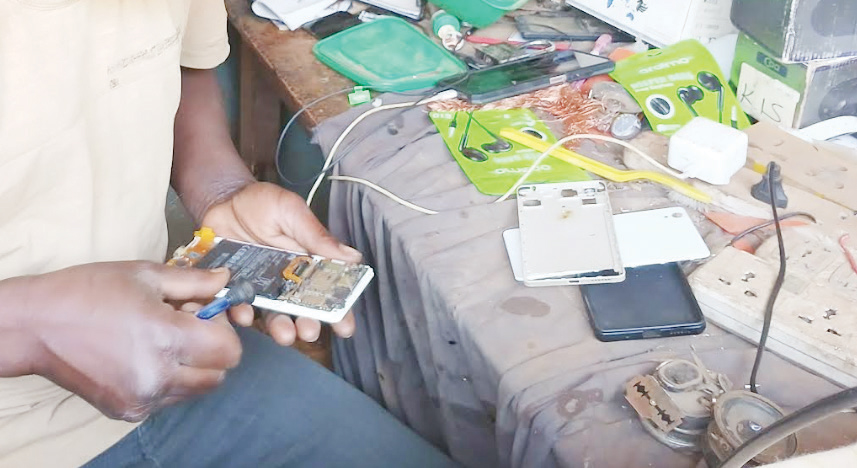
In Lilongwe, Lukiyo Kayo fixes electronics at Tsoka Market.
In Mzuzu, at Matayifa Market, Andrew Nyirenda does the same.
In Blantyre, Noel Mohipa repairs electronic gadgets in Limbe Market.
When such gadgets cannot be fixed, there is nowhere special to take them.
“We do not have a dumpsite specifically for electronic components; so, we discard them anywhere, mostly along the banks of the Lilongwe River or burn them. Sometimes, the city council collects them and hauls them off to Mtaya,” Kayo indicates.
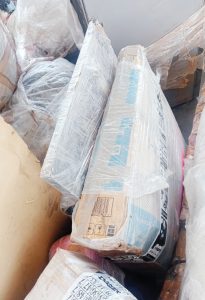
At Mtaya dumpsite in Lilongwe and Mzedi in Blantyre, city trucks and individuals dump waste mixed with broken phones, television sets, computers and solar panels.

At Mtaya, 15-year-old Raphz [not real name] is among barefoot boys and girls, including women, who rush to collect discarded gadgets.
“We collect various ICT items— for example broken phones, radio sets, television sets and other gadgets, including batteries and internal parts—to sell to scrap dealers who buy them in bulk,” he explains.
Improper disposal follows three paths.
When burned, phones and batteries release lead and cadmium into the air. These are pollutants linked to respiratory illness and cancer.
When dumped, the same metals seep into soil, persist for years and are absorbed by crops.
When it rains, they wash into rivers used for drinking and irrigation.
The danger is amplified by informal recycling.
Chisomo Chalemerah Chisale, Environmental Health Officer at Nsanje District Health Office, says the danger is amplified by informal recycling.
“Such practices can emit up to 1,000 hazardous chemicals, with prolonged exposure associated with neurological disorders, stunted cognitive growth in children, adverse birth outcomes, hormonal disruption and kidney complications, with children and pregnant women most at risk. Inhaling dust and fumes from burning batteries increases lead concentration in the blood, which can cause brain injury, kidney failure and respiratory damage, especially in children,” he says.
Malawi has never tested blood lead levels among informal pickers, but a 2022 study in neighbouring Zambia found informal e-waste recyclers carried blood lead levels up to four times the World Health Organisation (WHO) limit.
The crisis is not just toxic. It is digital.
Millions of discarded phones and hard drives still contain intact, unencrypted flash memory — private messages, mobile banking cache and business records.
Under Malawi’s Data Protection Act (2024), data controllers face strict obligations to ensure secure destruction.
Instead, un-sanitised logic boards are left exposed in open dumps.
According to a joint National Statistical Office and Macra 2019 survey, 56.6 percent of Malawians owned a mobile phone, 57.2 percent listened to radio and 22.2 percent watched television.
By the same period, Malawi’s annual e-waste generation had reached roughly 10 million kg, according to the Global E-Waste Monitor 2020.
In the past few years, Malawi has made unprecedented strides. Through the Universal Service Fund, Macra is building 195 smart computer laboratories in community day secondary schools. Simultaneously, the Ministry of Education—under the Building Education Foundations through Innovation and Technology (BEFIT) programme—has distributed over 10,000 tablets to more than 500 primary schools.
While the initiative is commendable, Malawi lacks a funded plan for disposing of these devices when they reach end-of-life in three to four years, raising the risk that schools meant to connect learners will turn into storage sites for obsolete equipment in a country with no formal recycling facilities.
The same cycle is quietly building in the health sector. Through the Ministry of Health’s Integrated Community Health Information System (iCHIS), over 3,700 health surveillance assistants share tablets and smartphones to report disease, nutrition and maternal data in real-time.
A similar gap exists in the health sector. Without a public, financed disposal plan, the health tablets and computers will not only add to the waste burden at dumpsites but will also retain un-erased patient records, in violation of the Data Protection Act (2024).
It is a local face of a global crisis.
According to the Global E-Waste Monitor 2024, the world produced 62 million tonnes of e-waste in 2022, rising by 2.6 million tonnes annually, projected to reach 82 million tonnes by 2030.
At Mzedi dumpsite in Blantyre, rain washes battery acid into the unlined landfill. That poison then flows into the Nasolo River and onward into the Shire River.
Under the Basel and Bamako Conventions, which Malawi ratified, this material is classified as hazardous waste whose dumping is prohibited.
In 2024, the government launched the National E-Waste Management Policy, which promises to introduce Extended Producer Responsibility (EPR).
Under EPR, telecommunications companies, importers and distributors such as Airtel Malawi, TNM and computer suppliers must pay a levy to collect, transport and safely recycle their products at end-of-life.
Two years later, there is still nowhere formal to take it.
However, efforts to enforce safe disposal appear to be stuck in a bureaucratic loop.
When contacted on the status of EPR, Macra Communications Manager Clara Mwafulirwa said the “Policy holder is the Department of Environmental Affairs”.
Ministry of Natural Resources and Climate Change spokesperson Tikondane Vega Chiwambo said the construction of collection centres is expected to start by 2030.
“The establishment of e-waste collection centres mostly depends on implementation of Extended Producer Responsibility, which is awaiting development of e-waste management regulations. Should all the conditions precedent be met, the project will start in 2030,” he said.
Nevertheless, Malawi 2063 Environmental Sustainability Champion Mathews Malata says the blame game exposes a deeper failure.
“We continue to experience the same challenges of poor coordination, institutional bottlenecks and attitude of those expected to provide leadership. A policy is only as good as its implementation, and we cannot continue developing policies without translating them into practical action. Every additional delay means more electronic waste accumulating without adequate systems,” he says.
Malawi 2063 Enabler 7 commits to clean, sustainably managed environment. Enabler 5 commits to a healthy population. Neither is possible when lead from batteries seeps into the Shire and 10 million kg of hazardous waste are buried in open dumps each year.
The same applies to Sustainable Development Goals. SDG 12.5 requires waste reduction through recycling. SDG 11.6 requires cities to reduce their environmental harm. SDG 3.9 requires fewer deaths from hazardous chemicals.
Malawi launched its e-waste policy in 2024. It plans to start collection in 2030. That is the very year the SDGs expires.
Elsewhere, it is a resource not a waste.
In 2021, Rwanda commissioned Enviroserve in Bugesera, which now recovers 700 tonnes of copper, gold and rare earths annually and employs 300 youths.
Kenya, according to its National E-Waste Monitor 2026, generated 56,000 tonnes in 2025, with recoverable metals valued at USD 48-50 million.
The model aligns Malawi with the EU’s Waste Electrical and Electronic Equipment Directive and South Africa’s National Environmental Management Act, which ban e-waste from open landfills.
The Netherlands collected and treated 255,000 tonnes of e-waste in 2024, according to the Dutch WEEE Flows 2024 report.
While Kenya, Rwanda and the Netherlands treat e-waste as a resource, Malawi still treats it as general waste.
The boys and girls at dumpsites are not the problem. They are what happens when a system does not exist.
The true test of Malawi’s digital revolution will not be how many devices we connect, but how safely we lay them to rest.