
Climate change refers to long-term shifts in temperatures and weather patterns. There are natural and anthropogenic, thus human-induced factors, that contribute to climate change. It should be noted that climate change has always happened on earth.
However, it is the rapid rate and the magnitude of climate change occurring now that is of great concern worldwide. Human activity, primarily the burning of fossil fuels like coal, oil and gas, has increased greenhouse gases in the atmosphere since the industrial revolution, leading to more heat retention and an increase in surface temperatures.
Examples of greenhouse gases include carbon dioxide, methane, nitrous oxide, water vapour and synthetic fluorinated gases. The greenhouse gases act like a blanket that is wrapped around the earth. This means the gases collect in the atmosphere and absorb sunlight and solar radiation that have bounced off the earth’s surface. By trapping the sun’s heat, they raise global temperatures, a phenomenon referred to as global warming. For instance, the average temperature of the earth’s surface is now about 1.1 degrees Celsius warmer than it was in the pre-industrial era.
But then, why worry about climate change? Why be bothered by a slight global temperature rise of say 1.1 degrees Celsius? Well, to examine this, let us refer to what the former executive director of UNEP (2006- 2016) Achim Steiner, said: “…The invoice for our climate-changing emissions will include more droughts, floods and other natural disasters. We need to ‘climate proof’ our farms, our infrastructure and our livelihoods in order to minimise our vulnerability to future disasters”.
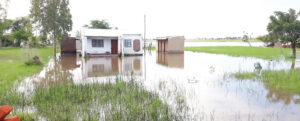
An acceleration in climate change and increased global surface temperatures is leading to rising sea levels, devastating floods, expansion of water bodies, especially the oceans, melting of ice in the arctic resulting in massive injection of water in the oceans, heavy precipitation, severe heat waves, wildfires, more frequent droughts, devastating tropical cyclones, among other disasters.
- Advertisement -
Now, the question is what next— or is all lost? Well, grim as it sounds, all is not lost, as long as the global community takes decisive, concrete and sustained action. Greenhouse gas emissions as a result of human activities is exacerbating climate change. Therefore, action and, not rhetoric, to eliminate, reduce or minimise the greenhouse gas emissions into the atmosphere should be a priority if we are to manage our vulnerability to future disasters. Further, besides cutting emissions of greenhouse gases, the identification and usage of alternatives to fossil fuels worldwide is key to slow down climate change.
The Paris Agreement, which is a legally binding international treaty on climate change, was adopted by 196 Parties at the UN Climate Change Conference (CoP21) in Paris, France, on December 12 2015 and entered into force on November 4 2016. Its overarching goal is to hold “the increase in the global average temperature to well below 2°C above pre-industrial levels” and pursue efforts “to limit the temperature increase to 1.5°C above pre-industrial levels.”
The challenge, though, is the slow pace of implementing commitments. This includes climate financing delays.
Climate scientists agree that to avoid the worst impacts of climate change, there is a need to reduce global carbon emissions by as much as 40 percent by 2030. This needs sustained action by the global community and pursuing concrete measures to decarbonise energy generation from fossil fuel-based production to renewable energy sources like wind and solar; to electrify cars and trucks; and to maximise energy efficiency.
- Advertisement -
- Advertisement -
Is there anything one can do at individual level? Yes, one can practice energy conserving measures as a daily routine, including use of energy efficient cars and appliances, use of low emission vehicles, use of public transport or carpooling, including the use of electric vehicles (EVs). I recently watched, on local television channels, the launch of Electric Vehicles (EVs), which means people are contributing to emission reduction and climate change management by embracing technology.
One can also take a step towards establishing carbon sinks through afforestation programmes. Just like this column, one can also choose to voice support of climate-friendly and climate change preparedness policies, as well as awareness creation on disaster risk reduction and management, among other initiatives.