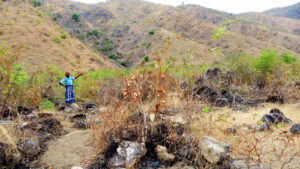
The destruction has been immense. Fields which were once teeming with lush crops on the banks of the Shire River are now dry and cracking.
The few wooded areas that we found at the foot of bare rocky hills four years ago are also bare now.
A large stretch of Neno southeast lies naked after the sprawling forests that once decorated this small southern Malawi district bordering Blantyre, Mwanza, Balaka and Ntcheu fell at the hands of charcoal producers on the prowl.
The remaining few branchy trees that used to provide convenient shade as the sun struck most in this already traditionally scorching area have been chopped down.
- Advertisement -

Even the thin spiky shrubs we found in the area of Traditional Authority (TA) Symon have been cleared as locals here desperately search for anything they can land their hands on to produce charcoal.
- Advertisement -
Now the charcoal producers are targeting distant forests, from where thin pillars of grey smoke can be seen billowing above rocky hills and knolls.
“It is our business and we cannot stop doing it,” Fred Sawa of Nkoka Village, TA Symon, states, his bloodshot eyes fixed onto a glittering axe lying across a thin footpath stretching from his village to distant wild fields.
Four years ago, Sawa and his colleagues used to build their charcoal kilns less than a kilometre from their homes.
Today, they have moved further into the forest to take down the remaining trees on flatlands and rocky hills near the Shire.
- Advertisement -
Despite that the Department of Forestry has intensified the implementation of new laws that provide stiffer penalties for charcoal traders and users, Sawa maintains he is not ready to abandon the business.
“I have tried other income generating activities but they have not worked for me. I have to feed my family.
“I know that what I am doing is illegal because the forests I am clearing belong to the government, but should my family starve because I have to protect trees?” he charges.
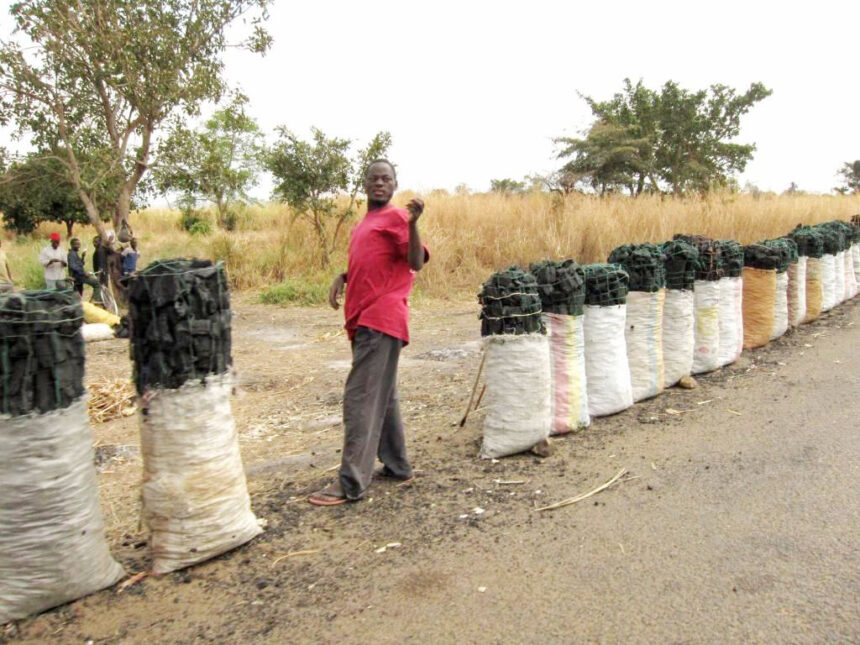
Outside his small raw-brick grass-thatched house, stacks of charcoal have been piled up waiting to be ferried to Blantyre some 100 kilometres away where most urban households use them.
Sawa reveals that demand for his illegal product has been rising owing to incessant power outages caused by the destruction of Kapichira Hydropower Station which was hit by water raging down the Shire.
The disaster, which was caused by an energetic tropical storm, took 129 megawatts of electricity off the national grid after a dam and spillways got damaged.
Sawa argues that as long as electricity, connected to just 11 percent of Malawi’s population, remains elusive in urban areas, demand for charcoal will remain high and traders will always find ways of evading the law.
“Of course, in our case, we are safe in the fact that forestry officers cannot visit locations where we produce the charcoal. It will be war. It is our business and we will jealously guard it,” he challenges.
The Ministry of Natural Resources and Climate Change prescribes a milder way of cleaning up illegal charcoal that contributes to the clearance of at least 32,000 hectares of forests in Malawi every year.
The ministry wants companies that produce briquettes to come up with business models that engage charcoal producers as retailers.
It concedes that the demand for charcoal, particularly in urban locations, is pushing forests to the brink of extinction.
“We must look at what to do with people selling or producing charcoal. Instead of these people supplying charcoal, they could become retailers of these briquettes,” the ministry said in a statement sometime back.
But dealers such as Sawa are defying provisions in the new forestry law that prescribe penalties of up to K5 million and prison terms of up to 10 years for those convicted of dealing in illegal charcoal.
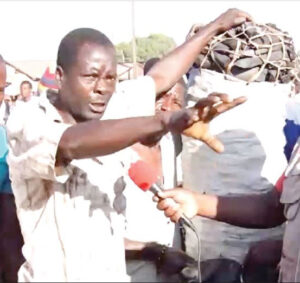
“Let them [law enforcers] arrest us, because we are not stopping producing charcoal any time soon,” another charcoal producer, Frank Ben, who twice every week peddles his bicycle saddled with three big sacks of the commodity to Balaka Town, says.
His palms look tough, perhaps having been hardened off by firm grips of axe handles when chopping down the prized hardwood in his village tucked between a heavily silted river and Balaka’s southern borderline.
He periodically rubs his eyes to ease off the irritation which he admits has gradually become part of his life.
In his trade, hazards are inevitable. He has been to hospital a couple of times where doctors often tell him that the charcoal dust he inhales causes complications to his respiratory tract and could eventually lead to lung damage.
“But what else can I do for my family apart from producing charcoal?” he queries rhetorically, leaning over the crossbar of his old bicycle which he claims he has ridden for over three hours to reach Balaka Town.
He sells each huge bag at K4,000, which then gets transported together with others in huge chunks to Blantyre where they fetch up to K12,000 each.
Ben confesses that the earnings from the sales significantly pale in comparison to the work that goes into charcoal production.
Even what gets into the huge banks that make the kilns comes out in relatively smaller quantities after they get heated in their oxygen-starved vaults.
“Charcoal production is very arduous. It has toughened some of us to the extent that we no longer fear being arrested,” he says.
His inflamed eyes further tell a story of a man willing to fight till the last drop of his blood if it is for the survival of his trade that is blood, sweat and tears.
As he speaks, in a Times Television programme that gets views of locals on trending issues, Ben pinches his torn dirty shirt which he says symbolises the poverty that has plagued his family of four.
“Tell whoever is saying we should stop producing charcoal that we are ready to die for this business,” he charges, a sensation of finality tinging his voice.
In several locations in the two districts, which are frequently struck by droughts attributed to the clearing of forests, adamant men are illegally producing charcoal to feed their markets which are reportedly controlled by bigwigs such as politicians.
From bases of bare hills and river banks, dry ravines and abandoned crop fields, grey fumes waft into the quiet skies as men like Sawa wait for their charcoal to be ready.
“Have you ever wondered how the charcoal reaches Blantyre from all these distant places? It does not fly; it goes through the numerous checkpoints you see on the roads,” Sawa says.

That insight seems to be augmenting his resolve to remain in the illegal trade which Deputy Director of Forestry Teddie Kamoto admits cannot be defeated by targeting producers only.
“It is sad that those who are supposed to act according to the law do not do it. There are shortfalls, but we are working on that,” Kamoto says.
He also admits that prices of gas, an alternative which authorities have been popularising for years in the midst of erratic electricity supply, frustrate efforts to save forests at the mercy of producers of illegal charcoal.
Kamoto reckons that even though the Ministry of Energy is responsible for energy solutions in the country, the wanton cutting down of trees has to be checked by the Ministry of Natural Resources.
“In fact, the gas is sometimes not even easily accessible while charcoal can easily be found in the locations where people live.
“But we still ask people to have a broader picture in mind. The pace at which forests are being decimated casts a dark picture on how the country will be like 10 years from now,” Kamoto says.
He further insists that the law will not be shelved simply because charcoal is the most easily available energy source in a country producing one of the lowest amounts of electricity in the world.
Kamoto maintains something destructive should not be allowed to fester on the premise that it meets people’s socio-economic needs.
“Let us take the example of selling Indian hemp or being involved in robbery. Those involved in such acts do that to make money but we cannot say because they have to feed their families, then they should do such illegal things,” he declares.
The new charcoal penalties have divided the civil society.
While consumer rights activist John Kapito wants the regulations to be shelved until households have alternative energy sources, others such as environmentalist Julius Ng’oma argue that continuing with the current rate at which forests are being decimated is suicidal.
Kapito maintains the promoted alternatives are out of most households’ reach.
“Punitive penalties, fines and long jail sentences are not an answer to the charcoal problem. If they enforce this law, then all of us will be arrested,” he pronounces.
The consumer rights activist then suggests that in the meantime, government can distribute gas appliances to rural areas and subsidise the energy source for the majority to afford it.
But in a statement that has been appearing in the local press for some days, the Ministry of Natural Resources is simply appealing to the general public to respect the law by desisting from dealing in illegal charcoal.
“Government continues to provide a conducive environment for private sector investment in the development of alternative energy sources,” the ministry says.
Ng’oma also posits that the law has to be respected without conditions.
“While we sympathise with the public, suspending the law is not an option. It is suicidal idea,” he says.
ut Kapito insists that the gas, briquettes and charcoal pellets that government is fronting as alternatives are available in very small quantities “and sometimes not available at all”.
In the first three quarters of 2021 alone, Malawi’s courts recorded 343 convictions and fines averaged K283,000.
Twenty vehicles which were used in transporting illegal charcoal were forfeited to the government.
With the Forestry Department now intensifying the implementation of the law, the penalties are expected to be stiffer.
Still, charcoal producers like Sawa are not moved an inch.
“It is dangerous business. But, at least, forestry officials have never been where we produce our charcoal. We are ready to fight them,” Sawa says.
He even blows up at the officials whom he accuses of often selling the charcoal they confiscate from dealers and stuff the money into their pockets.
As things stand today, Malawi faces a grave and worsening linked crisis of erratic electricity supply and environmental damage that are dividing even those pushing for green conservation.
Even in the midst of floods and droughts linked to forest degradation and deforestation, there are those who hesitate to accept that illegal charcoal will be out of the country’s energy mix before the end of this decade.
But the rate at which forests are vanishing in Malawi is atypical of the slower pace of life in rural areas where huge loads of charcoal are churned out for users in urban areas.