Malawi’s imports leapt by 330.3 percent in May this year to hit $286.1 million from $66.5 million in April, the Reserve Bank of Malawi (RBM) monthly report for May has shown.
The report, released on Friday, notes that the sharp growth in imports far outweighed the growth in exports which grew by 76.4 percent over the same period from $32.9 million in April to $58.1 million in May.
The sharp growth in imports resulted in a wider deficit of $228.1 million (K236.5 billion) than a deficit of $33.6 million (K34.9 billion) recorded in April 2023.
During May last year, the country recorded a deficit of $60.7 million or K52.2 billion.
RBM has attributed the surge in imports to the importation of $76.5 million fuel, $17.3 million pharmaceuticals, $11.2 million vehicles, and $5 million fertilisers.
- Advertisement -
This compares to imports worth of $0.6 million pharmaceuticals, $21.3 million fuels, $3.5 million vehicles and $4.5 million fertilisers for April 2023.
The bank further says the growth in exports was primarily driven by increased sales of sugar, tobacco, pulses and oil seeds; and tea and coffee; to $2.6 million, $7.5 million, $23.8 million and $9.9 million, in that order.
“In April 2023, the same commodities were recorded at $0.1 million, $1.6 million, $5.4 million and $6.4 million, respectively,” the bank says.
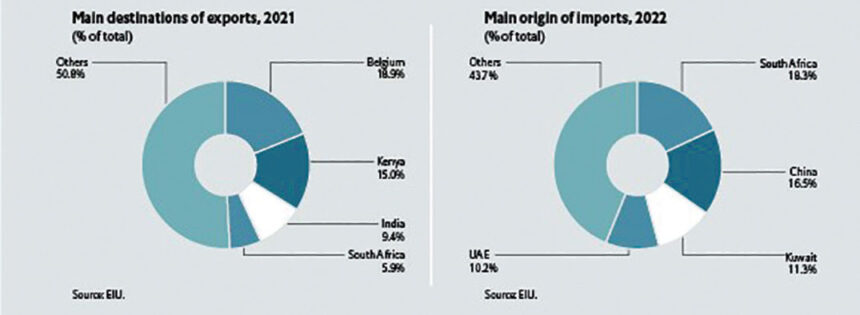
In its Second Quarter Country Report for Malawi, the Economist Intelligence Unit (EIU) says Malawi’s exports are driven largely by receipts of tobacco and tourism.
- Advertisement -
- Advertisement -
According to EIU, in the first quarter of this year, tobacco exports dropped by 81.5 percent, to just $21 million, owing to erratic weather patterns and high prices of fertiliser, causing the trade deficit to widen.
“A high import bill for food since Cyclone Freddy will sustain a wider current-account deficit while reducing foreign-exchange reserves. However, we expect the recovery of agriculture from weather shocks and high prices for fertiliser to boost tobacco and tea exports from 2024, raising export revenue.
“In addition, we expect that uranium mining, which has been held back in previous years by limited investment, will commence in late 2024,” EIU says.
Finance Minister Sosten Gwengwe recently said Malawi loses about $700 million through illegal exports of commodities.
Gwengwe said authorities have, from this year, put in place tight measures to ensure that all the exports are computed and that export proceeds come to Malawi.