The year 2024 will definitely go down in history as the year when Malawians spent seven months without knowing the future of the Extended Credit Facility (ECF) programme with the International Monetary Fund (IMF).
For starters, on November 15 last year, the IMF Board of Executive Directors approved a four-year $175 million ECF programme for Malawi.
The ECF was aimed at supporting the authorities’ commitment to restoring macroeconomic stability, building a foundation for inclusive and sustainable growth, including strengthen resilience to climate-related shocks, and addressing weaknesses in governance institutions.
The arrangement was also expected to catalyse grant financing and capital inflows, including foreign direct investment and trade credit.
Following the approval of the programme, the IMF made an immediate disbursement of $35 million to Malawi.
- Advertisement -
The approval of the programme brought excitement in the corridors of both the State House and Capital Hill as it came after almost two years of negotiations with the Bretton woods institution.
Authorities saw the granting of the programme as a game changer for Malawi’s wobbling economy.
To the authorities, the ECF was supposed to open the much-needed budget support taps, which were closed some years back.
And true to expectations of the authorities, in less than a month after IMF granted the ECF, on December 12 2023, the World Bank Board of Executive Directors approved the Malawi First Growth and Resilience Development Policy Operation with Catastrophe Deferred Drawdown Option (Cat-DDO).
- Advertisement -
- Advertisement -
This was a $137 million package which consisted of an immediate release of $80 million to support reforms and recovery and a $57 million CAT-DDO that could be triggered in the event of a crisis.
Just like any other ECF programme, the authorities had made some commitments to the IMF to be fulfilled over the period of the arrangement.
Key among them were issues to do with restructuring the country’s public debt, rebuilding international reserve buffers and normalising the foreign exchange market.
As usual, the IMF sent staff teams to Malawi to monitor progress on the agreed parameters.
From May 12 to 23, an IMF staff team—led by Mika Saito—visited Lilongwe to conduct discussions on the First Review of the ECF programme. The conclusion of the first review could have seen Malawi receiving a second disbursement from the IMF.
In a statement after the visit, Saito said the IMF team acknowledged the authorities’ firm commitment to successfully completing the first review of the ECF-supported programme.
“Fiscal discipline remains critical in the face of elevated spending pressures. Rebuilding international reserve buffers and normalising the foreign exchange market are critically important to facilitate the return of trade credit and reduce vulnerability to external shocks.
“Addressing weakness in governance and institutions remains important. Successful external debt restructuring is vital for macroeconomic stability.
“Discussions will continue in the coming weeks toward completion of the First ECF Review,” she said.
Weeks turned into months and it is now seven months since the IMF staff team left Malawi but there has been no significant progress on the matter.
In August, United States (US) Department of Treasury Deputy Assistant Secretary for Africa and the Middle East Eric Meyer visited Malawi and noted that the country may not meet the commitments necessary to receive a second tranche of the IMF ECF in the coming months.
Meyer observed that low revenue collection, ballooning expenditures and delayed full implementation of the Integrated Financial Management and Information System (Ifmis) had put at risk Malawi’s chances of staying on track with the IMF.
The high-ranking US official noted that there had been delays by Malawian authorities in reaching an agreement on necessary debt restructuring with some of Malawi’s international creditors.
This, according to Meyer, had been further complicated by deals that Malawi was pursuing with some investors, saying such deals could undermine Malawi’s agreements with the IMF and bilateral creditors.
“This is a critical juncture for Malawi to achieve macroeconomic stability and advance on the path to meet its vision 2063 goals.
“Urgent leadership and action are needed at all levels of the government to ensure Malawi stays on course with the ECF, implements the reforms it has committed to in order to stabilise its economy and build the foundation for economic growth and the long-term benefit of all its citizens,” Meyer said.
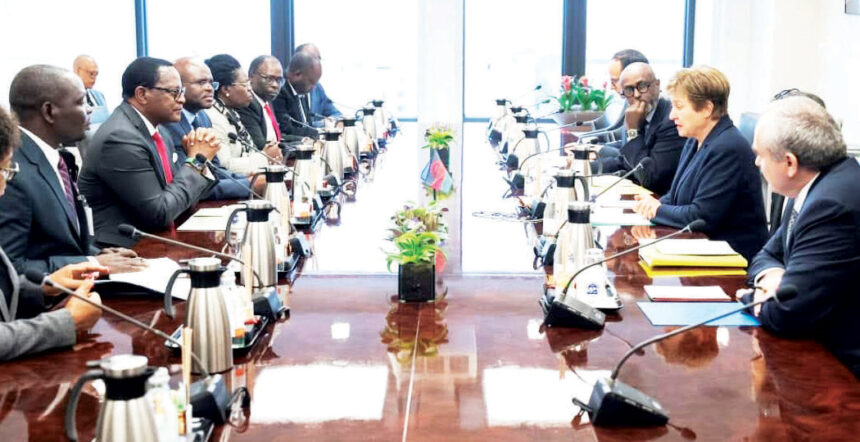
In late September, President Lazarus Chakwera went to IMF Headquarters to discuss the issue of ECF with IMF Managing Director Kristalina Georgieva.
Georgieva said the IMF was committed to supporting Malawi’s economic stabilisation efforts.
On December 19, Leader of Opposition in Parliament George Chaponda asked Chakwera to clarify on whether the country’s ECF programme was still on track or not.
Speaking in Parliament, Chaponda claimed that the local economy continued to face challenges due to wasteful spending and excessive borrowing.
But Chakwera urged the opposition leader to resist the temptation of making half-baked diagnosis of the local economy.
He said the IMF programme was on track.
“So contrary to the public propaganda pushed by the opposition, over expenditure within the 2024-25 budget is within the levels that were approved by this House early this year.
“In fact, if our spending was really outside the confines of the law, and the best practices of fiscal discipline, the donor community would not even trust us with the millions of dollars they are investing for us to procure and distribute maize to fight the spate of hunger that El Nino weather has spread in the 23 districts of our country,” he said.
He admitted that there were a few parameters of the ECF which the authorities were working on.