By Divya Srinivasan:
Almost one third (32 percent) of women aged 20 to 24 in Eastern and Southern Africa—around 50 million—were married before 18 years old.
To address this pervasive problem, the Southern African Development Community (Sadc) Parliamentary Forum has adopted the Sadc Model Law on Eradicating Child Marriage and Protecting Children Already in Marriage, a legal framework providing a comprehensive, integrated approach to ending child marriage and protecting children already married.
New research reveals that while some Sadc countries have taken commendable action to strengthen legal protections in this area, other Member States have made little or no progress.
While the Sadc Model Law is having a positive impact, its success depends on effective implementation and enforcement by states. To assist governments, the briefs also provide recommendations on strengthening elimination efforts through good application of child marriage laws and policies.
- Advertisement -
Sadc Model Law
Child marriage severely harms girls and exposes them to various human rights violations. It impedes their right to education, as marriage often entails being forced to drop out of school to assume adult responsibilities.
This lack of education perpetuates a cycle of poverty, limiting girls’ opportunities for personal development and financial independence.
Early marriages increase the likelihood of early pregnancies, posing significant health risks to girls whose bodies aren’t mature. This can result in complications during pregnancy and childbirth and is associated with higher maternal and infant mortality.
- Advertisement -
- Advertisement -
Moreover, child brides are often subjected to domestic violence and marital abuse as they lack the power to assert their rights, and alternative safe spaces are rarely available.
The Sadc Model Law defines a child as any person below the age of 18 and recognizes that child marriage violates children’s rights, including the right to education, health, and protection from harm.
It calls for prohibiting child marriage, creating prevention and response mechanisms, and promoting birth registration.
Other components include supporting child brides and their families and ensuring access to education and healthcare.
The Model Law sets 18 as the minimum age for marriage for both boys and girls without exception and is applicable to all types of marriages – whether under statutory, religious or customary law — with marriages involving a child declared null and void.
To address the complex root causes contributing to child marriage, the Law promotes a comprehensive, multi-sectoral approach based on coordination and collaboration between legal, education, healthcare, and social services sectors.
Inconsistencies and weak implementation of laws
It is important to recognize that some progress in reducing child marriage has been achieved in Eastern and Southern Africa. However, progress is too slow as the prevalence rate has only reduced from 39 percent to 32 percent over the past 25 years, while other regions have made much faster progress.
At the current trajectory, it is estimated that child marriage in the region won’t end until 2240.
Concerningly, most progress in Sub-Saharan Africa has occurred amongst the wealthiest families, while in poorer communities, there has been a rise in child marriage. This perpetuates an unacceptable and deeply entrenched divide along socio-economic lines and demonstrates how governments need to focus more on prioritizing elimination of child marriage.
Problems include a lack of adequate resourcing to programs addressing child marriage and a general lack of effective implementation of laws and policies, which feeds into low prioritization of decision-making and lack of action on child marriage.
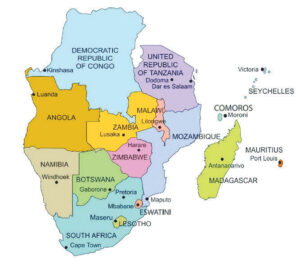
Out of the 16 countries in Southern Africa, only six countries – DRC, Malawi, Mauritius, Mozambique, Seychelles, and Zimbabwe – set 18 as the minimum age of marriage for both boys and girls, with no exceptions.
Five countries—Angola, Botswana, Comoros, Madagascar, and Namibia—set the minimum age as 18, but allow exceptions for customary and religious marriages and for marriage with consent from judicial or other government officials.
Statutory law in the remaining five countries— Eswatini, Lesotho, South Africa, Tanzania and Zambia – provides for a minimum age ranging between 15 and 18. These are different for boys and girls, with the boys invariably having a higher age limit.
In addition, all five countries allow for judicial or parental consent to lower the age of marriage even further, and in Eswatini and Lesotho, there are exceptions for customary law that permit marriage from the age of puberty.
These domestic laws violate the international and regional human rights standards that Sadc countries have signed on to. Deeply entrenched cultural practices, poverty, and limited access to education and sexual and reproductive healthcare are slowing progress and hindering reform efforts.
Prioritizing legal reforms to end child marriage
Contradictory provisions in different laws on child marriage create confusion in the application of the law and the inconsistencies make jurisprudence difficult to interpret and implement.
All Sadc countries must prioritize legal reform and enact robust legislative and policy frameworks that comply with international and regional human rights obligations. This means setting the minimum age of marriage at 18, without any exceptions.
While legal reform is crucial, governments must close the divide between legal approaches and those aimed at influencing social and community norms.
Prosecution and punishment of perpetrators should be accompanied by a multi-sectoral approach with an ample budgetary allocation.
Community awareness-raising is key and requires comprehensive sexuality education and behavior change campaigns that foster understanding about the negative impact of child marriage on girls and the wider society.
So too is the empowerment of girls through education and other opportunities that increase their agency and decrease their vulnerability to human rights violations.
Child marriage prevention must also be fully integrated into climate change mitigation and disaster response strategies. Africa is bearing the brunt of global warming, with extreme weather events, prolonged droughts, and food shortages intensifying economic hardships, conflicts, and forced migration.
Girls are especially vulnerable, as families may view marrying daughters as a strategy to cope with financial difficulties and as a way of protecting them from the heightened risks of sexual violence and exploitation found in unstable environments. IPS