By Innocent Kalikokha:
It is Tuesday morning and Bangula Old Market in Traditional Authority Mbenje in Nsanje District is at its loudest.
Traders are shouting prices, customers are haggling and children are running between stalls.
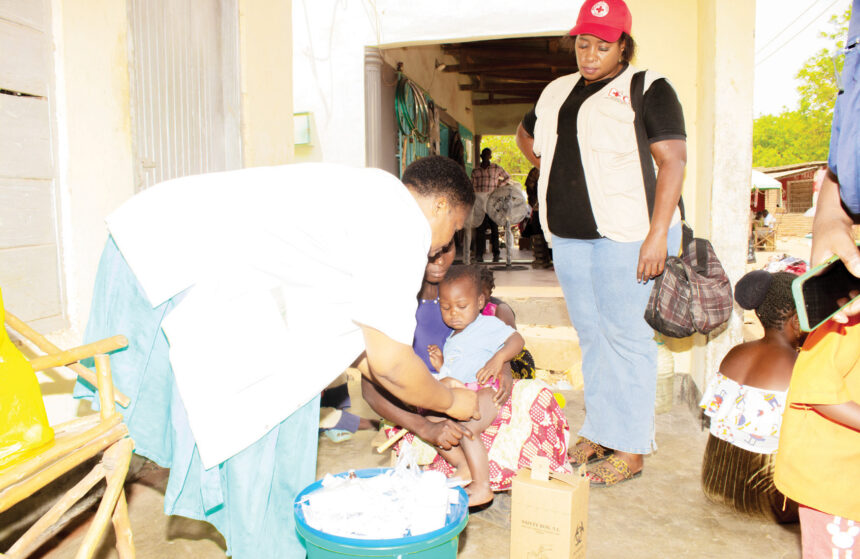
Amid the everyday chaos, something out of place has appeared. A vaccine cooler box, a registration book and a health worker in uniform.
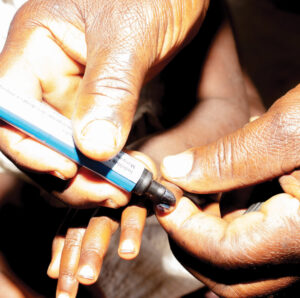
It is a Measles-Rubella vaccination post. For once, mothers do not have to leave the market to find healthcare because healthcare has come to them.
- Advertisement -
When the Ministry of Health launched the Measles- Rubella campaign in Nsanje, it partnered with the Malawi Red Cross Society (MRCS), health surveillance assistants, clinical officers and community leaders to ensure no child is left behind.
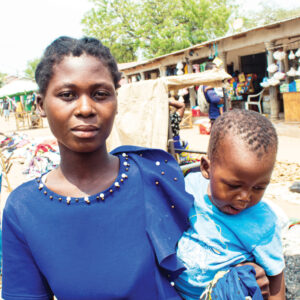
For 21-year-old Enelles Peter from Malikombe Village, the partnership made all the difference.
Her stall is her livelihood and closing it to walk to a hospital is not an option. She did not even know the campaign had started.
“After a Red Cross volunteer briefed me about the exercise, I immediately paused what I was doing at the market and went straight to the medical personnel to have my daughter vaccinated,” Peter says.
- Advertisement -
- Advertisement -
Fania Peterson from Nyanthana Village felt the same relief.
“I thought it wise to vaccinate my child to protect her from getting the disease and contain it from further spread,” Peterson said after her child received the jab between two merchandise stalls.
The turnout, with mothers stepping forward with their children, is supported by vaccination teams taking services closer to communities.
With support from MRCS, vaccines and equipment are being ferried daily to Kalemba Hospital, Sorgin Health Centre and outreach points such as Chisamba 2 Village.
Supervisors are also being facilitated to monitor the campaign in hard-to-reach areas.
MRCS has trained 100 volunteers for the three-month, K70 million project funded by the International Federation of Red Cross and Red Crescent Societies.
The volunteers are moving from house to house, identifying children aged nine months to nine years and encouraging parents to have them vaccinated.
“We visit every household to check if they have a child eligible to receive the vaccine. If there is one, we approach their parents and encourage them to have their children vaccinated after explaining the dangers of measles,” Rita Nota, one of the trained volunteers, recounts.
Nota adds that the training they received from MRCS equipped them with the knowledge and skills to convince parents.
At Kalemba Hospital, Clinical Officer Esme Abraham says the response has been encouraging.
“We are confident that we will achieve our target. We are impressed with the turnout in the first few days,” Abraham says.
For Chisomo Kamwendo, MRCS District Manager for Nsanje, the campaign is about more than vaccination coverage. It is about inclusion.
Kamwendo explains that the volunteers are conducting community sensitisation and social mobilisation, sharing accurate information about measles and vaccination, encouraging parents and caregivers to bring eligible children for vaccination and collecting and referring community feedback.
“MRCS is complementing government efforts to ensure communities are well informed, engaged and able to access vaccination services,” he says.
Kamwendo adds that the work is guided by three principles namely, Protection, Gender and Inclusion, Community Engagement and Accountability and Dignity, Access, Participation and Safety.
“We want to ensure that no child or community member is left behind because of disability, gender, location, social status, distance or other barriers,” he says.
As of last Wednesday, Nsanje District had recorded two deaths and 378 measles cases, according to District Health Promotions Officer George Mbotwa.
About 118,000 children are targeted for the Measles- Rubella vaccine in the district. The campaign started on Monday and ends today.
Malawi is conducting the Measles-Rubella Supplementary Vaccination Campaign in response to continued measles outbreaks and gaps in immunisation coverage.
The Ministry of Health is targeting children aged nine months to nine years, regardless of their previous vaccination status, to close immunity gaps and help interrupt transmission.
The campaign also includes Vitamin A supplementation for eligible children.
Meanwhile, the Ministry of Health has said some districts are recording unusually high numbers of measles cases, with the country also facing challenges in maintaining uptake of vaccines given during the second year of life.