By Jack McBrams:
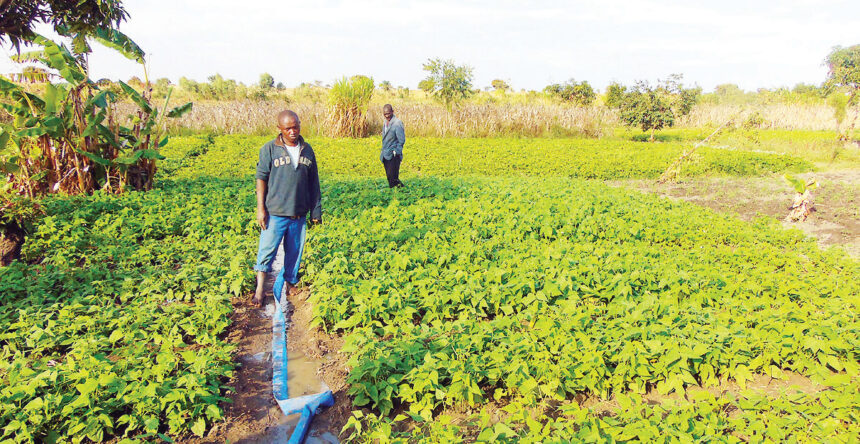
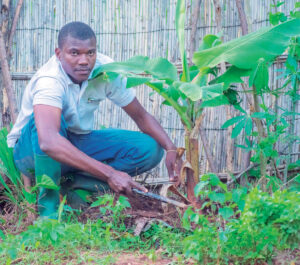
The mid-morning sun casts long shadows across a small demonstration field in Mchinji where a group of young farmers watches 27-year-old Daniel Chibwe carve a shallow trench into the soil.
It looks simple: just a line cut into the earth, but for Daniel and the trainees, it marks a new way of thinking about agriculture.
It is a swale, a water-harvesting structure rooted in permaculture and a small, slow solution he believes could reshape Malawi’s food future.
Mlatho Farms and the Agri-Learning Hub, the youth-led enterprise Daniel founded, was born from the pressures of youth unemployment and an increasingly unpredictable climate.
- Advertisement -
Daniel saw young people complete school only to return to idleness while the land they relied on suffered from erratic rains, depleted soils and persistent pests.
“I realised that few young Malawians were receiving practical tools to respond to these challenges. What was needed was a model that encouraged manageable, incremental changes while still supporting larger ambitions for farms and communities,” he says.
From this, Mlatho’s mission emerged: to help youth and surrounding communities adopt climate-smart agriculture and entrepreneurial thinking.
The Permaculture Awareness Course, Mlatho’s main training programme, reflects this approach.
- Advertisement -
- Advertisement -
Over five days, participants engage in fieldwork and theory covering agroecology, integrated pest management, soil rehabilitation and water systems.
They learn to make natural pesticides, produce organic manure from household waste and turn subsistence farming into sustainable agribusiness.
For many, it is the first time agriculture appears as an intellectual pursuit rather than inherited labour.
Daniel has witnessed dramatic transformations. Some trainees return home seeing farming as a viable enterprise.
At Magawa Secondary School, where Mlatho runs a permaculture club, students apply the techniques immediately after their Malawi School Certificate of Examinations, setting up small homestead gardens as they plan their futures.
One memorable alumna, Gertrude Kalikokha, came as an attachment student and later cultivated an acre of irrigated beans using Mlatho’s principles.
Mlatho’s profile has grown. In 2024, grants from partners such as Permaculture Australia and the Aspire Leaders Programme allowed the organisation to train farmers across Mchinji and support youth experimenting with value addition.
Funding from the Tony Elumelu Entrepreneurship Programme later supported a cooking-oil project that will benefit young farmers.
Daniel sees these developments as proof that young Malawians can thrive when given small chances.
Scaling has come at a personal cost. Daniel spends long hours on the road with limited resources and carries the doubts of those who struggle to see his vision.
He accepts this as part of the journey, saying, “It takes a lot of energy to keep believing when others don’t. But if you stop, the dream dies.”
Mlatho’s visibility rose when the Alliance for a Green Revolution in Africa, through its Youth Entrepreneurship for the Future of Food and Agriculture initiative, sponsored Daniel to attend the Africa Food Systems Forum in Senegal.
He describes it as a turning point because it expanded the scale of his imagination.
There, he met young farmers from across Africa who were commercialising organic products, building export-ready brands and securing investment.
These connections broadened both his network and his sense of what Mlatho could become.
Through the same network, Daniel later received an invitation from the Pan African Farmers Organisation to join their delegation to the World Food Forum in Italy, though he could not attend due to limited resources.
The invitation signalled that Mlatho was becoming part of a wider continental conversation about youth and agriculture.
His most recent milestone is one he speaks of with disbelief. In January 2026, he will represent Malawi at the Global Forum for Food and Agriculture and the Young Farmers’ Forum in Germany, joining only 20 young farmers selected worldwide.
He hopes to learn, meet investors and return with insights that can be applied at home. For Malawi, he says, the opportunity shows that its youth can compete globally not as beneficiaries but as innovators.
“Looking ahead, I envision an agroecology training campus able to host young Africans for extended periods along with a line of value-added organic products under the Mlatho name,” Daniel says.
He wants partnerships, even equity partnerships, that can help Mlatho grow. “It is better to own five percent of a million-dollar company,” he says, “than 100 percent of a billion-kwacha dream.”
Back in the demonstration plot, as Daniel brushes soil from his hands and gathers the young farmers under a mango tree for the next lesson, the promise of that future feels tangible.