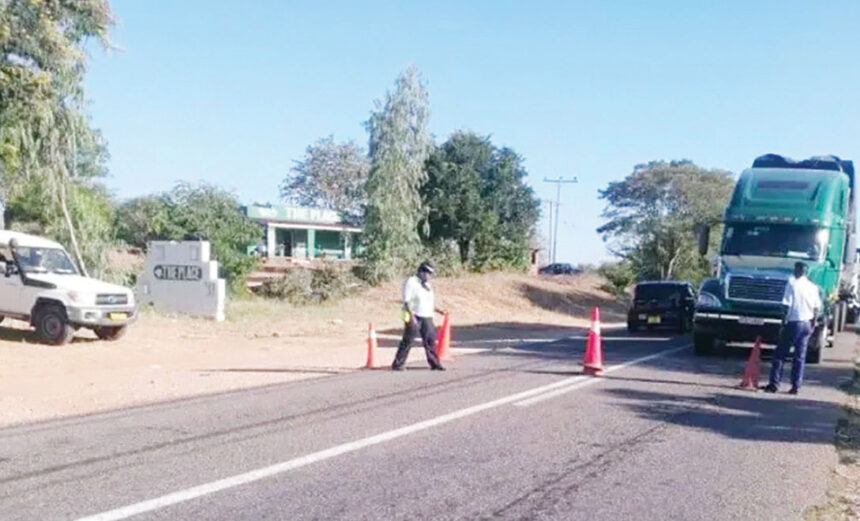

Steve Yohane is so convinced that Malawi Police Service officers treat every cross-border trader as a criminal that it would take him ages to believe otherwise.
To buttress his point, the Cross- Border Traders Association of Malawi president points at “some unnecessary roadblocks that are strewn across the country”.
“Take, for instance, the road from Mchinji Boma to Lilongwe,” he points out.
According to the Roads Authority (RA), Mchinji Boma is located 12 kilometres (km) from the Zambian border and 109 km from the capital city of Lilongwe.
It further indicates that Malawi’s designated public road network consists of 15,451km of roads, out of which 26 percent (4,038km) is paved.
- Advertisement -
RA indicates that the rest–that is, 11,413km, which represents 74 percent of the network–is either earth or gravel.
“The public road network is classified into five main categories: Main; secondary; tertiary; urban; and district.
Therefore, in the case of the Lilongwe-Mchinji Road, Yohane is referring to a paved and main road; one he feels is crowded with roadblocks that do no other work than to hinder trade.
“For your information, the road from Mwami/Mchinji One Stop Border Post (OSBP) in Mchinji District to Lilongwe is strewn with 14-plus roadblocks that do nothing better than to inconvenience cross-broader traders,” Yohane stresses.
- Advertisement -
- Advertisement -
“Fourteen-plus roadblocks for what? This is a free country,” he adds, shaking his head.
He has been vocal on the issue whenever he is invited to ‘Strengthening Malawi’s Regional Trade through The Promotion of Transparent and Predictable Regulatory Framework’ engagement meetings on non-tariff barriers.
According to the United Kingdom’s Institute for Government, a non-tariff barrier “is any measure, other than a customs tariff, that acts as a barrier to international trade”.
Yohane says when Malawi and Zambia’s heads of State opened the OSBP in the Central Region district, he was convinced that its goal of easing trade would be shared by those who man roadblocks in the country.
“So far, there is no such indicator,” he says.
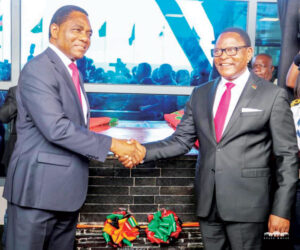
The facility was commissioned by Malawi’s Head of State and Government Lazarus Chakwera and Hakainde Hichilema of neighbouring Zambia on December 7 2023.
It is an integral part of the Nacala Transport Corridor, a brainchild of the Southern African Development Community (Sadc).
According to Sadc, the corridor is located on the Great East Road (T4) in Zambia and the M12 in Malawi, connecting Zambia and Malawi to the port of Nacala in Mozambique.
The regional grouping says the trade route is poised to create a win-win situation due to the simplicity of movement provided by the OSBP, citing the fact that it has combined two stops of adjourning border controls into one facility.
However, Yohane claims that some public and civil servants in Malawi seem poised to frustrate such a move.
“What worries us is that the distance from the border post in Mchinji to Lilongwe is approximately 109 kilometres. Why should we have all these roadblocks? To make matters worse, police personnel seem not to understand some issues. For instance, we, cross-border traders, are sometimes asked to show them our passports while we are in the interior of Malawi. Some police officers even ask for travelling documents from us.
“They sometimes ask for Malawi Revenue Authority (MRA) documentation and, yet, the country has specific agencies that specialise in such issues [passports and tax issues].
“In the end, we, cross-border traders, lose out on contracts to supply goods and services because people at these roadblocks delay us and our buyers end up buying from other suppliers.
“We have had cases where goods have gone bad after being detained unnecessarily for months on end. This must change if we, as a country, are to make inroads in cross-border trade. We must emulate other countries in the Sadc region, notably Zambia,” Yohane explains.
He adds that should the practices persist, Malawi may lose out on trade facilitation opportunities while other Sadc countries are meeting their socio-economic goals.
Yohane also implores officials in government ministries, departments and agencies to be giving instant feedback to traders so that, together, they can iron out issues that make cross-border trade a living hell for them.
The Malawi Confederation of Chambers of Commerce and Industry (MCCCI) has weighed in on the issue of non-tariff barriers as it has been engaging cross-border traders, Ministry of Trade, Ministry of Transport, Ministry of Agriculture, MRA, Malawi Bureau of Standards, Department of Immigration and Citizenship Services and Malawi Police Service, among other stakeholders, on the issue.

MCCCI Chief Executive Officer Daisy Kambalame indicates that apart from the issue of taxes, there could be other underlying factors that negatively affect service provision to cross-border traders.
“We [as MCCCI] have joined hands with a consortium of [officials] from the ministries of Agriculture and Trade to capture the experiences of cross-border traders so that we understand the non-tariff barriers they face.
“We also want them to understand applicable laws because we realise that if people have a different understanding of laws, law application will differ. We, therefore, want to create an environment where there is clarity and transparency,” Kambalame explained.
“Sometimes, people lack clarity on rules and what documentation to bring to those who process documents at borders and [roadblocks]. The good thing is that there is now a portal they can go to. That will give us a chance to focus on exports, which is another goal we must pursue,” she says.
She adds that appreciating challenges that cross-border traders face would put stakeholders in a position to address them and put Malawi in the right position to benefit from the African Continental Free Trade Area.
This is a free trade area encompassing most of Africa. It was established in 2018 through the African Continental Free Trade Agreement, which has 43 parties.
On her part, Ministry of Trade and Industry Director of Administration Sphiwe Msiska indicates that engagement is key to the facilitation of trade both in Malawi and outside Malawi.
“We appreciate that cross-border trade, which is often run by small-scale businesses, is important to the country,” Msiska said.
She, however, says the issue of roadblocks, which cross-border traders seem to be at pains with, is a national security issue that is beyond their scope.
Indeed, Malawi Police Service national spokesperson Peter Kalaya says roadblocks are one of the tools they use to tighten security in the country.
Kalaya says through roadblocks, police officers have managed to arrest criminals.
It is a point that Immigration Department and Citizenship Services spokesperson Wellington Chiponde reiterates.
He says through roadblocks that they erect from time to time, they have managed to corner irregular immigrants, some of whom could be a risk to national security.
Chiponde therefore stresses that roadblocks are a necessary evil.
“We, as a department, are aware that irregular migration is perpetuated by some unpatriotic citizens and residents who abet illegal entry of foreign nationals into the country. Suffice to say that our officers are working around the clock to combat the vice,” Chiponde points out.
Apart from the Malawi Police Service and the Department of Immigration and Citizenship Services, others that erect roadblocks in the country include MRA as well as departments of forestry, parks and wildlife personnel.
MRA Head of Corporate Affairs Steven Kapoloma acknowledges that they sometimes hire law enforcers to man roadblocks that they [MRA] erect for purposes of tax collection, verification and others.
On his part, Department of Parks and Wildlife Director Brighton Kumchedwa indicates that if roadblocks help the country stem cases of wildlife and other crime, they, indeed, serve a good purpose.
In the country, wild animals such as pangolins are hunted right, left and centre.
Ivory is also sought after, putting the country in a fix, in terms of enforcing laws through roadblocks use or opening the roadblocks to traders and let criminal suspects slip through law enforcers’ fingers in the name of promoting trade.
This notwithstanding, Yohane demands a change of approach.
“Officials can, for instance, consider adopting the joint-service provision approach so that cross-border traders can be spared from the problems they face when they separately attend to government officials who ask for different things at the many roadblocks that are spread across the country,” Yohane says, conviction in what he is saying written all over his face.