









 Many Malawians are struggling to meet their most basic needs and there are growing fears of another troubled harvest following the persistence of dry spells in several parts of the country.
Food insecurity, high prices and uncertainty about incomes continue to shape everyday life for ordinary citizens, especially those in rural areas who rely heavily on agriculture for survival.
However, it would be unfair to suggest that nothing positive is happening.
There are signs, however modest, that some efforts are being made to put the economy back on track.
Of course, no serious economic recovery can be achieved overnight, particularly after years of policy missteps and structural weaknesses.
- Advertisement -
What matters is the direction of travel and in this regard, there is at least some evidence of progress.
One noticeable change is the sense that someone is now firmly in charge of economic policy.
When one draws comparisons with the previous administration, it becomes clear that Malawi did not have the right person in the finance portfolio at a time when the country was in desperate need of strong and competent leadership.
Economic management requires clarity, discipline and a willingness to make difficult decisions, qualities that were largely absent in the past.
- Advertisement -
- Advertisement -
It bears repeating that the former minister of finance appeared not to understand the demands of the role.
At that time, President Lazarus Chakwera paid little attention to persistent concerns raised by Malawians about the need to appoint a capable individual to such a critical position.
This lack of responsiveness came at a high cost, as economic challenges deepened while corrective action was delayed.
Poor coordination, weak fiscal discipline and an apparent absence of strategic direction all contributed to the deterioration of the economy.
Today, while the country is far from where it should be Malawi at least has a minister of finance who appears to be working.
Some of us have repeatedly warned about the dangers of continuously borrowing to finance consumption rather than productive investment.
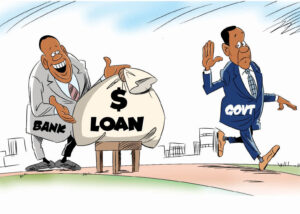
For years, Malawi has been choked by public borrowing, with very little effort made to curb the growing appetite for debt.
Recently, the government rejected multibillion kwacha bids offered during a Treasury bills auction, raising zero kwacha.
This was not an isolated incident. On several occasions, authorities have turned down bids, a move that Finance Minister Joseph Mwanamvekha says is aimed at taming domestic borrowing and prioritising fiscal consolidation and debt sustainability.
This approach appears to signal a shift in borrowing strategy as the government seeks to reduce debt servicing costs, which are consuming over K2 trillion every year.
High levels of public debt divert large portions of government revenue towards interest payments, leaving fewer resources for essential services such as health, education and infrastructure.
Over time, this weakens the state’s capacity to support growth and protect vulnerable citizens.
Furthermore, excessive domestic borrowing crowds out the private sector. When government absorbs a large share of available credit, banks and other financial institutions have less capacity to lend to businesses.
This drives up interest rates and makes borrowing more expensive for entrepreneurs, farmers and manufacturers.
As a result, private investment is suppressed, job creation slows and innovation suffers.
An economy dominated by government borrowing struggles to grow because productive sectors are starved of the financing they need to expand.
There has also been some encouraging movement on inflation. Inflation has remained stable for three consecutive months, with hopes among experts that it may decline further.
This stability is largely driven by falling food prices, particularly maize, which is the main driver of inflation in Malawi.
Encouragingly, maize prices have been dropping during a period when they would normally be rising.
Those who hoarded maize in anticipation of higher prices are now calling for permission to export it after realising that the local market cannot absorb their stocks.
The most unfortunate aspect of this situation is that many of these traders did not grow the maize themselves.
Instead, they purchased it from smallholder farmers at very low prices, only to speculate for profit.
This behaviour highlights the need for better market regulation and stronger protection for vulnerable farmers.
Overall, there is a growing perception that Malawi now has a finance minister who is actively engaged, unlike the previous one who appeared largely clueless about the economy.
That said, Malawians rightly expect more. Mwanamvekha and his team face an enormous task in restoring stability, rebuilding confidence and placing the economy on a sustainable path.
The early signs are cautiously encouraging but sustained commitment and bold reforms will be essential if the country is to truly recover.


