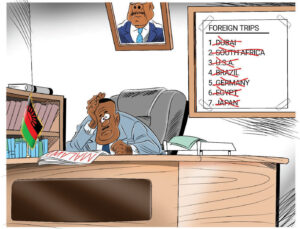
 Malawi has long grappled with the challenge of scarce resources. Every kwacha counts, yet history has shown us that corruption has persistently drained the coffers of this nation.
From ghost workers to inflated contracts, and from dubious procurements to unchecked travel allowances, the public purse has often been at the mercy of unscrupulous practices.
However, there is a glimmer of hope. In recent weeks, several measures have been rolled out with a clear intention to save the resources we have and to restore some fiscal discipline.
While some may view these steps as mere paperwork or symbolic gestures, they signal recognition by those at the helm that Malawi cannot continue down a path of uncontrolled expenditure and wastage.
One of the immediate actions has been the reduction of both external and local travel by public officers.
- Advertisement -
This may seem like a small thing, but consider the magnitude of savings when thousands of government officials, at all levels, cut down on flights, fuel allowances and accommodation costs.
In a country where the budget is perpetually under strain, every kwacha saved can be redirected to pressing areas like health, education and infrastructure.
Closely linked to this is the suspension of non-essential procurements. Offices across the civil service have been asked to put on hold purchases that are not immediately necessary for operations.
This step, though unpopular with some suppliers and contractors, is aimed at ensuring that money is spent only where it is truly needed.
- Advertisement -
- Advertisement -
By pausing unnecessary spending, the government can focus on priority items, especially those that impact service delivery directly.
Equally significant, though contentious, is the moratorium on recruitment. On the surface, halting hiring saves money on salaries, allowances and associated benefits.
Yet, this has its own consequences. For one, some departments are left understaffed, which can slow down service delivery and place additional burden on existing employees.
Hospitals, schools and other critical institutions may find it difficult to function optimally without the right number of staff.
Nevertheless, in the short term, this move is a reflection of fiscal prudence, signalling that every new recruit must be justified in terms of value to the public service.
Perhaps the most robust measure introduced is the vetting of all procurements by the Anti-Corruption Bureau (ACB).
This step is vital because many of Malawi’s financial scandals have historically originated in procurement processes; contracts awarded without proper tendering, inflated invoices, and ghost suppliers.
With ACB scrutiny, there is at least a layer of oversight designed to prevent misuse before it occurs, rather than reacting after the money is gone.
Taken together, these steps reflect a clear intent to clean up the fiscal space
Yet, we must be realistic. Cleaning the public purse is a battle that cannot be won overnight. Corruption in Malawi is systemic, embedded over decades and any meaningful reform will require persistence, vigilance, and, most importantly, adherence to the measures already announced.
It is adherence, rather than the mere announcement of measures, that will determine success.
Too often in Malawi, policies are introduced with fanfare only to fade away into ineffectiveness because they are not followed through.
Ministries, departments and agencies must now internalise these rules, not as temporary inconveniences, but as essential frameworks for protecting public money.
Interestingly, these principles are now being extended to the health sector, where corruption has direct consequences on lives.
The ACB has recently urged hospitals to adopt basic transparency measures such as visible duty rosters, uniforms and name tags for staff.
While these steps may appear minor, they are critical in curbing illicit practices like absenteeism, ghost staff claims and corruption.
When patients know exactly who is on duty and when staff are identifiable, the room for abuse diminishes significantly.
If all these measures are fully implemented, not just in government offices, but across institutions such as hospitals, there is reason to hope.
The vision is not just to save money but to create a culture of professionalism, and efficiency.
A country where resources are protected and public servants are held to high standards is a country more likely to deliver the services citizens deserve.
Of course, cynics may argue that every new initiative faces the same fate as its predecessors: strong beginnings that gradually lose momentum.
That is why sustained political will, continuous oversight and citizen engagement are indispensable.
Malawi has seen too many good policies fail due to half-hearted implementation or active resistance from those who benefit from the status quo