By Charles Mpaka:
Southern Africa is grappling with acute food shortage caused by one of the most extreme droughts to have hit the region in recent years.
Triggered by El-Nino, the drought scorched the 2023-2024 farming season, plunging more than 61 million people into emergency food aid situation as at May 2024, according to the United Nations Office for the Coordination of Humanitarian Affairs.
Just as globally, the region is trapped in the spiral of climate crises that are hitting countries back to back.
For instance, in March 2023, Malawi, Mozambique and Madagascar were also battered by Cyclone Freddy which killed thousands of people, displaced hundreds of thousands more and swept away hundreds of thousands of hectares of crops.
- Advertisement -
At the time the current drought hit, these communities had not recovered from effects of Cyclone Freddy and a series of other natural shocks over the past decade.
Worryingly, science shows that these climate disasters will keep occurring with increased frequency and severity.
As these catastrophes keep communities in their grip, biodiversity protection is also bearing the brunt.
When communities that are predominantly reliant on agriculture for livelihood have their crops burnt down by drought or swept away by floods, they will turn to other means to survive — including poaching and encroachment of protected areas to extract resources for food or income.
- Advertisement -
- Advertisement -

Conversely, as Phillip Kuvawoga, Director of Landscape Programme at International Fund for Animal Welfare (Ifaw) explains, for Southern Africa, these natural disasters exacerbate human and wildlife conflict as animals roam out of protected areas in search of food and water, in the process negatively impacting an already food insecure population.
The effects of climate disasters over wildlife conservation are challenging but they also increasingly highlight the need for adoption of impactful approaches that make both humans’ livelihoods and wildlife conservation resilient to climate change.
This nexus of climate crisis, human welfare and biodiversity conservation makes a strong case for nature-based solutions.
Ifaw pushed for this approach at COP28 in Dubai in December 2023 where it also unveiled a report which amplifies what nature-based solutions can achieve for climate, biodiversity and humans.
Nature-based solutions put nature at the heart of climate action, Ifaw argues. They demonstrate that nature is not just a victim of climate change but also a powerful ally in humanity’s fight to heal the Earth from climate chaos.
Harnessing nature-based solutions means addressing human-induced climate change while also ending biodiversity loss, restoring ecosystems and protecting wild animal populations.
Scientists back this approach.
In one study published in the journal Nature in March 2023, researchers observe that some quarters view climate solutions such as carbon capture and storage as having the additional benefit of protecting habitats and landscapes to conserve animal species diversity. However, the 15 scientists argue that this reasoning the additional benefit of protecting habitats and landscapes to conserve animal species diversity. However, the 15 scientists argue that this reasoning underestimates the role animals themselves play in controlling the carbon cycle.
They say protecting and restoring wild animals and their functional roles can enhance natural carbon capture and storage.
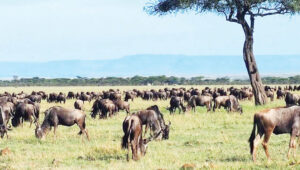
In illustration, they observe that when a rinderpest disease outbreak wiped out wildebeest population in the Serengeti plains in Kenya between the 1930s and 1960s, the grass that the animals would usually graze on built up as fuel, resulting in more frequent and intense wildfires plaguing the Serengeti ecosystem and releasing carbon into the atmosphere.
Since the restoration of the wildebeest population, the Serengeti is now absorbing an estimated 4.4 million more tonnes of carbon annually.
The researchers therefore call for “new thinking that includes the restoration and conservation of wild animals and their ecosystem roles as a key component of natural climate solutions.”
Ifaw advocates better integration of wildlife conservation into climate actions plans.
There is need to ensure that action to restore degraded landscapes is not prioritised at the expense of action to protect and conserve existing ecosystems and biodiversity. Actions should also account for the importance of wildlife and wildlife conservation for carbon capture and climate adaptation.
To implement these measures successfully, it requires adequate financing. Ifaw therefore challenges international finance providers to recognize the scientific evidence that demonstrate the extent to which wildlife and wildlife conservation activities can contribute to climate mitigation and adaptation.
Further, Ifaw believes that a lot can be achieved by also empowering communities themselves to practice nature-based solutions right around their livelihoods. As such, working with partners such as Comaco [Community Markets for Conservation] and smallholder farmers, Ifaw is promoting agricultural practices such as agroforestry and land use planning and forest management through natural regeneration, beekeeping and honey processing in communities across the Malawi-Zambia Transfrontier Conservation Area.
That’s because nature-based solutions make both wildlife and humans more resilient to climate impacts.
What is required is an “an integrated and holistic approach to support climate-resilient landscapes and communities”, Kuvawoga says.