





By Dalitso Kampira, contributor:
Every district has its own identity shaped by the traditions and beliefs of its people.
Thyolo is known across Malawi for its banana production and it is almost impossible to tell the district’s story without mentioning this nutritious fruit.
It is said that in the past, when a baby cried, some mothers in the Southern Region district would soothe their child with a banana instead of breastfeeding.
But that changed when the once-evergreen banana plantations began to wither and die.
- Advertisement -
The decline affected more than just the farmers. Entire communities in Thyolo, which had long depended on banana production for income and food security, were left struggling.
Now, thanks to the Centre for Agriculture Transformation (CAT), the situation is changing. Through its banana revitalisation project, CAT has helped to restore plantations and improve living standards in local communities.
Working closely with the District Agriculture Office and the Extension Planning Areas (EPAs), CAT identified Masambanjati EPA in Traditional Authority (TA) Khwethemule as a focal point for the initiative with particular emphasis on Mafunga Village.
Masambanjati EPA, which covers TAs Khwethemule, Mbawera and Changata, has about 39,135 farmers. Of these, 1,000 farmers from Mafunga Village have already benefited by receiving banana suckers.
- Advertisement -
- Advertisement -
“I was just an ordinary farmer growing bananas and selling them in town but after the virus destroyed my crops, I lost all hope,” says Henry Makungwa, a lead farmer from Mafunga Village.
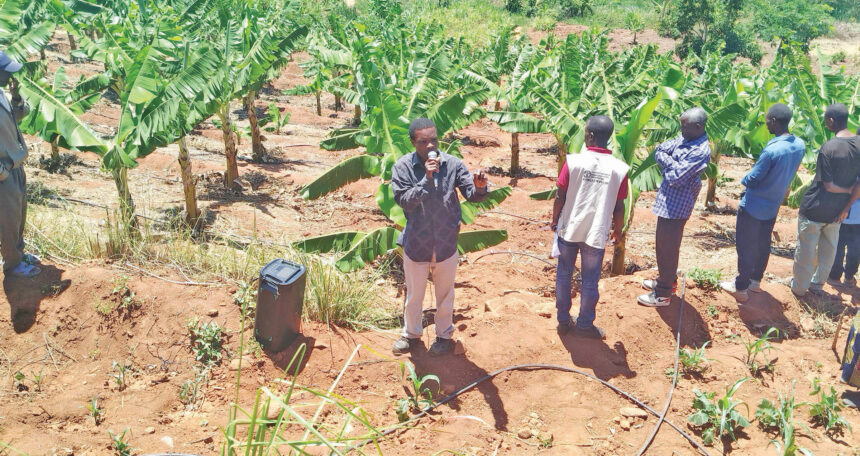
With support from CAT and the agriculture office, Makungwa has re-established his banana farm.
Today, his field serves as a demonstration site where other farmers come to learn modern banana-growing techniques. His story has inspired others and helped improve livelihoods across the area.
Mafunga residents are now benefiting from selling bananas and using them as a staple food.
“After meeting our food needs and selling bananas, I plan to start rearing chickens using the income I earn. I already keep goats so this is the next step,” Makungwa explains.
According to Christopher Kamwaza, an extension worker at Masambanjati EPA, collaboration has been key to the project’s success.
Kamwaza recounts that farmers have organised themselves into cooperatives to ensure the continuity of the programme with support from CAT and the government.
“CAT has provided us with a high-yield variety of banana which is expected to improve rural livelihoods,” Kamwaza explains.
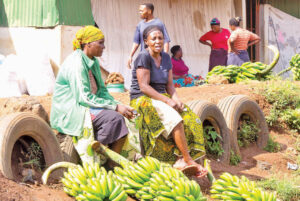
Both men and women have benefited from the initiative. In the past, they relied heavily on bananas to sustain their families, often transporting truckloads to Blantyre and Lilongwe for sale.
Margret Nkhalamba, another farmer from Mafunga Village, shares her story. She says her parents raised her and paid their children’s school fees through banana farming.
“Today I can read and write because of it. With this new project, I am able to build a house and educate my children,” she says.
Thyolo Crop Protection Officer Nani Lazalo urges farmers to follow proper planting and management practices to increase production.
“By following the principles of banana cultivation and learning from demonstration sites, farmers can produce high-quality bananas that are in high demand on the market,” Lazalo says.
Senior Chief Khwethemule praises the initiative for restoring banana fields in the hilly district.
He praised CAT for helping to restore lost banana varieties in Thyolo, saying it has helped reduce hunger in the district.
For his part, Thyolo District Council Director of Agricultural Services Jackson Mvula describes the programme as a model of effective public-private partnership.
“It focused on two main goals: providing planting materials and sharing technical knowledge on modern banana cultivation.
“Over 200 farmers have been trained and their skills are now spreading to others, increasing yields across the area,” Mvula explains.
He adds that bananas play a vital role in food security because the income from sales allows farmers to buy other essentials for their families.
Before the Banana Bunchy Virus, many farmers built iron-roofed houses and paid school fees using banana profits.
As CAT’s current project phase ends, Executive Officer Nkhoma says sustainability depends on farmers taking ownership.
“Restoring banana production in Thyolo was not easy but thanks to the communities’ commitment and co-financing from the National Bank, the project has been fruitful,” Nkhoma says.
He adds that Malawi’s dependence on imported bananas from Tanzania affects the national economy.
“By building local capacity and resilience, Malawi can one day export bananas instead of importing them, boosting foreign exchange earnings,” he adds.