By Charles Mkoka:
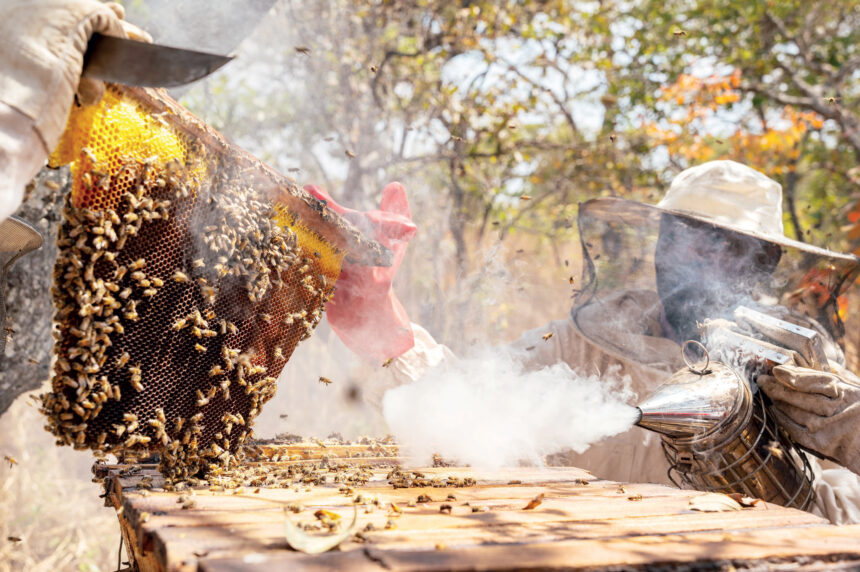
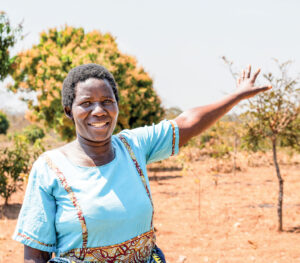
Growing up in Bilala Village on the outskirts of Kasungu National Park (KNP), Chricy Banda learned beekeeping from her father, who kept bees in traditional hives made from the bark of indigenous trees.
The process was simple but came at an environmental cost.
“My father used to remove bark from trees to make traditional hives. The hives were then covered with thatch grass on both ends, leaving a small entrance for the bees,” Banda, a senior lead farmer in climate-smart agriculture, says.
Stripping bark from living trees weakens or kills them. Traditional hives also generally produce lower honey yields than modern ones.
- Advertisement -
Banda’s turning point came in 2014, when conservationists began engaging communities around KNP in sustainable livelihood opportunities.
She was among the first beneficiaries trained in improved and environmentally friendly beekeeping practices.
Her experience reflects the community-based conservation work supported by the International Fund for Animal Welfare (Ifaw) through its flagship ‘Room to Roam’ initiative, which seeks to strengthen livelihoods while reducing pressure on natural resources.
From traditional hives to sustainable beekeeping
- Advertisement -
- Advertisement -
Since 2020, Ifaw has helped distribute 1,700 beehives to communities living along the periphery of KNP. Organised into clubs of about 10 members each, the groups manage around 15 hives.
Kasizika Beekeeping Club in the Chisinga area has grown from four hives in 2018 to an apiary of 38 hives.
Recently, Ifaw supported intensive training for almost 400 beekeepers to improve their skills and increase the quality and quantity of honey produced.
Led by Honey Products Limited, an organisation focused on environmental conservation and creating economic opportunities for community beekeepers, the training covered improved production methods, processing, branding and commercialisation.
The average output is currently about five kilogrammes (kg) of honey per hive, while properly managed hives can produce up to 45kg per season.
“We are hoping this might be possible with the December harvest,” Phillip Namagonya, Ifaw Projects Officer says. “This could be a game changer for the incomes of local beekeepers.”
Poverty and forest loss are closely linked in Malawi. As rural families seek income, forests face growing pressure from activities such as charcoal production.
Beekeeping offers an alternative source of income while creating an incentive to protect the forests on which bees depend.
Honey and beeswax are among Malawi’s important non-wood forest products.
The Malawi Beekeepers Association has about 5,000 active producers, while annual honey production is estimated at between 5,000 and 8,000 tonnes.
Modern hives and improved beekeeping methods can increase yields and household income. The economic value of beekeeping can also encourage communities to protect forests rather than turn to illegal charcoal production.
Healthy forests provide the flowering plants and trees that bees need, linking beekeeping to wider ecosystem health.
Expanding the sector while protecting bee forage could therefore support livelihoods and reduce pressure on forests.
Covering approximately 2,316 square kilometres, KNP has a long history of human interaction with the surrounding landscape.
Formal conservation measures began in 1930 when the area was declared a Game Reserve. It was later upgraded to park status under the Parks and Wildlife Act in 1970.
Today, communities surrounding the park continue to depend on natural resources for their livelihoods, while population growth is placing increasing pressure on forests and wildlife.
Sustainable livelihood opportunities are therefore becoming increasingly important.
Community livelihoods
Ifaw, in partnership with the Malawi Department of National Parks and Wildlife (DNPW), is supporting efforts to strengthen community livelihoods while reducing pressure on the park’s natural resources through the Room to Roam initiative.

Beekeeping has emerged as a key conservation enterprise, with the potential to generate income without destroying forests or wildlife habitats.
“We believe beekeeping, when done right, can transform people’s livelihoods around KNP, thereby reducing the pressure to poach animals and destroy trees for charcoal production,” Bruce Sosola, Ifaw Country Director for Malawi says.
“Honey has proven to be a commercially viable business in the conservation sector, with steady and promising prices locally.”
The benefits extend beyond honey production. Bees play an important ecological role through pollination, supporting agricultural production, plant diversity and healthy ecosystems.
Honey and other bee products can also contribute to household nutrition, traditional medicine and income generation.
The beekeeping training team, led by Honey Products’ Chancy Mhango, travelled from south to north along Kasungu’s elephant-proof fence. The final training session of the week took place at Chisinga, a community on the Malawi-Zambia border.
“Many of the participants showed willingness to learn and committed themselves to practising beekeeping in a modern way.
“Their knowledge and practical understanding improved, strengthening prospects for better hive management and high-quality honey production in the coming seasons,” Mhango says.
The training team travelled with 4×4 vehicles loaded with beekeeping equipment, including honey presses, hives, smokers and protective suits, boots and gloves.
Participants of different ages attended indoor and outdoor sessions, carrying chairs, notebooks and pens to the training sites.
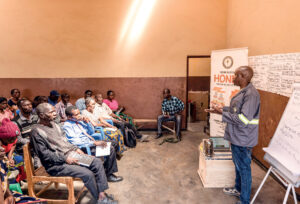
“The natural resources we heavily relied on decades ago can no longer sustain us all,” Mhango said during a training session at Katope Cooperative.
“We must reduce our high dependence on destructive activities such as illegal charcoal production. This generates short-term income but destroys the forest and the environment. Beekeeping is a conservation enterprise and a long-term income-generating activity.”
A 2007 study titled Charcoal: The Reality: A Study of Charcoal Consumption, Trade and Production in Malawi found that charcoal and firewood dominate Malawi’s energy mix.
It also described charcoal as a major domestic commodity whose production is often treated as either non-existent or illegal.
Bees as a deterrent to elephants
The situation highlights the need for sustainable livelihood options such as beekeeping for communities living close to protected areas.
An added benefit is the potential role of bees in reducing human-elephant conflict. The insects can deter elephants from raiding crop fields because elephants tend to avoid the noise and attacks associated with disturbed bee colonies.
“Bees have long been used as a key protector against human-elephant conflict. Communities have used beehive ‘fences’ for decades to protect themselves and their property from elephants,” Namagonya said.
Combined with the 133km elephant-proof fence built by Ifaw along Kasungu’s eastern boundary, beekeeping forms part of efforts to reduce conflict between communities and wildlife.
For Banda, who has seven children, adopting modern beekeeping and climate-smart farming methods has changed her outlook on the future.
“Since learning the new approach, I have been able to send my children to secondary school. I also rear chickens, doves and hares at home.
“I am now an advocate for sustainable beekeeping, climate-smart farming practices and community fence protection because it is more rewarding and environmentally friendly in the long term,” she said.
The Ifaw-DNPW community development initiative aligns with Malawi 2063, particularly the pillar on agricultural productivity and commercialisation and the enablers on human capital development and environmental sustainability.
For women like Banda, the benefits are measured not only in honey produced or income earned but also in the ability to support their families, invest in their children’s education and reduce dependence on activities that degrade the environment.