Given a chance, some community members who use water from Mudi River downstream would have abandoned that water source long ago. But, as THOMAS KACHERE writes, they have no choice.
On paper, Blantyre City Council (BCC), individuals, companies and organisations are doing their part in protecting the environment.
In reality, however, they are even worsening the situation.
A typical example is BCC which, instead of leading by example, is, in some cases, said to be contributing to the problem of pollution.
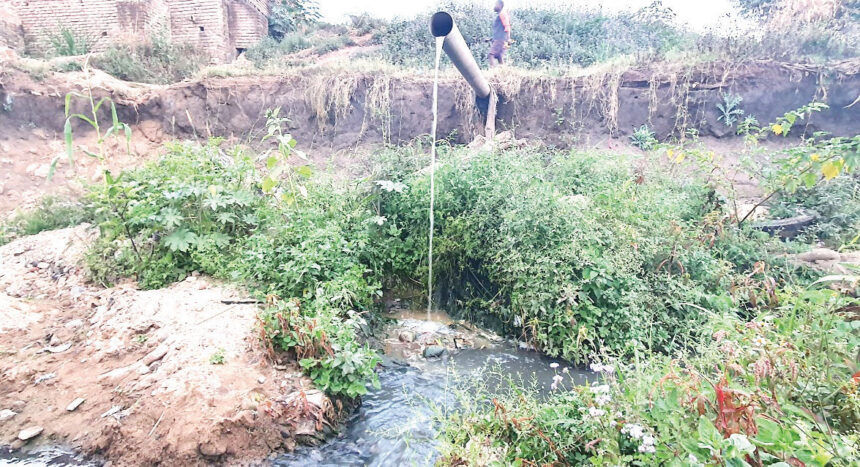
Just 200 metres from Blantyre Flea Market, a sewer pipe which BCC owns has been discharging human waste into Mudi River day in day out.
- Advertisement -
This, according to environmentalists, is putting lives of community members that use the water for domestic purposes at risk.
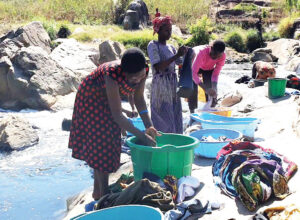
The water that is so opaque and stinky that one cannot look at it twice takes on a more transparent appearance downstream, where children swim and play freely in the water, bathing and throwing it at each other, while adults put it to more serious use— like bathing and washing Environmentalists are concerned that the community members could catch waterborne diseases, notably cholera. Memories are still fresh of people that lost their lives to cholera between March last year and March this year.
Ministry of Health records indicate that the disease has been endemic in Malawi since 1998, with seasonal outbreaks reported during the rainy season.
However, cholera came with a bang last year, when the first case was reported in Machinga District and, then, spread throughout the country to become one of the worst outbreaks in years.
- Advertisement -
- Advertisement -
The ministry and World Health Organisation indicate that by March 3 2023, the country had recorded 36,943 cases with 1,210 deaths.
Some of the practices that were cited as fuel for cholera are the careless dumping of diapers and discharging waste into rivers and streams.
As if this is not enough, some cities have been failing to stop sewer material from getting into rivers such as Mudi, despite that some unsuspecting community members use the same water for domestic purposes downstream.
I followed the river from Blantyre Flea Market, where I was welcomed by a terrible stench.
When I went downstream, I found people using the polluted water for washing, bathing and watering plants.
A Mrs Pensulo, who resides in Gaka area, pleaded with those polluting the source to consider people who use water from the river downstream.
“We are very much concerned with some people, organisations and companies’ tendency of polluting Mudi River because some of us rely on it as a source of water.
“This is despite that, sometimes, our children get skin diseases after getting in contact with the water. Remember, our children use the water for bathing,” she said.
Jazira Ishmael from Manase Township blamed companies and organisations for polluting the river.
“People, organisations and companies should find other means of disposing waste, other than pouring it into Mudi River. We, people who stay downstream, depend on the water for all purposes,” Ishmael said.
Meria Makaisa from Gaka said the waste should be buried somewhere instead of being deposited into the river.
Concerned Youth Organisation Executive Director Harvey Chimaliro expressed shock at the levels of pollution in Mudi River, saying it poses a threat to people that depend on its water.
“This is a very bad situation, one that should be addressed immediately to stem cases of cholera. We are coming from a situation where we were hard hit by cholera.
“As such, I am calling on Blantyre City Council and all those responsible to take appropriate action so that we do not have a recurrence of the cholera outbreak and other diseases,” Chimaliro said.
He further observed that wastewater from toilets and factories is a major environmental problem, such that it can cause degradation of aquatic ecosystems.
In addition, he said, contaminated water can harbour bacteria, some of which are the causative agent for diseases such as diarrhoea, cholera, dysentery, typhoid, hepatitis A and polio.
On the other hand, Executive Director for the Coordination Union for the Rehabilitation of the Environment Reginald Mumba blamed the authorities for the river’s current status.
“It is surprising that this has been happening for some time and, yet, Blantyre City Council officials have been failing to fix the sewer pipe. If it is a problem of funds, I think they can get the funds if they come up with a proposal and submit it to the government or any donor. I am sure it can be considered because the pollution is endangering lives of many people,” he said.
Responding to the issue, BCC Deputy Mayor Funny Balaba said the council receives complaints from service users pertaining to broken sewer lines but it has challenges in rectifying them within the recommended 24-hour period because of the scarcity of spares.
“Our sewer system is very old and, sometimes, we find it difficult to get spares in our markets because it is an outdated system. So, that could be another problem that culminates in us taking a long time to fix broken sewers.
“However, we are having a big project (Sanitation and Waste Water Management in Blantyre), which is coming and is funded by the World Bank. We are implementing it with Blantyre Water Board. Once that is done, the problem will be history soon,” Balaba said.
Sustainable Development Goal number six goes beyond drinking water, sanitation and hygiene to also address the issue of quality and sustainability of water resources, which are critical to the survival of people and the planet.
However, the attainment of the goal is at risk if problems such as that of broken sewer pipes persist.