




By Temwani Mgunda:
With high levels of chronic malnutrition during the period following the political transition in 1994, it was a must for the Government of Malawi to reach people, especially in the rural areas, with different services, including nutrition programmes. But for close to a decade, activities aimed at supporting nutrition in the country’s rural communities suffered.
This was largely because the people entrusted with the task—the homecraft workers—had been removed from the government system and their duties were transferred to the health surveillance assistants (HSAs) who, unfortunately, were overwhelmed with work as their duties included countless other health-related assignments other than promoting nutrition and at the same time they were under-equipped with resources.
“It was until 2004 that the Department of Nutrition was created and in 2009 nutrition community workers were recruited and deployed across the country. But a scaling up nutrition (Sun) gap analysis conducted later revealed that stunting was still high in the country,” recalls Felix Phiri, Director of Nutrition under the Ministry of Health.
Phiri says the analysis further established that the key driver of stunting was not food insecurity, but lack of behaviour change among Malawians in terms of dietary diversity. He further notes that for families to provide optimal nutrition and hygiene care to their small children, there was a need to reach them with nutrition education and water, sanitation and hygiene (Wash) messages, with the aim to trigger social behaviour change.
- Advertisement -
“This prompted us to reflect on developing a model that would be more empowering and community-led as well as cost-effective. Our reflection led to the birth of the care group model which is a community mobilization approach of organizing and training communities to promote nutrition behaviour change through increased coverage of caregivers and mothers,” Phiri explains.
He says it was believed that the approach could help operationalise the SUN movement, following challenges in reaching out to the target rural population with limited number of frontline workers.
Institutionalising the approach

According to Phiri, following the success registered by the care groups when they were first piloted, in 2017 government institutionalised the care group model, effectively making it become part of the country’s nutrition policy. This meant that it became the mandatory implementation structure for all development partners working in the nutrition sector.
- Advertisement -
“We noted that with the care group model in place, we made huge strides in improving nutrition in the country. Stunting reduced from 47 percent in 2009 to 37 percent in 2016,” the director of nutrition says, adding that acute malnutrition and Vitamin A deficiency were also successfully reduced.
GIZ Malawi Food and Nutrition Security Programme (FNSP)—with support from the German Development Cooperation—is one of the development partners implementing nutrition interventions in the country through the care group model since 2015, specifically targeting Dedza and Salima districts.
FNSP Team Leader, Martina Kress, notes that the care groups have been a huge asset for the programme and its implementing partners to reach the rural communities with nutrition training right at their doorsteps.
Kress says since the care groups rely on volunteers from within the communities, there is a sense of ownership as decisions are not left to the implementing partners.
“It was mandatory for us to base our programme design on the care group model, as our mandate is to support Government of Malawi with implementing their nutrition policy and strategy. Through the care group model, our implementing partners Care Malawi and Self Help Africa consistently and in line with the harmonised government approach reach mothers and their children in the rural communities with nutrition education and behaviour change communication,” she explains.
According to Kress, the model has also been quite effective in complementing the nutrition drive in Salima and Dedza in the areas of handwashing, infant and young child feeding and promoting innovative vegetable gardens, among others.
It has also been observed that the care groups correspondingly work as hubs for coordinating other activities than those targeting nutrition. For instance, the care groups help empower members economically through linking them to village savings and loans and offer a space for initiating some agriculture interventions such as promoting livestock rearing as a way of complementing the nutrition drive.
“From time to time, the care groups have also been employed as a platform for delivering health campaigns in times of disease outbreaks such as cholera and Covid-19,” Kress notes.
Adopting a new model
Much as the care group model has for long been hailed for scaling up rural nutrition in the country, some donors and implementing partners have had concerns regarding the approach, prompting the Government of Ireland to support the Department of Nutrition with an evaluation of the care group model in 2021.
Following the evaluation exercise which revealed gaps and shortcomings of the care group model, GIZ FNSP organised a care group learning event that brought together implementers of the approach to exchange notes and learn from each other. This eventually moved the Department of Nutrition to review the care group model to enhance its effectiveness.
“The model was wanting in some aspects. The major problem is that it excludes other groups within the community as it mainly involves expectant and lactating women while many issues that affect scaling up nutrition such as climate change, hygiene, feeding the home and family planning are not only for women, but the whole community,” Phiri explains.
It is against this realisation that the Department of Nutrition is now changing the strategy with the aim of attaining inclusivity at community level and that the approach will be called the community care group model.
According to Phiri, the community care group model will be shaped based on the approach employed in nutrition interventions by Welthungerhilfe (WHH)—a German aid and development agency.
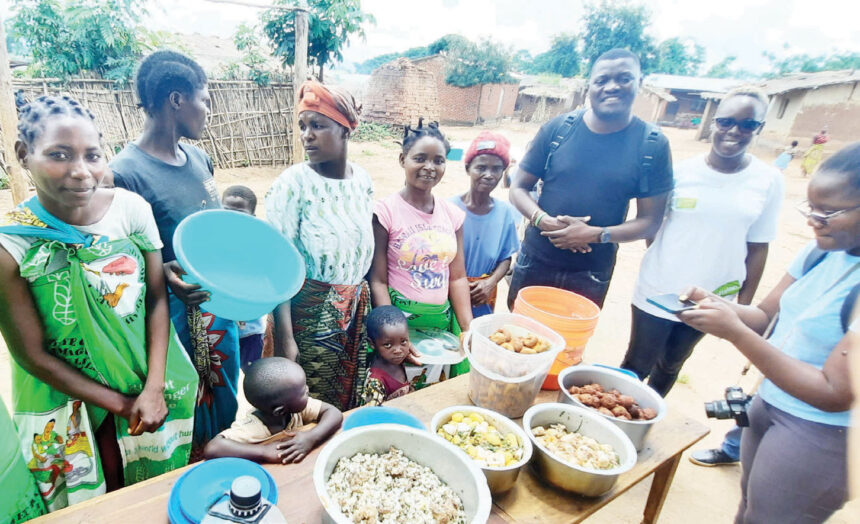
He says in its approach called participatory hygiene and nutrition education which is implemented through school and community health clubs, WHH does not limit itself to lactating and expectant women, but involves everyone in the community, including the youth and other demographics.
“Most of the issues around promoting nutrition demand the involvement of everyone in the community, not just a woman or a household,” Phiri observes.
WHH—currently with hygiene and nutrition projects in Dedza, Mangochi, and Dzaleka Refugee Camp—has been using the school and community health clubs since 2013, according to Renata Krzywon-Schramm, the agency’s head of projects in Malawi.
Krzywon-Schramm says much as they were aware of the policy on the care group model, they still believed in the effectiveness of their approach because it promotes inclusivity in the promotion of nutrition and other related issues such as sanitation and hygiene.
“Our aim was to complement government structures in the promotion of hygiene and nutrition. We generated ample evidence to show that the model used in school and community health clubs can cover some of the gaps not filled by the care groups,” she explains.
The Department of Nutrition’s inclusion of the community care group model in the new Nutrition Policy is evidence of successful collaboration among the Government of Malawi, donors and implementing partners in finding the lasting solution to scaling up nutrition in the country’s rural areas.
According to Kress, while the department played its role to harmonise efforts in improving nutrition across the country, the implementers identified more opportunities for improving the prescribed model and explored adaptations while donors supported Government with systematically collecting the evidence and creating space for joint learning and innovation.
“And with all partners playing their role in collaboration, Malawians should anticipate a revised and improved model for the care groups, geared towards better tackling the challenges rural communities face when it comes to nutrition,” she says.