By Jimmy Chazama:
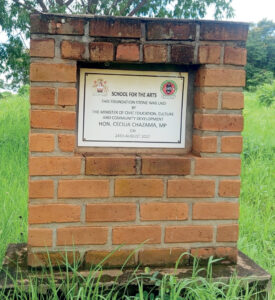
Nine years after a foundation stone was laid in Lilongwe, the National School of Arts remains only a promise.
The project was initially budgeted at K5 billion, but officials now acknowledge the figure is likely to rise as costs adjust to inflation, design changes and the scale of construction.
First launched in 2017 and repackaged in 2024 as part of the National Arts and Culture Centre, the project has seen progress largely on paper.
Ministry of Youth, Sports and Culture spokesperson Macmillan Mwale says land acquisition, environmental assessments and surveys are complete.
- Advertisement -
Copyright Society of Malawi (Cosoma) project officer Shadrick Kumtengo acknowledges the frustration but insists the groundwork is necessary.
“This is a big project that has to follow procedures. Cosoma alone cannot fund it, so we rely heavily on government support.
“The government has made allocations, but until consultants are recruited, designs finalised and contractors procured, construction cannot begin,” Kumtengo says.
He says the project has faced delays due to funding challenges and logistical setbacks but remains hopeful that construction will begin once preparatory work is complete.
- Advertisement -
- Advertisement -
“The School of Arts is critical for Malawi’s creative sector, which lacks a dedicated institution to train and nurture talent,” he says.
Unlike institutions such as the University of Malawi, the Malawi University of Science and Technology or Music Crossroads, the School of Arts will not duplicate academic programmes.
Its uniqueness lies in being practice based and industry driven, with a focus on hands on training rather than theory.
With an intake of about 300 students across disciplines, the school is expected to operate as a continuous process of training and professional development, supporting steady growth in the creative sector.
For now, the foundation stone surrounded by green grass remains the only visible sign of progress.
It stands as a reminder that a project was promised here and that Malawi’s creative youth are still waiting.
For young actors like 15-year-old Azizah Martin, the absence of such an institution has already taken a toll.
“I missed an opportunity to audition at Lumbadzi because I was nervous. With proper training, I could have had confidence,” Azizah says.
She adds that rehearsal space remains one of the biggest challenges.
“Mostly we rehearse at Madsoc Theatre, but sometimes the venue is booked, so we rehearse at school. Schools do not have a stage, so I have to imagine where the audience is sitting to know my position, and that confuses me,” she says.
For painters, the lack of resources is equally limiting.
Visual artist Peter Wanyanga, known as Trooper Arts, shares similar frustrations.
“I once failed to get a job because I had no certificate in painting and was not registered. I mostly paint at home, where mistakes are common, and because paint is expensive, I cannot produce as much as I would like,” says Wanyanga, a 26-year-old abstract artist from Zomba.
Musicians face similar uncertainty.
Eighteen-year-old hip hop artist Shonex says a producer once advised him to abandon hip hop for dancehall because of his voice.
“I tried, but people did not like it. Now I do not know which genre to focus on. Without mentorship, I even think of quitting music because of teasing,” he says.
Poets also feel the absence of structured training.
Gideon Thole recalls auditioning for Malawi Has Talent but failing to qualify.
“Most of us are recording poets, and although we try to master live performance, it is hard without formal education. We often guess our way forward, and that does not work,” Thole says.
He adds that access to rehearsal and training space is particularly difficult.
“As a poet, live performance is central to my craft, yet I rarely have access to proper space. I rehearse in bedrooms, open areas or venues not designed for training,” he says.
Actor and stage manager Gift Singini of Dzuwa Arts recalls his experience with Zathu auditions.
He once auditioned for a Zathu radio play and was selected, but received the script late on the day of recording and struggled.
“I was told my voice sounded like I was reading. Although disappointing, the experience taught me professionalism and motivated me to prepare better,” Singini says.
He believes the lack of structured training and mentorship has slowed the growth of the creative industry.
Musicians Union of Malawi president Vita Chirwa says the concerns raised by young musicians are long standing.
“For a country as culturally rich as Malawi, it is unfortunate that we have long lacked a formal public school of music and arts,” Chirwa says.
“Outside a few private or international institutions, largely accessible to the privileged, and initiatives like Music Crossroads, most young Malawians have relied on raw talent and informal mentorship. That gap has cost many opportunities.”
He adds that the National School of Arts has the potential to change this.
Chirwa says a properly structured School of Arts would provide standardised training in music theory, performance, production and business.
“This would improve technical competence and provide certification and exposure required during auditions and assessments. Talent is abundant in Malawi. What has been missing is a platform to refine it,” he says.
Film Association of Malawi vice president Gilbert Moyo agrees, saying many filmmakers rely on YouTube tutorials, leading to trial and error.
He adds that a formal institution would improve film quality and help artists brand themselves professionally.