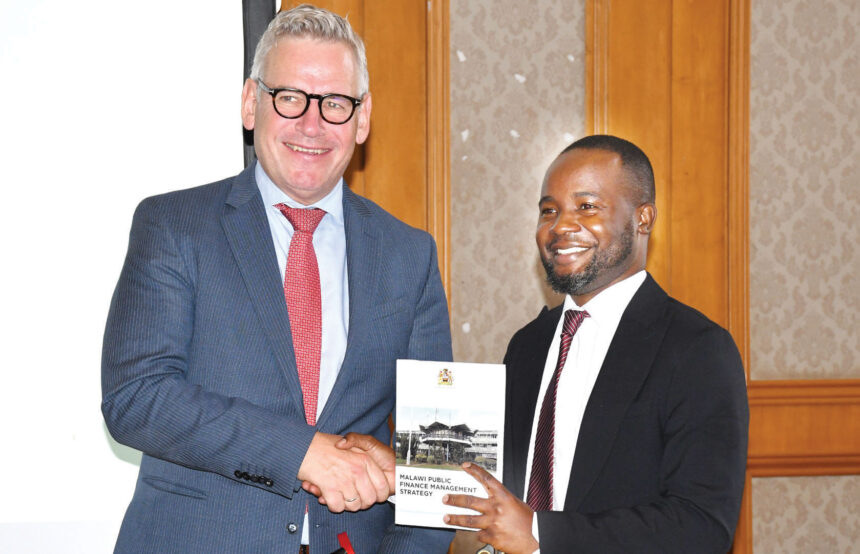
Development partners in the country have said government’s commitment to implement public sector reforms remains a critical condition for their resumption of general direct budget support for Malawi.
They said this yesterday when the Ministry of Finance launched a third Public Finance Management (PFM) Strategy for 2023–2028.
The launch of the public finance management strategy comes after the amendment of the PFM Act 2003 by Parliament last year.
The European Union ambassador to Malawi, Rune Skinnebach, commended government for developing what he called an ambitious blueprint to provide effective and efficient public resources.
Skinnebach called for a shift in behaviour and mindset across government departments at all levels.
- Advertisement -
“From the perspective of the European Union, Malawi possesses the ability to steer this reform agenda to success.
“We acknowledge that the road ahead may be long and winding, but the EU and other development partners stand ready to support you,” said Skinnebach.
World Bank’s Country Director, Hugh Riddell, said the new strategy is an opportunity to further support and incentivise the government’s implementation of the Public Finance Management Strategy through the introduction of a new instrument to Malawi, the Program for Results.
“What distinguishes the instrument is that it disburses funds to the government upon the achievement of results, as opposed to the funding of inputs and activities as a typical investment project financing project would,” Riddell said.
- Advertisement -
- Advertisement -
He said the Programme for Results is an instrument that was designed by the World Bank almost 13 years ago but has not been introduced in Malawi.
He said the strategy is the successor to what the previous public finance management strategies had failed at.
According to Riddell, one of the important and critical instruments that the government has now put in place is the Ifmis [Integrated Financial Management Information System].
He however expressed concern over the accumulation of domestic debts where the government is using the funds to finance budget deficits.
“If the government can put in place measures to protect the Ifmis, the World Bank is likely to resume direct budgetary support,” he said.
Norwegian ambassador to Malawi, Ingrid Marie Mikelsen, has described the strategy as a renewed commitment from the government of Malawi.
“All the Malawi government needs is to sustain the reforms, strengthen public finance management, and ensure that the new strategy has the desired impact on service delivery,” Mikelsen said
Minister of Finance and Economic Planning, Sosten Gwengwe, said the strategy seeks to build on successes and address challenges encountered in the previous reform programs.
“Notable successes include those registered under the Governance to Enable Service Delivery Project (GESD) funded by the World Bank that complements efforts in the fiscal decentralization process through development project financing at the local level, improved asset management, quality of financial reports, and compliance with the Public Procurement and Public Finance Management laws in terms of timely submission of financial reports, he said.”
Gwengwe cited the arrest of 39 officials from the Accountant General who are suspected to have abused over K800 million as a result of the performance of the new Ifmis.
He said other successes registered under the GIZ project include the enhancement of Ifmis functionality, contract management, and tax administration.