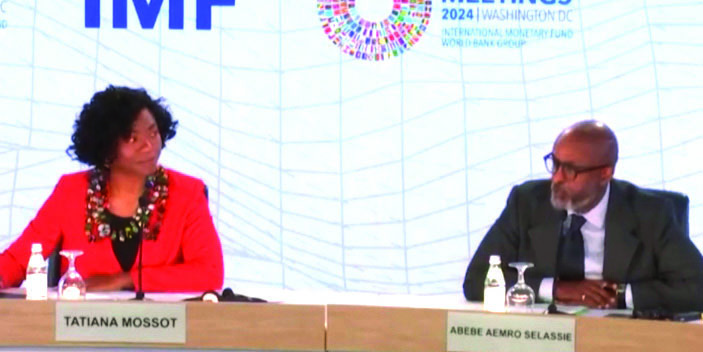
International Monetary Fund (IMF) Director of the African Department Abebe Aemro Selassie has said the unaddressed debt situation in Malawi remains a concern.
Selassie was speaking in Washington DC, USA, on Friday when the IMF launched the 2024 Spring Meetings Regional Economic Outlook (REO) for sub-Saharan Africa.
Years of unsustainable domestic and external borrowing and the adverse impact of multiple external shocks have resulted in the widening of macroeconomic imbalances, including protracted balance of payment needs.
The IMF Board of Executive Directors observed in November last year, when it granted Malawi the current $175 million Extended Credit Facility (ECF) programme, that successful external debt restructuring is vital as there is no reasonable mix of adjustment and financing alone that can deliver macroeconomic stability.
Briefing reporters in the US Capital, Selassie said while some of Malawi’s official creditors recently provided financing assurances, others are yet to.
- Advertisement -
“And that is, I think, one of the most pressing impediments that we see in our ability to continue to provide financing.
“Over the last couple of years, the fund, the World Bank, has provided a lot of financing to the country, but this financing cannot be effective, of course, without debt relief for the country,” Selassie said.
In the latest report, the IMF has maintained a growth forecast of 3.3 percent for Malawi in 2024.
Selassie observed that the project was made before the full effects of El Nino were understood.
- Advertisement -
- Advertisement -
In an interview on Saturday, Finance Minister Simplex Chithyola Banda said authorities appreciate that any movement towards effecting Malawi’s support and financing is dependent on its performance on the ECF programme and that debt restructuring is very key.
Chithyola Banda said Malawi is negotiating with its creditors on how best to restructure the debts and that it has so far engaged in very progressive debt restructuring talks with India, China, Kuwait Fund, Saudi Fund for Development, Afreximbank and Trade and Development Bank.
According to the local Chancellor of the Exchequer, authorities are hoping that all of the creditors will understand, appreciate and accept Malawi’s proposals for the debt restructuring.
“We feel IMF and World Bank will understand our position as Malawi has perpetually experienced external shocks that made it extremely difficult to achieve some of the prior actions. Cyclone Freddy, back to back with El Nino, has made our path towards economic recovery extremely bumpy,” he said.
According to the IMF, after four challenging years and multiple shocks, sub-Saharan Africa’s economy appears to be on the mend.
It says it expects growth to accelerate to 3.8 percent from 3.4 percent last year, after peaking at almost 10 percent in late 2022.