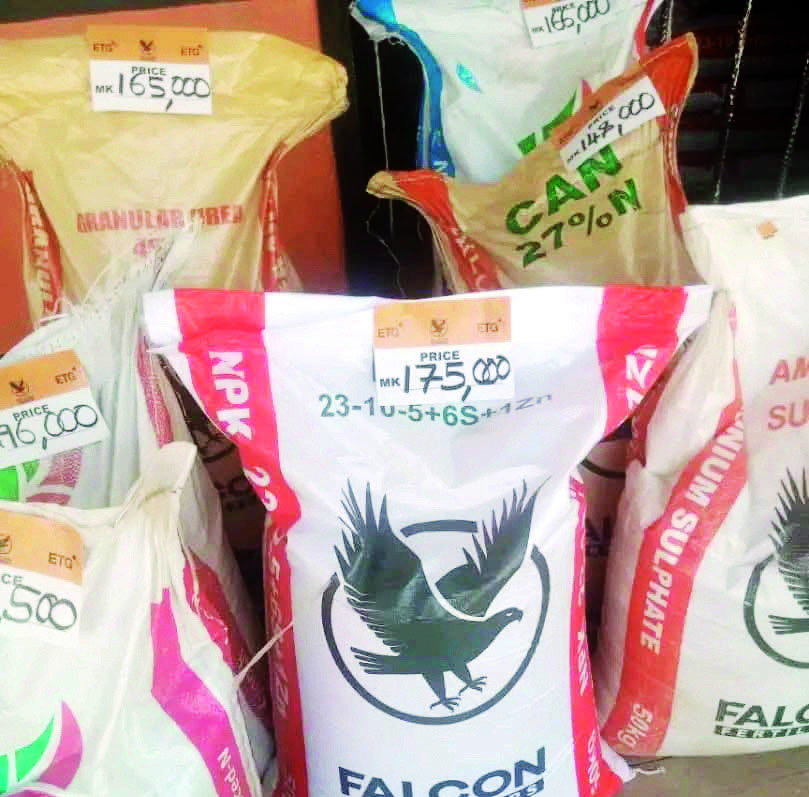
Fertiliser prices have surged by an average of 24 percent since January 2025, threatening agricultural output for the next season. This comes at a time the country is facing acute shortage of fertiliser—a critical commodity for food production—due to forex scarcity. A snap survey by Times Business found that retailers are selling fertiliser at prices ranging from K148,000 to K196,000 per 50-kilogramme (kg) bag depending on type. For instance, CAN is currently fetching K148,000, Urea K165,000, NPK K175,000 and Super D K196,000 per 50kg bag. This compares to prices recorded in January 2025, when Urea was being sold at K133,000, NPK at K138,000, Super D at K175,000 and CAN at K130,000 per 50kg bag. The average price has jumped from K144,000 per bag in January to K171,000 currently, representing a 24 percent increase. In an interview, Chairperson for Mpatsa Holdings Limited Jimmy Koreia Mpatsa said the price increases reflected broader economic challenges, particularly foreign exchange shortages.
Agriculture policy expert Leonard Chimwaza said price instability negatively affects both commercial and subsistence farming.
“The instability of the prices of production inputs has a negative bearing on both commercial and subsistence farming. The value of output per unit area will be low, hence affecting the anticipated margins.
“There is a need for [the adoption of] a multifaceted approach towards stabilising forex availability to aid smooth importation of key commodities like fertiliser and promote investment plans towards local fertiliser production in Malawi,” Chimwaza said.
Fertiliser Association of Malawi (Fam) spokesperson Hannah Mankhambera attributed the price surge to continued foreign exchange shortages and global market factors.
- Advertisement -
“The rise in retail fertiliser prices is largely a result of continued foreign exchange shortages, which make it difficult for importers to secure the required forex on time and [exchange the local unit] at a predictable rate,” Mankhambera said.
She said association members had made efforts to secure products early but forex constraints remained a risk.
Fam reports holding a total of 284,659 metric tonnes, including 44,356 metric tonnes in warehouses, 168,267 metric tonnes in transit and 72,036 metric tonnes on the high seas.
Recently, President Peter Mutharika admitted that procurement delays and foreign exchange shortages had hindered timely fertiliser delivery for the 2025-26 planting season.