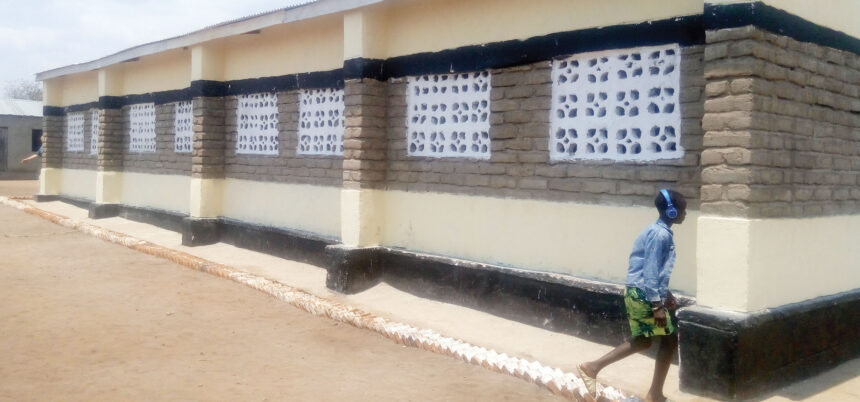
In the scorching sun of Mpangama Village, Traditional Authority Makanjira in Mangochi District, children as young as four years are seen walking to Mpiripiri Primary School, over six kilometres (km) away from home.
This, according to quality education access advocate in the area Ethel Suda, is because there is no other school that is closer to them than Mpiripiri.
Still, the six km-plus distance is against primary school guidelines and policies, which espouse that there should be a primary school at a radius of five kilometres from another primary school.
“That is why I have been doing everything, including walking on foot, to convince the education authorities and well-wishers to establish a school in Mpangama Village or close by so that children from the area should not be covering long distances to school.
“As at now, in part due to the long distance to school, children have been going on fishing errands during school time, thereby denying themselves a chance at a brighter future. This is not on,” she lamented
- Advertisement -
No wonder, Suda was on cloud nine on Monday, October 28 this year, when German non-governmental organisation Reisende Werkschule Scholen—or the Travelling Work School—handed over a school block with two classrooms to the people of Mpangama Village and surrounding areas.
Every now and then, she could be seen rising from her seat and joining women who were celebrating the occasion.
It was as if, for once, it had dawned on the community members that education is the key to an unknown, but certain, future.
“This is what I have been fighting for; it is a day I have been looking forward to,” she said of the school block, which nine German students constructed.
- Advertisement -
- Advertisement -
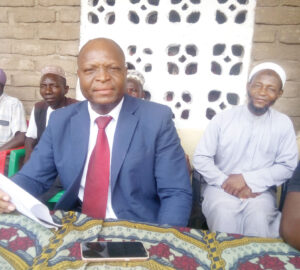
Senior Group Village Headman Mpangama was equally elated.
It was as if the modern structure that stood imposingly above surrounding houses would, come the next day, not be there anymore.
Of course, it has become a permanent structure in the lives of the people now.
“This is unbelievable; having a modern school block right in the village. I did not see this coming.
“I am especially happy because without a structure like this in the vicinity, it was difficult to convince some children to forgo fishing errands and embrace primary school education,” he said, in reference to the growing allure of Lake Malawi, which is a stone throw away.
For years, according to the traditional leader, some children’s attention has been divided; one part of the mind being drawn to the spectacle of a dugout canoe filled with Chambo [Tilapia saka], with the other part of the mind being drawn to textbooks that primary school learners handle during the school term.
As such, it has not always been easy to direct all children to school; in this case, Mpiripiri Primary.
“All along, I have been of the view that children should be in school, instead of being at the lake or working at home. Children have to be concentrating on studies so that even if they do not get employed once they finish their education, they should at least know how to, using knowledge acquired in school, navigate past challenges they will face in adult life.
“I am, therefore, happy that after eight weeks of toiling in the sun, the nine German students have finished the work and handed the school block over to us, community members,” the traditional leader explained.
According to Rodrick Chiumba, who is the Primary Education Adviser (PEA) for Lulanga Zone in Mangochi District, efforts aimed at reducing the distance that learners cover from home to school are always welcome.
He pointed out that as such, the Ministry of Education has been working with non-governmental organisations, development partners, among others, to ensure that learning is a pleasant experience for children in the country.
“As such, additional blocks go a long way in easing pressure on education infrastructure, especially in areas where the learners’ enrollment rate is higher than that in other areas.
“For instance, at Mpiripiri Primary School, standard one has in excess of 600 learners, which demands more learning space and even teachers. For this reason, efforts are being made to ensure that there are enough school blocks in the country,” Chiumba emphasised.
He, therefore, implored parents and guardians to be sending their children to school.
Mpiripiri Zone PEA, Peter Mteteka, concurred with Chiumba.
He added that the Ministry of Education has been promoting integrated education in a quest to meet learners’ holistic needs.
“That is why the ministry is ensuring that the distance from one school to another is five kilometres. It is also ensuring that a site where a primary school is being established should have space for at least eight blocks, replete with an administration block, six toilets each for boys and girls, football and netball grounds as well as enough space for the construction of eight teachers’ houses.
“The ministry, through its guidelines, is also ensuring that each primary school has sites for vegetable gardens and woodlots, halls, safe water sources and enough land to accommodate other development activities, among other things. Education service committees, which are available in each education district, are ensuring that stakeholders are aware of these requirements,” Mteteka said.
The PEA then said what the Germans have been doing in Malawi, in terms of building school blocks in areas where illiteracy levels remain high, is commendable.
He urged them to be working hand-in-hand with the education authorities to ensure that education goals were met, saying education is one of the sectors touted in the Malawi 2063 vision.
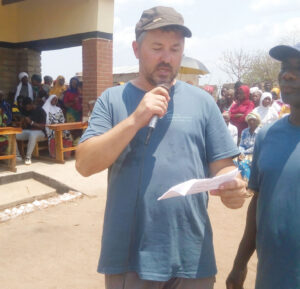
Taking his turn, Reisende Werkschule Scholen Chairman Christoph Heckhausen indicated that the handing over of the school block was a momentous occasion.
“We are the tough local [Malawian] workers and our group of nine students from the Travelling Work School from Germany. We have been coming to Makanjira for almost 20 years and have, since then, built four school buildings in Nangungu and five school buildings in Chilinda.
“Now we have constructed the first building with two classrooms for the new Mchangani Primary School in Mpangama Village. In two years, we will be here again to construct another school building. We would like to thank all the people who have supported the project and contributed to its success. We would also like to thank all the people who have been so kind to us over the past eight weeks,” Heckhausen indicated.
He added that the Germans knew that there was a long way to go before the school block could be put to use.
“There is still some way to go before the school is used here. There is still no head teacher. Until school starts, we will be storing school materials such as exercise books, books, pens and balls, which will then be available to you, learners, when school starts.
“We hope you enjoy this school and that it will enable a lot of kids to start school,” Heckhausen explained.
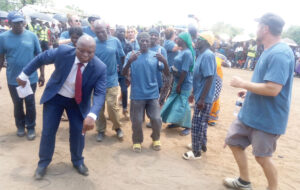
Before long, girls, women and elderly people turned the ground on which, moments before, Heckhausen stood into a dancing arena.
Soon, he and the other Germans joined in, throwing feet all over the place while others were throwing hands in the air—call it celebrating education the Makanjira way.