By Alick Ponje in Belém, Brazil:
For three decades, world leaders have met at United Nations Climate Change Conferences (COPs) to address the rising risks from extreme weather and environmental change.
Despite these discussions, nations such as Tuvalu and Vanuatu continue to face rising seas, stronger storms, disappearing coastlines and shifting rainfall on a daily basis.
These countries are already living with the consequences of environmental disruption while the world debates solutions.
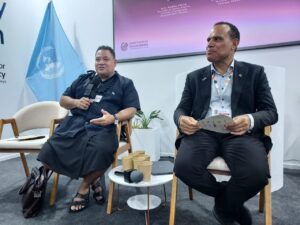
At COP30, currently underway in Belém, Brazil, Maina Vakafua Talia, Tuvalu’s Minister of Home Affairs, Climate Change and Environment, spoke during a high-level side event on the urgent need for a global fossil fuel treaty.
- Advertisement -
The panel explored the legal pathways to such a treaty, finance and incentive mechanisms, how it would complement the Paris Agreement and why countries should join “this practical and fair international effort”.
“The logic is very simple. To achieve 1.5 degrees Celsius, we need a treaty that tackles the root causes of the crisis. This is about the survival of our people,” Talia said.
Global legal and political backing
He recalled attending COP21 in Paris and the Silver Declaration, which brought Pacific governments, non-governmental organisations and civil society together to push for the 1.5-degree target.
- Advertisement -
- Advertisement -
“It is time for serious practical action rather than continuing to talk and talk and talk,” the minister said.
The Paris Agreement, adopted in 2015, sets the goal of keeping global temperature rise this century well below 2°C above pre-industrial levels while pursuing efforts to limit it to 1.5°C.
Limiting warming to 1.5°C is seen as critical for reducing risks such as extreme heatwaves, rising sea levels, loss of biodiversity and severe impacts on vulnerable populations.
Ralph Regenvanu, Vanuatu’s Minister for Climate Change Adaptation, Energy, Environment, Meteorology, Geo-Hazards and Disaster Management, highlighted the importance of legal accountability.
“The International Court of Justice advisory opinion makes clear that states must control fossil fuel production in their territories.
“We in Vanuatu are moving to 100 percent renewable electrification by 2032. But global action is crucial. Without high emitters joining, our efforts alone will not save the Pacific,” Regenvanu said.
Cambodia’s Secretary of State Chea Sam Ang warned that governments and industries are planning to increase fossil fuel production.
“This path defies science and endangers our collective future. What we build today will be what we use tomorrow,” Ang said before announcing that his country was endorsing the treaty.
The campaign for a fossil fuel treaty
The announcement means that at least 17 countries have endorsed the Fossil Fuel Non-Proliferation Treaty, which is being championed by a diverse coalition of individuals, organisations and governments around the world.
At the heart of the campaign is the Fossil Fuel Non-Proliferation Treaty Initiative, which coordinates advocacy efforts alongside civil society organisations such as the Rapid Transition Alliance and the Women’s International League for Peace and Freedom.
The health sector has also been a strong supporter, with numerous public health organisations and figures such as Maria Neira of the World Health Organisation highlighting the threat fossil fuels pose to human health.
Political leaders have lent their voices as well.
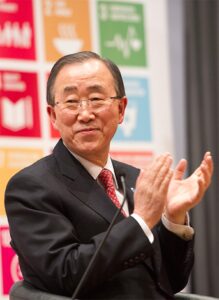
Nobel laureates, former UN Secretary-General Ban Ki-moon and President José Ramos-Horta of Timor-Leste have all publicly backed the treaty.
Climate Change Ambassador Camacho-Thomas of Antigua and Barbuda said international cooperation is essential in the fight against fossil fuels.
Camacho-Thomas also warned that “looking away” while climate change is wrecking people’s lives is an immoral imperative.
“A treaty creates clear practical legal and financial mechanisms. It complements the Paris Agreement while protecting the most vulnerable countries,” she said.
Urgent climate threats and corporate influence
The panel painted a stark picture, showing that current policies put the world on track for nearly 2.7°C of warming.
They also indicated that “major oil and gas producers, including Australia, Canada, the United States and Norway, have increased fossil fuel production by 40 percent since 2015.”
Malawi itself is facing immediate environmental threats. This week, storms damaged dozens of houses in the capital, Lilongwe, a city seldom known to experience such phenomena until recently.
The country’s climate change department has issued a nationwide alert for unstable weather expected from November 17 to 23, 2025.
It reports that Malawi will experience windy, cloudy and warm conditions accompanied by heavy thunderstorms and rainfall driven by the Inter-Tropical Convergence Zone.
“The system is forecast to move from Southern to Northern regions, bringing localised downpours and increasing the risk of flash floods, particularly in low-lying and poorly drained areas,” the department said.
While Malawi has not yet formally signed the Fossil Fuel Non-Proliferation Treaty at the national level, momentum is building locally.
Two of the country’s cities, Lilongwe and Mzuzu, have endorsed the treaty, with Lilongwe becoming the first African capital to support the initiative.
Lobbying, inequality and calls for justice
Meanwhile, analysis by the Kick Big Polluters Out coalition shows that fossil fuel lobbyists have an unprecedented presence at COP30 in Belém.
They reportedly outnumber delegates from vulnerable nations by staggering margins, nearly 50 to one for the Philippines, more than 40 times the number from Jamaica and at least 15 times that of Malawi.
More than 1,600 lobbyists gained access through official or party overflow badges, according to the analysis.
Trade associations reportedly brought dozens of representatives from ExxonMobil, BP and TotalEnergies, major multinational energy companies.
Additionally, several Global North countries included fossil fuel representatives in their official delegations, the analysis states.
Civil society groups have warned that this corporate presence threatens the negotiations.
“It is infuriating to watch the very corporations driving this crisis being given a platform to push false ‘solutions’ that sustain their profit motives while communities facing floods, droughts and heatwaves are underrepresented,” Jax Bonbon of Philippines-based CSO IBON International said.
Rachitaa Gupta of the Global Campaign to Demand Climate Justice described the entry of fossil fuel lobbyists into the climate change talks as a betrayal of the process.
According to Gupta, the lobbyists attend talks to protect their profits, push false solutions and undermine communities.
Other activists drew links between fossil fuel expansion and global injustices.
Pat Bohland from the Women and Gender Constituency said: “Feminists are once again outnumbered eight times by lobbyists representing the exploitative fossil system continuing petro-masculinities and patriarchy.”
Tom BK Goldtooth, Executive Director of the Indigenous Environmental Network, dismissed suggestions that the Brazil climate summit is the Indigenous Peoples COP.
Goldtooth pointed out that local Indigenous Peoples must struggle to gain entry while fossil fuel lobbyists enter freely.
Nerisha Baldevu of Friends of the Earth Africa added: “From the halls of the [UN Framework Convention on Climate Change] to our lands, fossil fuel corporations are wrecking our communities and environment.”
This story was produced as part of the 2025 Climate Change Media Partnership, a journalism fellowship organised by Internews’ Earth Journalism Network and the Stanley Center for Peace and Security.