It is 11am on the Liwonde- Balaka Road and Yusuf Ngunga, who is behind the steering wheel of a taxi, has to be 200 percent alert.
“Eeeeh man, you cannot afford to blink while driving on this road. This is perhaps the worst road in Malawi,” Ngunga says as he occasionally switches lanes from left to right just to elude potholes.
According to Ngunga, the appalling condition of the road has led to frequent breakdowns of vehicles, sitting tire bursts and suspension issues emerging as most common challenges.
“At least today we are able to see the potholes because it is dry. But think of it when it’s raining and the potholes are filled with water. It’s a disaster. It is like driving in the graveyard.
“Again think about driving on this road during the night, when you have to dim the lights at some point when another vehicle is approaching. You just end up in a trench,” Ngunga says.
- Advertisement -
Even to passengers, frequently travelling on the stretch is a nightmare as it results in backache.
Pregnant women face the greatest risk.
Asiyatu Malenga has vivid memories of how her in-law nearly had a miscarriage on the road due to its bumpy surface.
Standing during question time in Parliament, Machinga Likwenu lawmaker Bright Msaka says the poor state of the road stretches from Mangochi Turn-off to Bunda Round-about.
- Advertisement -
- Advertisement -
“Honourable Minister, what plans to do have to fix the potholes between Mangochi Turn-Off and Bunda Round-about?
“Those of us from the Eastern Region and Southern Region and parts of the Central Region, coming to Parliament are suffering. Our vehicles cannot last two trips on this road,” Msaka said.
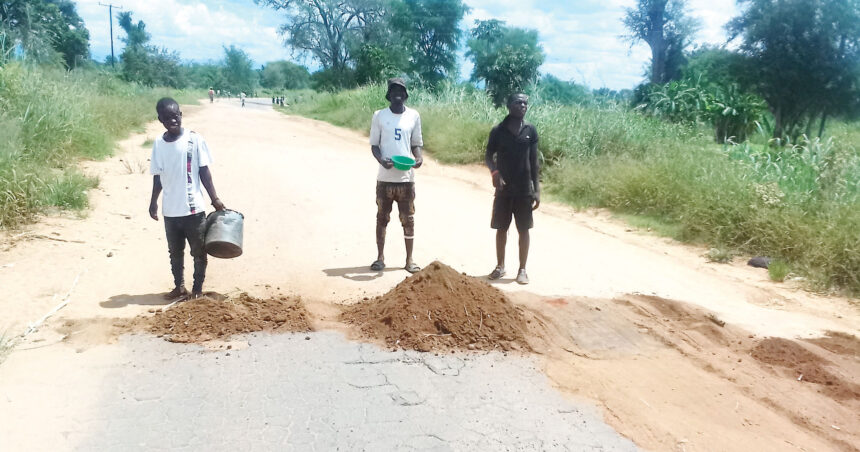
A stone throw from Capital Hill and Parliament, on the road from Kawale to City Centre, some young men are busy patching potholes with stones and mud.
They then collect money from motorists for doing a job that is supposed to be done by government personnel.
At Kanengo, especially the road to Area 25, another group of young men is also filling patches of the road with mud and collecting user fees from motorists.
The people of Balaka and Lilongwe City may think that they have the worst roads but the people of Salima have their story to tell about the M5 Road, which is almost nonexistent.

Transport Minister Jacob Hara admits that most of the country’s roads are in dilapidated state.
According to Hara, this is so because the country went into the rainy season without maintenance contractors because of issues of price escalation due to the devaluation of the Kwacha.
The Transport Minister says the hands of the government were tied as they were waiting for approval from Public Procurement and Disposal of Assets Authority (PPDA) to adjust prices.
“That’s why most of our roads have deteriorated. It looked like we were not attending to them but the truth of the matter is that our hands were tied.
“We couldn’t even get a contractor to work on that because we didn’t have approval from PPDA to adjust the prices because these contracts are contracts that are done prior to the rainy season and most of these contracts were tendered before the devaluation [of the Kwacha].
“So that put us in a very big fix and it is unfortunate that it is going to cost us much more than what we were trying to save in the first place but some of these are issues that we take responsibility for. We should have made these decisions much earlier but the good news is that the contractors are here. We have the approval from PPDA and we will quickly get into these and make good of these roads,” Hara said.
According to the Malawi Police Service Crime and Accidents report for 2023, a total of 1,001 people died in 4,977 road accidents.
Out of the total number of people who died, 450 were pedestrians, 254 were passengers, 119 were peddle cyclists, 95 were motorcyclists, 82 were motor vehicle drivers while one was an oxcart rider.
Road safety expert Abdul Osman admits that the poor condition of the roads poses a risk to motorists.
But Osman, who is also Roadnetic Managing Director, was quick to note that, with good driving skills, the risk can be minimised.
According to Osman, it is the duty of road users to assess road conditions and adjust their driving to suit the prevailing road conditions accordingly. That way, even if the condition is bad, the risk can be managed easily.
“It is so interesting to also note that even with good road conditions, the risk is also there, as road users drive too comfortably and tend to speed. With bad road conditions, road users were supposed to be driving more carefully; that is, at very reasonable speed. But that is not the case,” Osman says.
According to Osman, whether the road condition is bad or good, the risk is still there and that what matters most is the mental and physical condition of the driver.
“If the driver’s condition is good, the risk will be minimal regardless of the road condition. On the other hand, if the driver’s mental and physical condition is bad, the risk will be very great regardless of the condition of the road,” Osman says.