By Cathy Maulidi:
Investigators of the plane crash that killed the then vice president Saulos Chilima and eight others on June 10 have released an interim report.
It highlights several safety concerns of this flight.
Published yesterday, the report of the German Federal Bureau of Aircraft Accident Investigation (BFU) reveals a number of technical deficiencies.
They include that while the military airplane had a device which flight crews are supposed to use to transmit distress signals that can aid safety response operations, the instrument was dysfunctional.
- Advertisement -
The investigators found that the Emergency Locator Transmitter (ELT), as the device is called, was out of service because its battery had expired.
The battery expired in 2004.
The report also suggests that the instrument was outdated.
Mounted on the plane was an ELT which transmits signals on the frequencies 121.5 MHz and 243 MHz.
- Advertisement -
- Advertisement -
However, since February 1, 2009, satellites only monitor the internationally agreed emergency frequency of 406 MHz and the Malawi Air Force had not serviced the equipment accordingly.
“According to the Malawi Air Force, for such devices there were no spare parts and no budget for new 406 MHz ELT,” the report says.
It also says the plane was not equipped with a Cockpit Voice Recorder (CVR) or a Flight Data Recorder (FDR), which could have provided crucial information about the crash.

Basically, a CVR records verbal communication between crew members within the aircraft’s cockpit as well as voice transmissions by radio, according to encyclopedia Britannica.
The FDR, on the other hand, records basic aircraft conditions such as airspeed, altitude, heading, vertical acceleration, pitch as well as individual instrument readings and internal environmental conditions.
“The lack of a CVR and FDR made it difficult to determine the exact circumstances of the crash,” the BFU report says.
It also notes that the radar data of the f light on the day of the accident were not recorded, further complicating the investigation.
“The absence of radar data and flight recorders hindered the ability to reconstruct the flight’s final moments,” it says.
The radio communications between the flight crew and the air navigation service units at Lilongwe were not recorded, according to the report.
“Radio communications between the flight crew and the Flight Information Service (FIS) were also not recorded,” read the report.
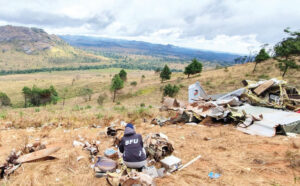
In its dangerous turns in Chikangwawa forest as shown in the pictures provided, the plane, according to the report, clipped a tree with its wing, causing significant damage and loss of control, before crashing into the slope of a hill.
“The aircraft’s impact with the tree was a critical factor in the crash, as it led to a loss of lift and control, resulting in a fatal descent into the hillside,” it further reads.
The investigators found that the GPS [Global Positioning System] had switched off automatically about 2:45 hours on June 10 after the aircraft’s impact due to low battery power.
At about 2:30 hours, search and rescue personnel from Mzuzu Airport and others arrived at the region around Ekwendeni to search for the airplane.
“Later witnesses came forward whose information suggested that a crash in the area of the cell tower Raiply had occurred. Subsequently, the search and rescue personnel were sent there,” it says.
The airplane crashed into the slope of a hill about 2 km east of M1 road and about 700m south of a settlement.
There was no evidence of fire in flight or after the impact. The report states the pilots were well trained and experienced in the job.
The investigators obtained eight of the nine post-mortem reports available for investigation purposes.
“According to the post-mortem reports, the occupants suffered fatal multiple injuries in the form of high-impact trauma on impact. Leading were severe injuries of head and thorax, followed by multiple fractures of the arms, legs and pelvis,” it says.
The report recommends that all aircraft operating in Malawi be equipped with CVRs and FDRs to prevent similar incidents in the future.
Additionally, it highlights the need for improved weather reporting and forecasting in the region.
“The poor weather conditions contributed to the crash, and better weather reporting could have helped the pilots make informed decisions,” it says.
The investigation makes specific recommendation to certain departments. They include that:
- The Minister of Defence of the Republic of Malawi should ensure that aircraft of the Malawi Air Force transporting persons are equipped with a functional Emergency Locator Transmitter (ELT).”
- The Minister of Transport and Public Works of the Republic of Malawi should ensure that up-to-date information concerning radio navigation aids in Malawi is available to aircraft crews at all times.
- The Department of Civil Aviation should check the proper function of the radio navigation aids and update the respective information.