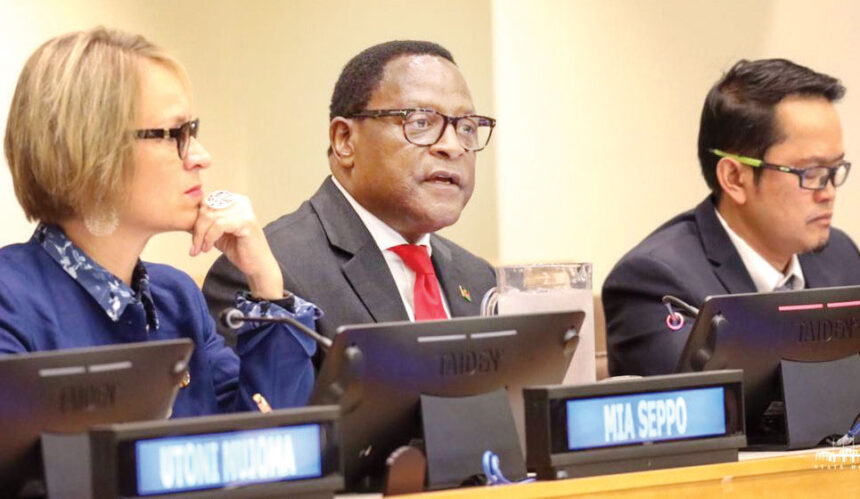
President Lazarus Chakwera has said Malawi has prioritised the agriculture sector to enhance job creation.
The sector contributes about 25 percent to gross domestic product (GDP) and employs about 80 percent of the country’s workforce.
The President made the remarks at the United Nations General Assembly (Unga) in New York, the United States, where he affirmed Malawi’s commitment to the Global Accelerator Initiative.
“Through diversification, mechanisation and value addition, we aim to boost productivity and generate decent work, without compromising the level of employment. We emphasise on private sector investment and innovation to drive these initiatives in agriculture.
“Our efforts at expanding …programmes will equip the youth with modern skills and entrepreneurial capabilities, thus covering the identified gaps. While our mining sector holds substantial economic potential, it remains largely untapped, as it contributes a mere 1 percent to GDP currently,” he said.
- Advertisement -
Chakwera further said the government intends to focus on building entrepreneurship and value addition skills that will enhance citizens’ active participation in mining activities, which will foster job creation, particularly among the youth.
“To address our labour, employment and social protection challenges, we are aligning with the strategy to rapidly expand social protection and create quality jobs. Our comprehensive roadmap focuses on economic diversification, increased job opportunities and enhanced social protection, in line with our MW [Malawi] 2063 goals and Sustainable Development Goals,” he said.
Chakwera’s sentiments come against recent findings by Afrobarometer that indicate that Malawi is among 36 African countries that are at 14 percent on positive rating of government performance on job creation.
Employers Consultative Association of Malawi Executive Director George Khaki attributed the problem of high levels of unemployment in the country to economic challenges the country is going through.
- Advertisement -
- Advertisement -
He further indicated that natural disasters have affected the country in the past two years.
For instance, in January 2022, Cyclone Ana hit parts of Malawi followed, in March the same year, by Gombe, which destroyed property and claimed lives of people and livestock.
“We have to look at the causes of the unemployment. Recently, we have had economic, pandemic and weather shocks, which have had grave implications on the creation of employment.
“We, as a country, are not producing as many jobs as we would want to do,” Khaki said.