By Isaac Salima:
For 38 years, Rachel Baluwa, also 38, has had one dream: To find water without breaking sweat right in Mtanja Village, Traditional Authority (TA) Mpama, Chiradzulu District.
She is yet to realise her dream
“I cover a long distance, on foot, to fetch water from the nearest water source. Needless to say, for the better part of these years, I have been covering a long distance to fetch water from unsafe sources such as wells and streams, making the water unsafe for drinking,” Baluwa points out.
Enifa Mlenga, also from TA Mpama, is tired of the situation.
- Advertisement -
She says, like all citizens of Malawi, people in her area deserve equally better.
“We deserve to have access to potable water. We deserve healthy life. We deserve a share of the development cake.
“However, this is not the case now,” Mlenga stresses.
Mlenga’s sentiments are not new.
- Advertisement -
- Advertisement -
The Southern African Regional Poverty Network indicates that poor access to safe water is one of the indicators of poverty.
And, in a paper titled ‘The Right to Development, The Quality of Rural Life, And The Performance of Legislative Duties During Malawi’s First Five Years of Multiparty Politics: A Paper Based on Research on the Right to Development, the Quality of Rural Life, Legislation and the Performance of State Duties’, legal expert Garton Kamchedzera and Chikosa Ulendo Banda indicate that when people’s lives are improving, development trickles to service users.
“The quality of life is a useful indicator of a country’s state of human development. Accordingly, Malawi’s Constitution requires the State actively to promote the welfare of the people of Malawi through policies and legislation.
“Although macro-indicators can indicate the level of general well-being in a country, the quality of rural life may be conflated. Levels of human development and well-being in rural areas are generally poorer than standards of life in urban areas. Malawi’s Constitution hence stresses that ‘rural standards of living’ must be recognised as ‘a key indicator of the success of government policies’,” Kamchedzera and Ulendo Banda point out.
They, however, observe that poor reporting mechanisms on development initiatives being implemented annually defeats the cause of transparency and accountability.
“However, it is crucial to bear in mind that the link between development and human rights is inexplicable. The synergy between human rights and development has long been recognised. The UN Charter made that link in 1945.
“The impetus to recognise development as a human right globally, however, came with the adoption of the Declaration on the Right to Development in 1986, following the African Charter on Peoples’ and Human Rights, which had in 1981 indicated that the right to development was a human right. The Declaration on the Right to Development defines development as a comprehensive economic, social, cultural and political process, which aims at the constant improvement of the well-being of the entire population and of all individuals on the basis of their active, free and meaningful participation in development and in the distribution of benefits therefrom,” Kamchedzera and Ulemu Banda further indicate.
So far, this has not been happening in districts such as Chiradzulu, where Rodgers Mnema and other people are not impressed with levels of service delivery.
“We have been suffering from waterborne diseases because of the neglect we suffer at the hands of policymakers,” Mnema explains.
The victims have, unfortunately, included schools.
Take, for instance, Nyungwe Primary School, which has an enrollment of 1,245 learners.
For a long time, the facility only had two basic toilet facilities, according to the school’s head teacher Charles Phiri.
“This was compromising adherence to hygiene practices,” he indicated.
“Sanitation challenges were contributing to absenteeism, including among girls, especially during menstruation,” Phiri adds.
This was also the case at Bilal and Mbulumbuzi health centres, where adherence to hygiene practices was almost non-existent.
Now there seems to be light at the end of the tunnel as some non-State actors have started coming to the rescue of people in the district. These include World Vision and Water For People, who are implementing water, sanitation and hygiene (Wash) initiatives.
At Nyungwe Primary School, for instance, additional latrines and washrooms have been constructed.
As for Bilal and Mbulumbuzi health centres, adherence to hygiene practices has improved after the two organisations initiated the construction of incinerators, washrooms and placenta pits, which are yet to be completed.
At Mbulumbuzi, the facility is expected to have four bathrooms, four latrines and incinerator and a placenta pit.
One of the women who had just delivered at the facility, Midresi Mtukula, said the hospital needs such structures.
“This will help in ensuring that dignity and hygiene of women, especially those who have just given birth, is respected,” she said.
Mbulumbuzi Hospital in-charge George Silla said having such structures will be a big plus in health service delivery.
“This is a big facility and, as such, it deserves more than one washroom,” Silla pointed out.
Another intervention is the Nsanja Scheme, which is designed to ensure that community members have access to safe water.
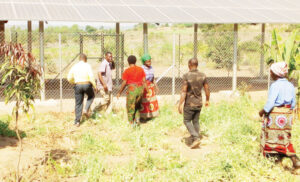
The scheme has seen the erection of a water tank on Nsanja Hills which, with the aid of solar panels, will be pumping water to 38 tap stands planted around the village.
With two taps on each stand, 2,500 people surrounding Group Village Head Chakakazi are assured of water access.
“Of course, we will be collecting a small amount from users for operational costs. This is expected to ease challenges that people have been experiencing to get clean water,” Marvin Mphepo, who is the chairperson for Nsanja scheme, points out.
With about 22 boreholes installed and 18 others rehabilitated within the area, water woes are now a thing of the past.
World Vision Sanitation and Hygiene Promotion Adviser for Chiradzulu Timeo Kapaza said the three-year project aims at ensuring that access to Wash services is guaranteed for everyone.
“We are targeting households, schools and healthcare service facilities,” Kapaza explained.
Ten TA’s in Chiradzulu District will, in the end, be all smiles.