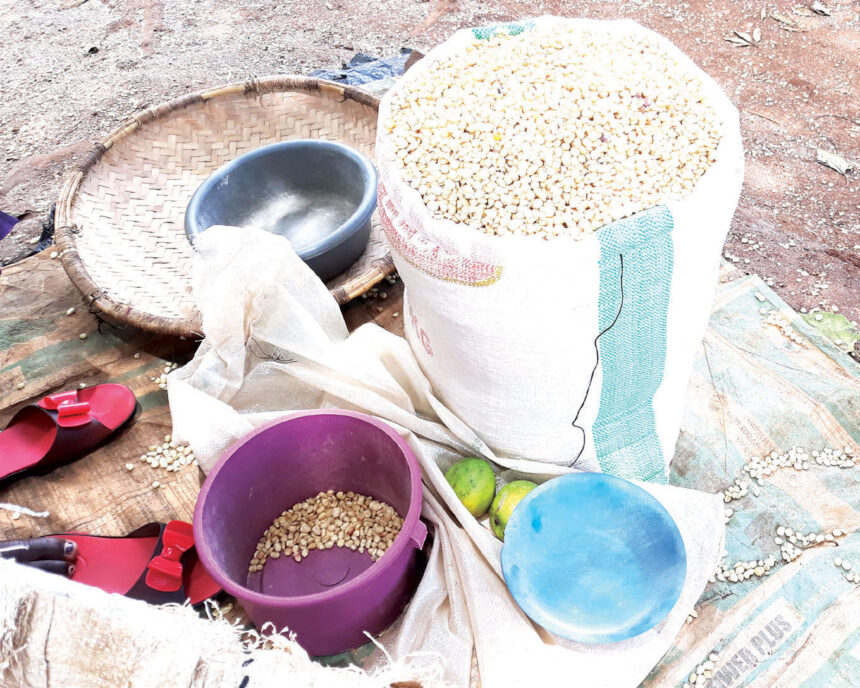

Maize production has decreased by 5.6 percent in the 2022-23 farming season, a development experts say spells disaster.
Ministry of Agriculture statistics indicate that during the period in question, the country produced 3.5 million tonnes (mt), down from 3.7 million mt during the preceding farming season.
This is according to the ministry’s final Agriculture Production Estimates Survey, whose results were released Thursday.
The survey indicates that maize production has declined due to reduced inputs uptake and use, reduced area of cultivation and unfavourable weather conditions that induced floods, mainly in the Southern Region.
It also says dry spells affected crop production in the Northern Region district of Karonga.
- Advertisement -
The report shows that despite the drop, results of the Food Basket Survey show that the country has a total maize supply of 3.5 million mt, against the total maize requirement for the 12 months projected at 3.4 million metric tonnes for food, industrial and seed use.
It further says considering all key cereals (rice, millet and sorghum), the projected cereal surplus is estimated at 314,598 mt.
“From this food balance sheet projection, the country remains relatively stable, in terms of maize availability as well as cereal food supply across the country,” the report reads.
The survey further indicates that production of other cereals, namely millet and sorghum, have gone up by 20.8 percent and 8.1 percent, respectively; production of cow peas, groundnuts, beans and pigeon peas has increased by 8.9 percent, 7.7 percent, 7.4 percent and 6.4 percent, respectively.
- Advertisement -
- Advertisement -
It adds that Irish potatoes, sweet potatoes and cassava have registered increments of 5.1 percent, 1.6 percent and 0.04 percent, respectively.
The population of cattle has increased from 2,052,933 to 2,187,583, representing 6.6 percent increase.
Populations of quails, pigeons, ducks, pigs, goats, sheep and rabbits have also increased by 48.5 percent, 19.7 percent, 12.7 percent, 10.7 percent, 6.2 percent, 5.6 percent and 3.0 percent.
In contrast, the population of chickens has dropped by 4.5 percent.
Even though the government is optimistic, experts in the area of agriculture have indicated that the confirmation of reduced maize output will result in hunger, rising maize prices and a jeopardised economy.
Civil Society Agriculture Network Board Chairperson Herbert Chagona said the drop may appear to be small but, on the ground, it will have a huge impact because things are already worse now.
He added that the development is a clear indication that, unless something happens, the country will face acute hunger because things are already bad while the country is just a step away from the harvest period.
They say, during the lean period, the situation may get worse.
“The immediate solution is that the government should open Agricultural Development and Marketing Corporation (Admarc) markets because, that way, prices will go down and people will be able to sell maize to Admarc, where there is a surplus, and sell it where there is a shortage,” Chagona said.
Agriculture economist from Lilongwe University of Agriculture and Natural Resources Horace Phiri said results of the survey are just a confirmation of what Malawians already expected.
He expressed hope that the results would serve as a wakeup call to policy makers so that they are prepared for the worst because, in the long run, prices will shoot.
“When you know of the danger ahead, you prepare and, where we are going, we might face food insecurity and hunger because prices will be high, such that people will hardly afford food. Therefore, I believe that since we, as a country, are aware of the situation, we will prepare better,” Phiri said.
Commenting on the development, Minister of Agriculture Sam Kawale said the government will respond through the 68,420mt and 15,960mt of maize kept by the National Food Reserve Agency and Admarc, respectively.
“The government will further procure about 42,000 metric tonnes additional maize for the Strategic Grain Reserves using the K12 billion in the national budget, the CESD (Contingency Emergency Response Component) through the Agricultural Commercialisation Project; and African Risk Capacity Insurance payout funds,” he said.