Malawi remains among countries in the sub-Saharan Africa region at higher risk of debt distress as the interest burden on public debt continues rising. As CHIMWEMWE MANGAZI writes, rising debt has been posing a risk to the country’s fiscal sustainability as debt servicing costs rise, thereby reducing space for discretionary spending.
With public debt soaring to K7.9 trillion, an equivalent of 75 percent of the national gross domestic product (GDP), the government has lately intensified efforts toward securing a temporary relief through restricting.
Recently, the Treasury set a debt restructuring strategy which serves as a cornerstone for restoring debt sustainability.
The debt plan, according to a memorandum the government issued, is designed to achieve debt sustainability and close the financing gaps.
It says the strategy seeks to bring external public debt back to a moderate risk of debt distress in the medium term through a combination of policy adjustment and the necessary debt treatment.
- Advertisement -
Malawi has engaged creditors such as China, India, and Afrexim Bank.
In its 17th Malawi Economic Monitor (Mem) released recently, the World Bank said the success of the ongoing external debt restructuring negotiations between Malawi and its creditors would help ease the country’s debt burden.
According to the bank, rising total public debt and debt servicing costs pushed public debt into distress.
A debt crisis occurs when a government is unable to meet its debt obligations, usually in the form of interest payments or repayment of principal on loans.
- Advertisement -
- Advertisement -
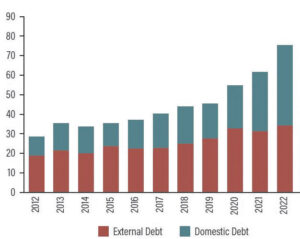
The World Bank Mem says worsening fiscal deficit continues to push public debt on an upward trajectory as it increased to 75.2 percent of gross domestic product (GDP) in December 2022, up from 61.5 percent of GDP in December 2021.
“This jump was driven by both domestic and external debt. The government’s recourse to mainly finance high fiscal deficits with high-cost domestic borrowing contributed to domestic debt reaching 40.8 percent of GDP in 2022, up from 30 percent in 2021.
“External debt also increased to 34.4 percent in 2022, from 31.5 percent of GDP in 2021. This was driven by conversion of short-term swaps, which were contracted for increasing liquidity, into medium-term swaps,” the publication reads.
In the 2023-24 financial year, the government has budgeted for K3.87 trillion against K2.55 trillion in revenues and grants, translating to K1.23 trillion of fiscal deficit for the year.
At this rate, it is highly likely that the debt to GDP ratio may swell beyond 80 percent at the end of 2023. Beyond the internationally recommended 60 percent, the debt to GDP just signifies that the country’s fiscal space is unsustainable and its creditworthiness is poor.
In an interview Tuesday, Economist Exley Silumbu said the government is in a debt trap as it attempts to service previous debts.
“What is very important is to discourage excessive government borrowing. The government itself should know that we are going overboard and not wait for someone to tell us that we have overborrowed.
“What we require is fiscal prudence. The signs start at an early stage and one sign is that excessive government borrowing starts choking credit to the private sector and results in high interest rates which we have witnessed in recent years,” Silumbu said.
Former Chief Economist at the IMF Godfrey Kalinga said Malawi’s debt levels have become unsustainably high resulting in structural fiscal deficits following suspension of direct budget support in 2012.
“From around 2008 the expenditures began to exceed the resources available and by 2012 the expenditures were already so high that we had major foreign exchange problems. The gap that evolved on the fiscal front through the cutting off of foreign aid by six percent has been there ever since, no administration has found the means of reducing it,” Kalinga said.
A recent statement published by the RBM indicates that between 2012 and 2020, total external debt amounted to $1.2 billion, of which $800 million was contracted from the Afreximbank and $350 million was contracted by the Central Bank on behalf of the government while $450 million was for its own books.
It concedes that the borrowings, coupled with other bilateral debt contracted by the government, have rendered Malawi’s external debt unsustainable, as classified by the World Bank and IMF’s framework for debt sustainability analysis.
“Debt service payments, which fell due after June 2020, have depleted foreign exchange reserves and are affecting current service delivery by the government. To date, several negotiations have been held with creditors both to the government and the RBM.
“The negotiations have been very positive and the creditors have shown willingness to assist the country to reach debt sustainability. The government remains optimistic that the discussions will conclude with acceptable terms for both the government and the creditors,” the statement reads.
A recent study by the Economics Association of Malawi, the Lilongwe University of Agriculture and Natural Resources and Ofxam has revealed that the huge public debt over the past years has not significantly impacted development on the ground.
Malawi is gradually surpassing the pre- Heavily Indebted Poor Countries and Multilateral Debt Relief Initiative state when, in 2006, it got relieved of its external debt.