The country continues to struggle to finance its budget, with the Reserve Bank of Malawi (RBM) indicating that the 2023-24 national budget registered a deficit of K247.5 billion in the first quarter.
The 2023-24 national budget is pegged at K3.7 trillion.
But Finance Minister Sosten Gwengwe Sunday said the financial plan remains on track.
RBM indicates that, in April— which is the first month of the financial year— budget operations recorded a deficit of K95.2 billion.
According to the RBM Monthly Economic Report for April, central government revenue and expenditure for the central government were recorded at K185.8 billion and K281billion in April 2023, respectively.
- Advertisement -
In May, central government operations recorded a deficit of K100.8 billion as expenditures far outweighed revenue.
“The central government collected K184.9 billion revenues during May 2023. This was, however, lower than the required financing of expenditures, which amounted to K285.7 billion during the period.
“Consequently, a fiscal deficit of K100.8 billion was incurred in May 2023, against a deficit of K95.2 billion for the preceding month, and compared to a deficit of K91.3 billion for May 2022,” RBM’s Monthly Economic Report for May reads.
In June, the budget deficit improved to K51.5 billion, with expenditure seen at K255.4 billion against a revenue pocket of K203.9 billion.
- Advertisement -
- Advertisement -
In his presentation of the 2023- 24 national budget statement, titled ‘Sacrificing Today for A Better Tomorrow: Regaining Macroeconomic Stability and Growth through Collective Responsibility for Our Shared Future’, Gwengwe said the budget has a deficit of K1.32 trillion.
He observed that the deficit would be financed through foreign borrowing, amounting to K288.78 billion, and domestic borrowing, amounting to K1.19 trillion.
In an interview Sunday, Gwengwe said the budget remains on track.
“We are executing this budget using a new quarterly allocation system. It will guarantee that we have no unplanned slippage at the end of the financial year,” Gwengwe said.
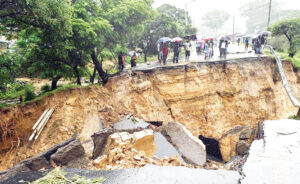
The government is implementing the budget under a tough environment as it also has to take care of infrastructure ravaged by the devastating Tropical Cyclone Freddy, which was not taken into consideration at the time of presenting the financial plan.
On May 1 this year, President Lazarus Chakwera disclosed that the damage caused by the cyclone had been estimated at over $500 million..
Chakwera added that experts also estimated that the work of recovery and reconstruction would cost an additional K700 billion, “which the country does not have”.
“This is not what natural disasters threaten to do, but what natural disasters have done. For this reason, we cannot afford to respond to the effects of natural disasters on workers as if we are a nation under threat. The only response that is appropriate is that of a nation under attack.
“We are under such heavy attack that we need reinforcements from other nations in order to not only mobilise the K107.3 million needed to respond to the humanitarian crisis at hand and the K700 billion needed to adequately recover and reconstruct what has been lost, but we also need the support of other nations to better prepare for and mitigate against the next disaster before it comes,” Chakwera said.