




By Charles Mpaka:
On the night of August 17, 2022, a herd of elephants roamed out of Kasungu National Park into the neighbouring village in Kaphaizi area.
There, the animals uprooted tomato plants, squished cabbages and harvested bananas.
Terrified people had abandoned their houses and congregated at a clearing, beating anything that could produce sound and whistling and lighting up fires to scare the elephants away.
- Advertisement -

This trick was going to work as the animals started to troop back to the park – but not before two of the pachyderms exacted one final assault.
- Advertisement -

They invaded Skwiza Mwale’s home, demolished one corner of her house and plundered seven of the 10 bags of maize – her harvest for the year – which she had kept there.
Mwale and her three children had escaped to safety.
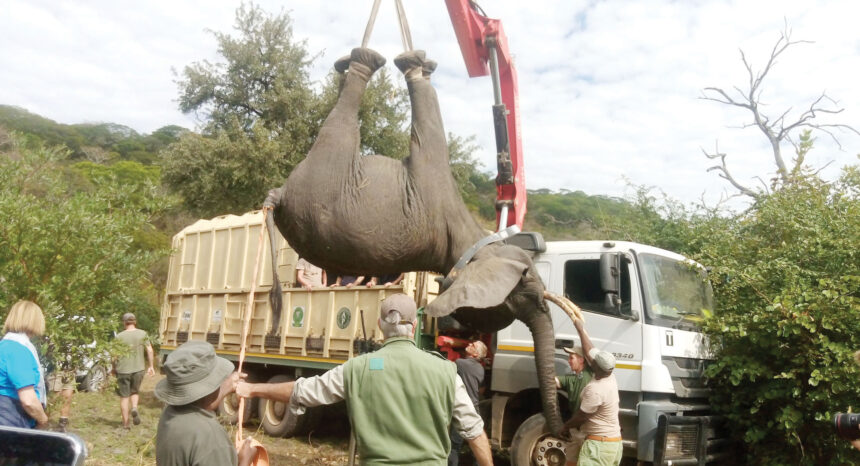
That raid was the second in the two weeks after a month-long translocation of 263 elephants from Liwonde National Park.
The first case happened on August 10, 2022.
- Advertisement -
That morning, one elephant strayed into Ndengwe village. It found unsuspecting Tadeo Phiri mowing grass in his field. It grabbed him with its trunk and smashed him to the ground three times.
Today, the 71-year-old, who has a hearing impairment for which he couldn’t catch warning shouts when the elephant invaded, is unable to walk following hip and collar bone fractures he suffered in the incident.
Since the translocation, Kasungu Wildlife Conservation for Community Development Association (Kawiccoda) has recorded five elephant raids.
The latest happened last week.
An elephant wandered into a village further north. It trampled upon a man to death, bringing to four the number of people killed by the elephants since the translocation.
Kawiccoda chairperson, Siwinda Chimowa, describes the past one year as a period when many people lived in fear.
However, he says the raids are petering out in frequency as the perimeter fence construction stretches into the distance.
History of raids
It’s not that there had been no elephant raids at all before the translocation, according to Chimowa.
“But they were localised in one section [in the Southern part] where the resident herd still roams.
“My village is next to the park. We got used to them. We knew what times they liked to come out; we also learnt how to keep them away so they would cause minimal damage,” he says.
The raids of the past year are from the translocated herd. Conservation experts say it is natural for a new group to wander about as they establish their new territory.
Kasungu National Park degradation
That original herd is the remnant of a population that was once in thousands.
Between 1970s and early 1990s, Kasungu National Park was a thriving elephant habitat. It boasted a healthy wildlife population.
Inside the park is the rustic Lifupa Lodge. Recently rehabilitated, it offers a spectacle of the rising morning sun arrowing its rays on the tranquil waters of Lingadzi Dam.
From the verandahs of the lodge’s grass-thatched bungalows, one can watch hippos cavorting in the waters on the other side of the dam where green grass merges with savanna woodland that stretches as far as the eye can see.
This park was a paradise –once.
Then came a new government system in 1994, and its socio-economic vices.
Public spending to national parks shrunk. Lifupa Lodge became decrepit. Under-funded and under-equipped, park officials became disenchanted.
Poachers and encroachers took control.
The degradation had actually hit the entire Malawi-Zambia conservation landscape.
Kasungu National Park lies in the transboundary conservation corridor which also has Lukusuzi and Luambe national parks in Zambia.
For decades, poachers terrorised the landscape, decimating elephants for ivory to supply Asian markets. Elephant numbers dropped drastically. In the case of Kasungu National Park, the population declined from around 1,200 in the 1970s to 50 in 2015, according to government figures.
‘Combating Wildlife Crime project’
Between 2017 and 2022, the International Fund for Animal Welfare (Ifaw) implemented the Combating Wildlife Crime project.
The USAID-funded project has enhanced law enforcement in the landscape through training of game rangers and judiciary in wildlife crime investigation and prosecution.
It has improved ranger welfare through provision of decent housing, food rations, allowances, equipment and patrol vehicles.
The highpoint of the project was the translocation in July last year of 691 animals which included the 263 elephants.
Tourism promise

Director of National Parks and Wildlife, Brighton Kumchedwa, credits the project with reduction of poaching and steering the park back on the path to its former status as a tourism haven.
To whip up the tourism wave, last year, government launched the Tourism Month and the national tourism policy documents in the park in September.
Without giving statistics, Kumchedwa says tourism traffic to the park is rising. And he is optimistic of impressive numbers before long.
Room to Roam
For Ifaw, it finds satisfaction in the rebounding of the once-depleted wildlife populations.

Patricio Ndadzela, Ifaw Director for Malawi-Zambia, says the positive outcomes of the translocation are within the organisation’s Room to Roam initiative.
To survive, elephants need routes to access food and water in a “natural functionally-connected and secure habitat” where humans also thrive. This is the bedrock of the strategy.
Ifaw hopes to achieve this through enhancing capacity of authorities so they efficiently manage the conservation area.
The measures also include continuous engagement of communities in the buffer villages so they substantially participate in law enforcement and benefit from wildlife resources.
Ndadzela suggests Room to Roam initiative seeks to confront arguments that communities living near protected areas bear the costs of living with wildlife but do not always share in the benefits or participate in decision-making around wildlife management.
“Recognising that all instances of poaching are the result of human activity and that communities bear the social legitimacy of illegal wildlife crimes in the landscape, Ifaw has integrated community participation into all aspects of conservation work in order for it to be successful,” he tells Malawi
Balancing human and elephant needs
Mary Rice, Executive Director for London-based Environmental Investigation Agency (EIA), speaking last year about the translocation, said that moving live elephants for conservation purposes is an accepted practice.
But such translocations need to balance the needs of human development against the ongoing biodiversity loss. She admitted that this is not easy to achieve.
“Yet it is because of the very real threats facing humanity and nature that we need to find a way that recognises the needs of both humans and elephants,” Rice said.
Ifaw says it is aware of the dual needs of people and wildlife, hence implementing livelihood activities in the surrounding communities.
‘Keep them away for good’
When the elephants destroyed Mwale’s house, she had been dragged deep into crisis.
Single and jobless, rebuilding her house and replacing the plundered maize so her family could be food secure again would be daunting.
She sold one of the three bags of maize that had remained so she could fix her house. But she had no idea where to find money to replace the maize.
She got a lifeline. Ifaw hired her for a four-month piece work for the express purpose that she should use her wages to buy food for her family.
There has not been another raid in her village since; and she hopes it doesn’t happen again.
That time, Ifaw had constructed just 40 kilometres of the 130-km fence. Today, 67.5km has been constructed. Another 20km will be completed by December 2023 and the final 42.5 kilometres by 2025.
As the fence work progresses, belief is growing among communities which Malawi News visited three weeks ago that elephant raids could end and peace would prevail.
That’s Mwale’s hope too.
“Those animals are very cheeky,” she says. “They walk away the way they want. It’s a scary job trying to keep them off. We hope the fence will keep them away for good.”