Fewer than seven percent of households in Malawi can generate sufficient income from farming to meet their basic needs, the latest World Bank Malawi Country Economic Memorandum has shown.
The development means that 93 percent of households, who claim to be farmers, cannot survive on farming.
According to the memorandum, on average, farming contributes only 30 percent to the total income of the median farming household, typically MWK 16,190 (about $20 in nominal terms), in value per capita annually from their efforts.
It says female-headed households face additional hurdles, experiencing limited access to agricultural resources and services, thereby exacerbating gender gaps in agricultural productivity and the ability to meet basic needs through agriculture.
Most farming households, the memorandum says, are already turning to alternative employment opportunities beyond their own farms to mitigate or escape poverty.
- Advertisement -
Rural Malawian households adopt various diversified livelihood strategies, including engaging in casual labour, securing longer-term wage employment, managing household enterprises and, to a lesser degree, receiving regular income payments such as pensions and social protection transfers.
“Moreover, many of these households lack the resources or skills necessary to create or secure employment that provides sufficient income. Under current conditions, non-farm rural employment does not yield incomes high enough to lift households out of poverty.
“Nonetheless, income from off own-farm activities constitutes most of the income of most rural households, with 73 percent of farming households deriving more than half of their annual income from off-farm sources. A small but growing share of commercially oriented farmers is uniquely positioned to support the transformation of rural markets and drive economic growth within rural communities. Presently, this group currently comprises only 7 percent of all Malawian households,” the memorandum says.
According to the World Bank, agriculture in Malawi has consistently been characterised by low and stagnant productivity.
- Advertisement -
- Advertisement -
Approximately 80 percent of farming households operate on the basis of just one rain-fed crop per year, leading to significant year-to-year variability in production.
This, the report says, is further exacerbated by factors such as limited use of improved agricultural technologies, inputs and practices; poor access to credit and markets; extremely small farmer landholdings compared to regional counterparts; and, increasingly, the impacts of climate change and variability.
“The average Malawian farm size is only 0.7 hectares (ha), significantly smaller than farms in neighbouring countries. The agriculture sector is highly susceptible to climate shocks, with recurrent extreme weather events, including dry spells and devastating tropical cyclones, impacting lives, livelihoods and the country’s socio-economic infrastructure (Government of Malawi 2023).
“Notably, the second-biggest impact of climate change on the Malawian economy is through shocks to labour productivity (World Bank 2022). Over the past 15 years, the value added per worker has not only remained below the regional average but shown minimal change (World Bank 2022). This, in turn, affects Malawians’ livelihoods, food security and resilience, particularly in rural areas,” the memorandum says.

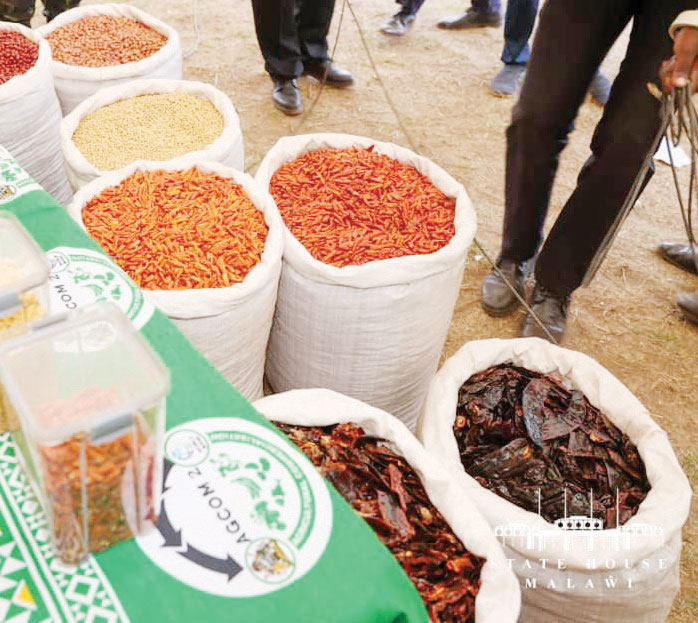
As one way of boosting agricultural production in the country, the Malawi Government, with support from the World Bank, launched the $95 million Agriculture Commercialisation (Agcom) Project on January 10 2020.
Two years later, on November 16 2023, President Lazarus Chakwera launched the $295 million Agcom 2.
Speaking during the launch of Agcom 2, Chakwera said, in addition to commercialising smallholder farms to produce exports, the initiative would also help the country produce the food necessary to curb the hunger that is threatening some parts of the country.
“No country is coming here to feed us; so, we must work the ground to grow the food necessary to feed ourselves. As it is, at the start of December, it will be good for us, as a nation, to take a moment to pray that God gives us good rains so that our work in the fields does not go to waste.
“However, even where the rains do not do well, this Agcom 2 programme gives us the chance to invest in irrigation infrastructure so that when there is no water from the sky, we can use the water that Malawi is already blessed with on the ground,” Chakwera said.